Establishment Labs (ESTA): Customer Relationships, Concentration and Contracting Posture
Establishment Labs manufactures and sells implantable medical devices for cosmetic and reconstructive surgery and monetizes through product sales via a mix of exclusive distributors and direct sales in selected markets, with additional revenue timing effects from consigned inventory and ratable recognition of distribution exclusivity payments. Revenue drivers are global distribution agreements and direct-channel penetration in high-value markets; operating leverage depends on scaling international distribution while managing related-party and consignment exposures. For the full coverage and monitoring console, visit https://nullexposure.com/.
How the company sells — the commercial model that matters to investors
Establishment Labs runs a hybrid go-to-market model: exclusive distributors cover most international geographies, while a direct sales force operates in the United States, Brazil, Argentina and several European countries. The company recognizes revenue from consigned implants only when implantation is confirmed, and it recognizes payments received for distribution exclusivity ratably over the contract term — both mechanics that create timing variability between shipments and recognized sales. These contract features produce a mix of spot-like recognition for implanted consigned product and multi-year revenue deferral for exclusivity agreements, which is material to near-term revenue visibility and cash-to-revenue conversion.
Every disclosed customer relationship in the filing
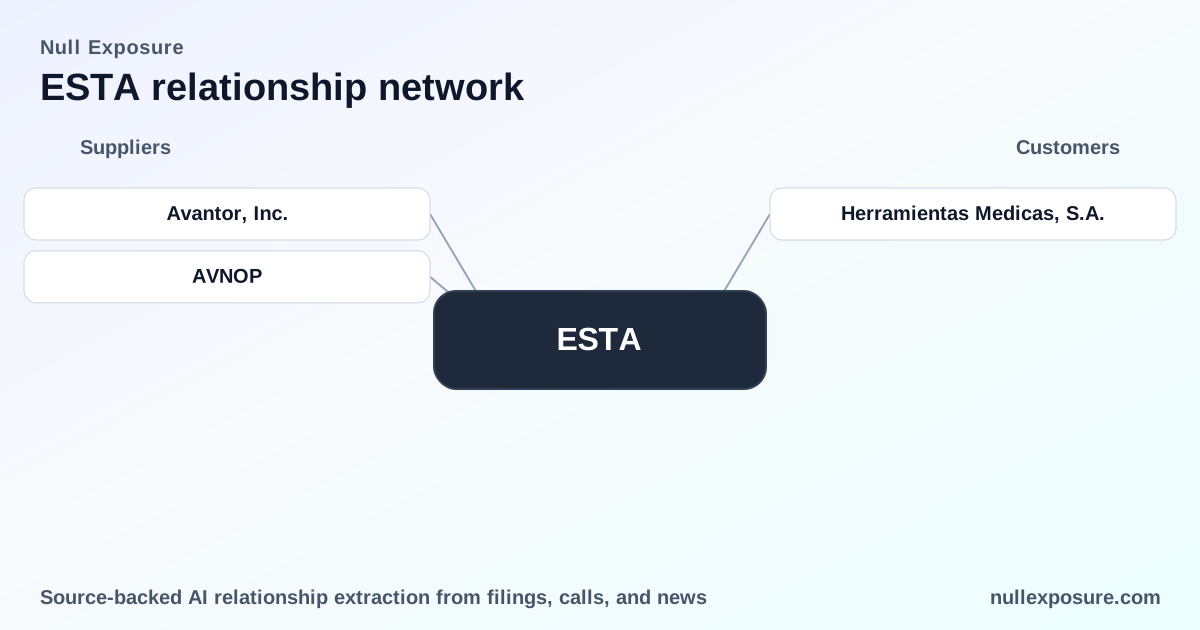
Herramientas Medicas, S.A. — Establishment Labs recorded roughly $1.1 million of product sales to Herramientas Medicas, S.A. in FY2024; this distributor is owned by a family member of the company’s CEO, making the arrangement a related-party distribution that is disclosed in the FY2024 Form 10-K. According to the company’s FY2024 filing, recorded revenue from Herramientas Medicas totaled $1.1 million in 2024 (compared with $1.2 million in both 2023 and 2022). (Source: Establishment Labs Form 10-K, FY2024.)
Geographic footprint and what the numbers signal for revenue concentration
The company’s filing lists regional revenue splits that underscore a global footprint with meaningful regional concentration in EMEA and Asia-Pacific. The filing reports EMEA revenue at $78,209, Asia‑Pacific at $48,408, Latin America at $34,998 and North America at $4,410 (as presented in the company’s geographic revenue schedule). Establishment Labs also discloses commercial availability in more than 80 countries through exclusive distributors, while retaining direct sales operations in selected countries. This structure delivers broad market reach but concentrates sales risk through a relatively small number of exclusive distributor relationships in key regions.
Contracting posture, timing and maturity — how revenue actually flows
Company disclosures describe two distinct contract mechanics that shape revenue recognition and investor visibility:
- A portion of revenues originates from consigned inventory held at physicians, hospitals or clinics; revenue is recorded only when the device is implanted and the company is notified, creating spot-like recognition timing for implanted consigned product.
- The company also accepts payments from distributors in exchange for distribution exclusivity, and those payments are recognized ratably over the exclusivity term, producing long‑term, contractually governed revenue recognition.
Collectively, these mechanics mean revenue volatility is driven by both end-market implant activity (spot timing) and the amortization schedule of exclusivity fees (multi‑period recognition). Investors must track implantation confirmations and the schedule of exclusivity payments to reconcile cash flow with recognized revenue.
Governance and related-party considerations investors should watch
The disclosed sale to Herramientas Medicas, S.A. is a related‑party transaction because the distributor is owned by a family member of the CEO. The absolute dollar exposure to that single related party is small relative to trailing revenues (roughly $1.1 million against $211.1 million TTM revenue), but the governance angle remains relevant: related‑party distribution arrangements warrant continuous disclosure and board-level oversight given potential conflicts and reputational risk. (Source: Establishment Labs Form 10-K, FY2024.)
Financial scale, concentration and criticality
Establishment Labs reported $211.076 million in trailing twelve‑month revenue with gross profit of $146.308 million and negative net income metrics (diluted EPS -1.72). The Herramientas Medicas flows represent approximately 0.52% of TTM revenue, indicating immaterial direct financial concentration, but the larger investor exposure is to the health of exclusive distributors and the company’s ability to convert consigned stock into implant-confirmed revenue. The hybrid distribution model creates operational leverage: successful conversion of consigned inventory and expansion of direct channels in key markets are the primary paths to margin improvement. (Source: company financial summaries and FY2024 disclosures.)
Operational constraints and maturity signals that shape execution risk
- Contract mix: The coexistence of consignment (spot recognition) and long‑term exclusivity payments (ratable recognition) creates asymmetric cash-to-revenue timing and requires active revenue-side forecasting. The company’s filing explicitly describes both recognition approaches.
- Global reach with selective direct sales: The company sells via exclusive distributors in many countries but operates direct sales in the U.S., Brazil, Argentina and several European markets; this indicates a maturing commercial model that mixes outsourced scale with retained control in high-value territories.
- Distributor role is central: The filing emphasizes distributors as the primary route to market internationally, signaling dependence on partner execution and inventory management at the consignee level. These are company-level signals derived from the FY2024 filing rather than attributes of any single customer disclosure.
Investor implications — how to prioritize monitoring
- Governance: Track any future related-party transactions beyond the modest disclosed amounts and confirm board review and pricing policies for such arrangements. The existing related-party distributor is disclosed but requires ongoing transparency.
- Revenue quality: Monitor trends in implant confirmations (the metric that converts consigned inventory to recognized revenue) and the schedule of exclusivity payments to reconcile cash receipts with recognized revenue.
- Channel health: Evaluate distributor performance in EMEA and APAC where the company shows the largest revenue pools, and watch direct‑sales growth in the U.S. and Brazil as primary margin levers.
- Disclosure cadence: Expect relevant signals in quarterly filings and the next 10-K on consignment balances, deferred revenue from exclusivity fees, and any changes to distributor footprints.
Bold takeaway: Establishment Labs operates a globally distributed commercial model where distributor execution and consignment conversion are the primary drivers of near-term revenue variability; the disclosed related‑party distributor is small in dollar terms but important as a governance signal.
For a consolidated view of cross‑customer signals and to track changes in these disclosures over time, visit https://nullexposure.com/ for our monitoring tools and relationship dashboards.