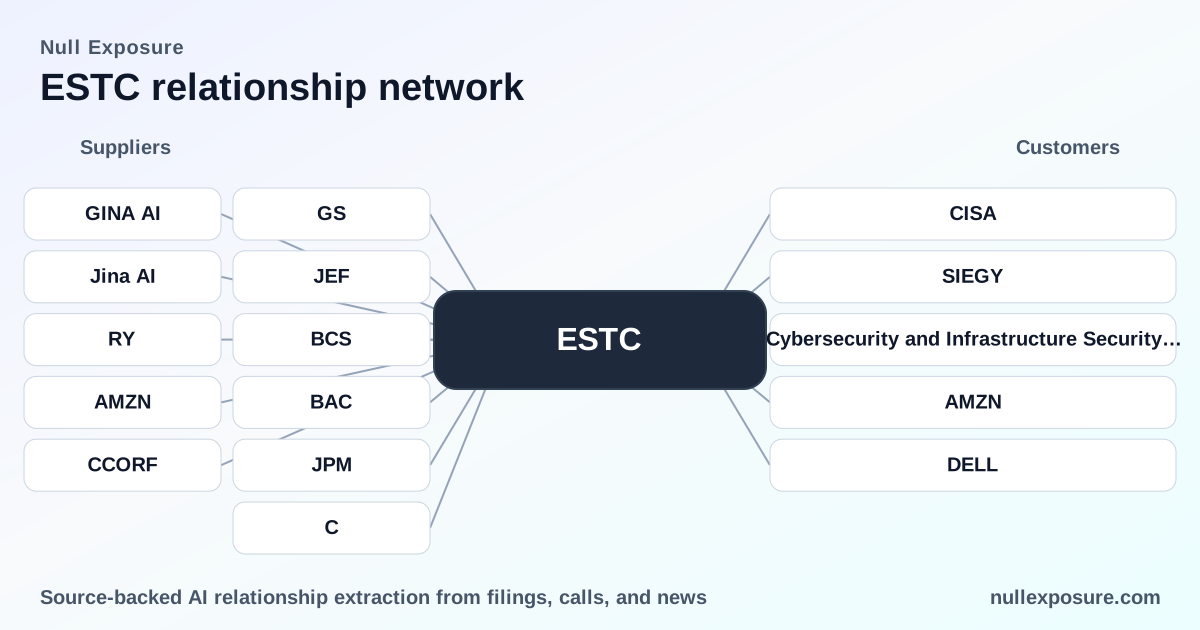
Elastic NV (ESTC) — Customer Relationships That Drive Reach and Revenue
Elastic builds and monetizes a search and observability platform sold primarily as subscription software and cloud-hosted services, with a growing portion of revenue tied to consumption-based Elastic Cloud offerings and ancillary consulting/training services. The company sells long-term and usage-based arrangements through cloud marketplaces and strategic partners, while also serving government and enterprise customers with mission-critical security and analytics deployments. For a deeper view of customer relationships and what they imply for revenue predictability and risk, visit https://nullexposure.com/.
How Elastic’s commercial model shapes customer value
Elastic’s commercial architecture combines three clear characteristics that investors should internalize: subscription-first monetization, a meaningful and growing consumption/usage component, and multi-year contractual visibility. Company disclosures show subscriptions constituted the overwhelming share of revenue (over 90%), while Elastic Cloud is largely consumption-based. Management invoices multi-year agreements on annual cycles and reports a large remaining performance obligation (RPO), providing medium-term revenue visibility.
- Contracting posture: The company sells one-to-three year subscription agreements billed annually in advance for term-based deals, with a dominant consumption orientation for cloud-hosted services, which amplifies upside as customers scale.
- Concentration and materiality: Elastic disclosed one channel partner represented ~12% of revenue in FY2025, a company-level concentration risk investors must monitor.
- Criticality and maturity: Elastic serves roughly 21,500 customers (FY2025) and reported $1.545 billion of RPO, with about 65% expected to convert to revenue in the next 12 months — indicators of a mature, recurring revenue base with measurable forward visibility.
- Geography and deployment: The platform is delivered globally across major cloud providers and hybrid environments, signaling broad addressable markets but also exposure to cloud infrastructure dynamics.
Relationship-by-relationship: what matters to investors
CISA — a federal security anchor
Elastic secured a multi-million dollar SIEM-as-a-service contract with the U.S. Cybersecurity and Infrastructure Security Agency (CISA), including deals in excess of $20 million and expanding agency adoption within the Federal Civilian Executive Branch. This engagement positions Elastic as a provider of uniform cybersecurity monitoring across federal agencies and demonstrates government demand for managed security services (FY2026 reporting and news coverage). (Sources: Tikr blog, InsiderMonkey and earnings-call references, FY2026.)
Amazon / AWS — strategic channel and product integration
Elastic announced a five-year strategic collaboration with AWS to deepen solution integrations, joint go-to-market activities, and simplify Elastic adoption via the AWS Marketplace, while Elastic Cloud Serverless is available on AWS with claimed throughput and latency improvements. This partnership strengthens distribution into cloud-native enterprise adoption and embeds Elastic into a major cloud ecosystem (Q4 earnings call; market coverage FY2026). (Sources: ESTC Q4 earnings call; TradingView coverage, FY2026.)
Siemens — security services integration
Siemens has incorporated Elastic’s SIEM technology into its global cyber defense center offerings, using Elastic to bolster defense-in-depth services across industrial sites and factory operations. This is a channel-to-customer conversion where Elastic supplies core security analytics for a global systems integrator (Q4 earnings call, FY2025/Q4). (Source: ESTC Q4 earnings call, FY2025/Q4.)
V2X / VVX — secure analytics for defense and intelligence use cases
V2X, Inc. announced a collaboration with Elastic to integrate search and analytics for government, defense and intelligence clients, emphasizing secure, compliance-conscious deployments for sensitive data environments. This relationship highlights Elastic’s orientation to high-security vertical use cases outside standard commercial deployments (press coverage, FY2026). (Sources: SimplyWallSt and SahmCapital news posts, FY2026.)
Dell Technologies — embedded AI data platform partner
Dell’s AI data platform now integrates Elastic alongside NVIDIA to create a tightly integrated AI stack that streamlines building and scaling AI workloads, moving Elasticsearch from a pure search tool toward reusable infrastructure inside enterprise AI environments. This expands Elastic’s role as foundational software inside vendor-delivered AI solutions (industry coverage and company commentary, FY2026). (Sources: TradingView/Zacks and InsiderMonkey coverage, FY2026.)
NVIDIA — AI infrastructure positioning
Reporting and market commentary describe Elasticsearch as a core component in AI “factories” built by Dell and NVIDIA, positioning Elastic as infrastructure that supports reusable AI workflows inside enterprise AI builds. This association with NVIDIA’s AI ecosystem accelerates Elastic’s proposition beyond search into data infrastructure for AI (industry coverage, FY2026). (Source: TradingView/Zacks coverage, FY2026.)
Emerald / EEX — SaaS transition through prior tool acquisition
Coverage noted Emerald’s movement into the SaaS business via an acquisition of a tool “known as Elastic,” indicating Elastic’s technology has been embedded into third-party SaaS transitions or resales in at least some channel contexts. This signals resale and embedded use cases of Elastic technology in adjacent SaaS offerings (press coverage, FY2024). (Source: Strata-Gee coverage, FY2024.)
Investment implications and risks investors should weigh
Elastic’s customer relationships reveal a two-track go-to-market: large, high-value enterprise and government deals (CISA, Siemens) that drive stickiness and higher contract values, and platform-level partnerships (AWS, Dell, NVIDIA) that scale distribution and embed Elastic inside cloud and AI stacks. Key takeaways:
- Revenue visibility is strong but blended. The company’s RPO and multi-year invoicing provide visibility, while consumption-based Elastic Cloud boosts upside and short-term volatility in billed amounts.
- Government contracts are strategic and sticky. Federal engagements like CISA increase credibility and create runway for additional agency adoption, but bring procurement and compliance dynamics.
- Channel and partner concentration is a real risk. A single channel partner represented ~12% of revenue in FY2025 — investors should watch concentration metrics and partner churn.
- Platform partnerships de-risk adoption but create cloud dependency. Deep ties to AWS and hardware/AI partners accelerate distribution but also tie Elastic’s economics to cloud provider relationships and marketplace dynamics.
For an actionable view of how these relationships translate into revenue exposure and risk-adjusted opportunity, access investor-grade customer intelligence at https://nullexposure.com/.
Bottom line
Elastic’s customer relationships combine high-value government cybersecurity wins and strategic cloud/AI partnerships that materially advance distribution and product relevance. Elastic’s subscription backbone, growing consumption revenue, and enterprise/government footholds collectively support sustained ARR growth, while partner concentration and consumption volatility are the principal risks requiring ongoing monitoring.