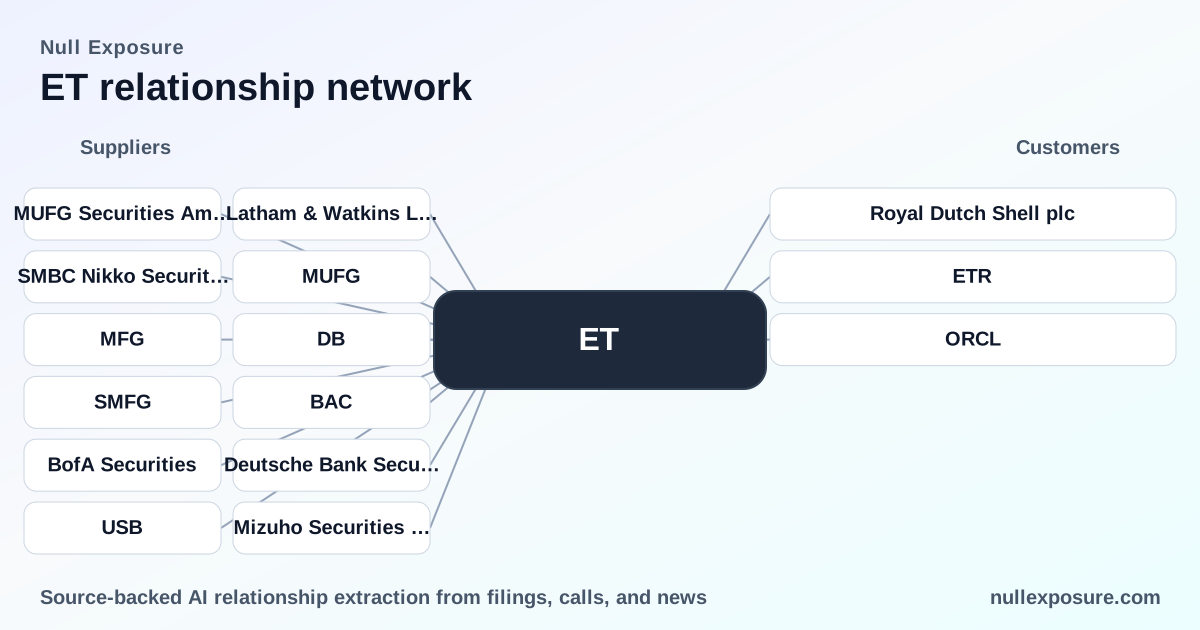
Energy Transfer (ET): Customer Map and What It Means for Investors
Energy Transfer operates an integrated midstream platform that monetizes through long-term transportation, storage and offtake contracts, fee-based commodity handling, and service agreements tied to terminals and pipeline capacity. The business combines large, contracted cash flows from long-dated LNG and firm transportation deals with more cyclical, spot-driven revenue from terminals and compression services — a hybrid model that supports stable distributable cash while funding growth through project-backed contracts. For deeper exploration of these signals, visit https://nullexposure.com/ for the underlying source referencing and coverage.
High-level read: what the customer relationships reveal about ET’s operating model
Energy Transfer’s customer footprint is a deliberate mix. Core revenue streams are anchored by long-term contracts—notably LNG offtake and multi-decade firm transportation deals—while selected assets (terminals, compression) provide short-term and spot exposure that capture market upside. This creates a contracting posture that is both conservative in cash flow coverage and opportunistic for margin expansion. The company’s counterparties span global energy majors, utilities and hyperscalers, concentrating much of the commercial exposure in North America but linking earnings to global LNG markets through exports.
Relationship-by-relationship: who matters and why
Below are the customer relationships surfaced in filings, earnings commentary and media coverage, each summarized in plain language and linked to its source in context.
-
Royal Dutch Shell plc
Energy Transfer’s Lake Charles LNG business derives all of its revenue from a series of long-term contracts with a Shell subsidiary, making Shell a foundational offtaker for that export terminal. This contract structure is disclosed in ET’s 2024 10‑K and underpins the predictability of the Lake Charles cash flow. (Source: ET 2024 10‑K disclosure on Lake Charles LNG) -
Oracle Corporation (ORCL)
ET has long-term natural gas supply agreements with Oracle to serve multiple hyperscaler data centers; management reported deliveries to three U.S. data centers totaling about 900,000 Mcf/day, with flows to Oracle’s Abilene, Texas facility already commenced. These agreements position ET as a strategic supplier into the data-center fuel market and were highlighted on ET’s Q4 2025 earnings call and in subsequent press coverage. (Sources: ET Q4 2025 earnings call; TradingView earnings coverage; Tikr investor note) -
Entergy Louisiana (ETR)
Energy Transfer signed a 20‑year binding agreement to provide at least 250,000 MMBtu/day of firm transportation to support new development in Richland Parish, Louisiana, with service beginning in December 2028. Management presented this as a material, long-duration firm-transport contract on the 2025 Q4 call and in earnings releases. (Sources: ET Q4 2025 earnings call; TradingView coverage) -
CloudBurst Data Centers
ET secured commercial agreements with CloudBurst as part of a cluster of data‑center deals that position the company within the hyperscaler energy-supply theme; the relationship was noted by industry commentary that tracks ET’s corporate agreements and strategic messaging. CloudBurst was called out alongside Oracle in third‑party analyst coverage. (Source: InsiderMonkey / Raymond James commentary via industry news) -
CPS Energy
Media reporting describes a payment dispute in which ET demanded $317 million for gas sold to CPS after a winter event, highlighting counterparty billing and collections risk when extreme weather and contractual terms collide. This episode surfaced in local reporting and frames a cash-collection and reputational vector that investors should watch. (Source: San Antonio Express-News reporting)
What the constraints and contract signals mean for investors
Collectively, the extracted constraints paint a coherent commercial picture:
-
Contracting posture — skewed to long‑term but not exclusive. Multiple evidence points to long-term, often multi-decade contracts (Lake Charles LNG, Entergy Louisiana), giving ET durable fee-like cash flows. At the same time, specific assets generate short-term or spot income (term and spot storage at Nederland Terminal; compression services with fixed-fee but shorter initial terms), which provides optionality to capture marginal price improvements.
-
Concentration and customer mix. Energy Transfer’s counterparties include global majors, utilities, hyperscalers and other industrials; while Shell and large utilities represent concentrated, high-dollar counterparties, the broader customer base spans many shorter-term industrial relationships. Geographically, operations are primarily North America with commercial linkages to EMEA/APAC driven by LNG export economics.
-
Criticality and materiality. Some services are operationally critical to production and transportation (compression and firm pipeline transport), implying service continuity is high priority for customers and for ET’s contractual enforcement. Management also signals certain exposures are immaterial to consolidated results, indicating a mix of critical and non-critical revenue lines.
-
Maturity of relationships. The disclosed contracts are generally mature and long-dated (20‑year LNG/transportation and multi-year offtakes), which reduces short-term renewal risk but increases the importance of counterparty credit and contract enforcement over time; prospect-stage commentary appears for future offtake arrangements in project feasibility discussions.
Key investment takeaways and risk points
- Positive: ET’s combination of long-term offtake/transport contracts with fee-based terminal and service revenue creates a cash-flow profile attractive to income-oriented investors; Shell and Entergy Louisiana contracts materially underpin near- to mid-term project cash yields.
- Watch: Spot and short-term exposures (terminals, compression, dispute events such as CPS Energy) introduce earnings volatility and collections risk. Large counterparty disputes and commodity-price swings are the primary operational risks to monitor.
- Credit & counterparty risk: Long-duration contracts reduce revenue volatility but concentrate exposure to a smaller set of large counterparties; the Shell/Lake Charles linkage is a structural strength if the counterparty credit and contract terms remain sound.
Bottom line — how customers shape the investment case
Energy Transfer’s customer roster demonstrates a deliberate strategy: lock-in long-dated, contract-backed revenue where possible, and balance that with short-term assets that capture market upside. For investors and operators evaluating ET, the critical lens is counterparty credit and contract enforceability — these shape distributable cash reliability more than near-term commodity cycles. For source-level diligence and cross-references to the filings and media cited here, consult https://nullexposure.com/ for the underlying extraction and documentation.