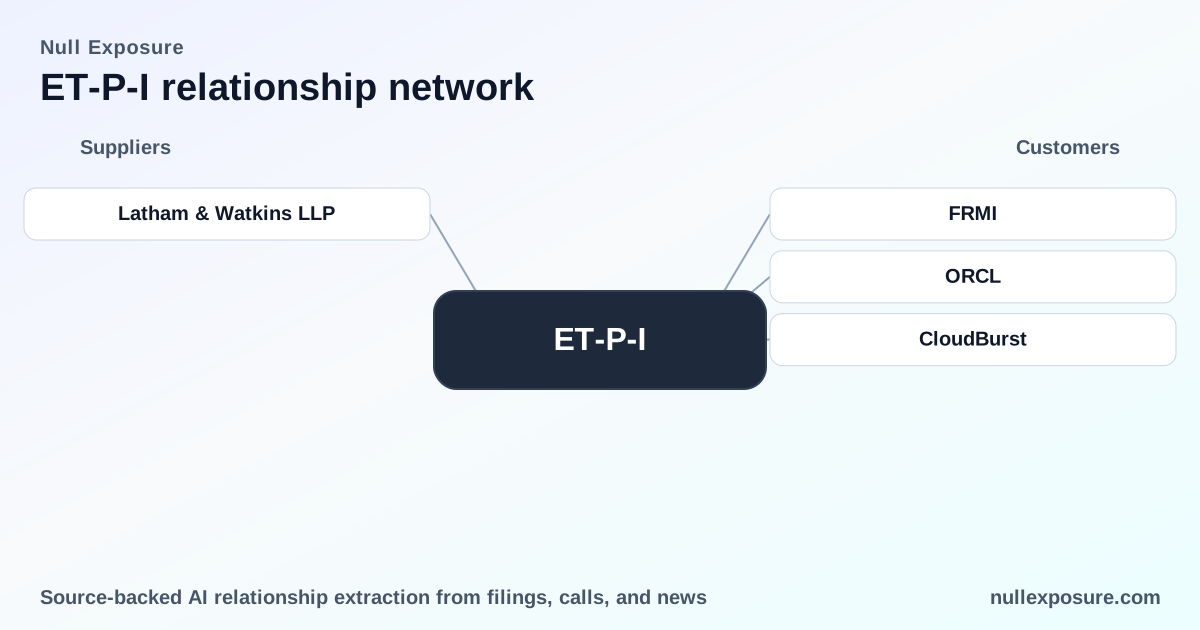
ET‑P‑I: An investor thesis on customer relationships driving energy‑transition returns
ET‑P‑I is an investment firm that deploys capital into energy transition projects and infrastructure, monetizing through long‑dated project returns, contracted commodity and service revenues, and strategic partnerships with large off‑takers. Its recent customer signals show a deliberate pivot from traditional LNG channels toward direct supply relationships with data‑center developers and regional producers — a shift that has material implications for contract structure, revenue predictability, and counterparty concentration. For a concise mapping of ET‑P‑I’s commercial exposure, visit https://nullexposure.com/.
Why customers matter: the commercial logic behind ET‑P‑I’s deals
ET‑P‑I’s business model is built on two revenue levers: infrastructure value creation (capex and capacity) and recurring cash flows from supply agreements or take‑or‑pay style contracts. The customer relationships surfaced in public reporting and trade press indicate a clear operating posture:
- Contracting posture: relationships with data‑center operators and energy producers imply negotiated multi‑year supply arrangements rather than ad‑hoc spot sales, supporting predictable cash flow and easier project finance.
- Concentration: a small set of large customers can accelerate scale but raises counterparty concentration risk; this is a central trade‑off for investors assessing ET‑P‑I.
- Criticality: supplying fuel or throughput capacity to data centers and regional producers ties ET‑P‑I to mission‑critical infrastructure for customers, increasing bargaining leverage but also operational expectations.
- Maturity: the mix of large tech off‑takers and regional producers suggests ET‑P‑I is in a growth phase of commercial deployment rather than a legacy, fully stabilized cash flow profile.
These are company‑level signals drawn from the visible customer roster; no regulatory filing constraints were returned in the relationships payload.
Customer roster: what ET‑P‑I is selling and who is buying
Below I cover every relationship flagged in the public results. Each entry is a plain‑English take and a concise source note.
Fermi America — The Globe and Mail (March 2026)
Energy Transfer has signed agreements to supply natural gas to Fermi America as part of a broader push to serve data‑center operators, indicating ET‑P‑I’s exposure to large‑scale, campus‑style energy projects. According to The Globe and Mail press release (first seen March 9, 2026), Fermi America is named among multiple data‑center off‑takers receiving gas supply commitments.
Oracle — The Globe and Mail (March 2026)
Oracle is listed alongside other data‑center operators as a recipient of natural gas supply agreements, showing that ET‑P‑I’s commercial reach includes major corporate cloud players. The Globe and Mail press release (March 9, 2026) references Oracle as a named off‑taker in those supply arrangements.
FRMI (Fermi America) — The Globe and Mail (March 2026)
The same Globe and Mail note identifies FRMI (Fermi America) in the FY2026 period as a named counterpart for natural gas deliveries, reinforcing that ET‑P‑I’s client list includes firms developing gigawatt‑scale energy campuses. The Globe and Mail press release documents the inclusion of FRMI among recent agreements (March 9, 2026).
Oracle — Sahm Capital (February 2026)
A Sahm Capital industry note reports that Energy Transfer has begun large‑scale natural gas deliveries to Oracle’s Texas data center, an operational development that signals the transition from project announcements to active supply. Sahm Capital’s analysis (February 23, 2026) describes the start of significant deliveries to Oracle’s Texas facility.
FourPoint Resources — ClickPetroleoEGas (May 2026)
A press item covering a Utah terminal expansion notes a partnership that grants FourPoint access to 50,000 barrels per day, suggesting ET‑P‑I’s relationships extend into crude handling and export capacity for regional producers. The report on the terminal expansion and capacity allocation (May 2026) documents FourPoint’s secured access.
FRMI — InsiderMonkey (FY2025 reporting, cited March 2026)
InsiderMonkey profiles Energy Transfer’s commercial strategy and highlights that the company has secured partnerships with a Colorado‑based data center and Fermi’s gigawatt energy campus in Texas, indicating multi‑jurisdictional customer commitments as of FY2025. InsiderMonkey’s piece (first seen March 9, 2026) lists Fermi/FRMI among in‑progress agreements.
Fermi — InsiderMonkey (FY2025 reporting, cited March 2026)
A separate InsiderMonkey mention reiterates Fermi’s role as a strategic customer, noting a gigawatt‑scale campus in Texas as part of Energy Transfer’s expansion into data‑center fuel supply. The InsiderMonkey commentary (March 2026) emphasizes Fermi’s campus as a material commercial relationship.
CloudBurst — The Globe and Mail (March 2026)
CloudBurst is named among data‑center operators receiving contracted natural gas supply, signaling ET‑P‑I’s engagement with both established cloud firms and specialized data‑center developers. The Globe and Mail press release (March 9, 2026) lists CloudBurst in the group of recent agreements.
Investment implications: what this customer mix means for returns and risk
- Revenue predictability improves when supply flows shift from spot to contracted deliveries for data centers; this supports project financing and valuation uplift for ET‑P‑I’s assets.
- Counterparty concentration is a double‑edged sword: contracts with large tech customers like Oracle reduce marketing risk but increase exposure to a few counterparties; underperformance or renegotiation by a major customer would have outsized impact.
- Operational execution matters: transitioning from capacity announcements to sustained deliveries (as reported for Oracle) converts value only if pipeline, terminal, and logistics performance align with contractual commitments.
- Commodity linkage remains relevant: while data centers pay for reliability and capacity, underlying fuel price volatility and regional infrastructure constraints will still influence contract economics and margin capture.
Key takeaway: ET‑P‑I’s customer signals show a purposeful move into high‑visibility, long‑term off‑take relationships that enhance revenue visibility but concentrate counterparty risk — a classic trade‑off for investors seeking scaled, project‑level returns.
Constraints and company‑level signals
No explicit constraints were returned in the relationship payload. As a company‑level signal, the absence of listed constraints suggests either a lack of public regulatory caveats tied to these customer links or that contractual details remain commercially sensitive and not disclosed in standard filings. Investors should treat the commercial picture as partially observable and prioritize diligence on:
- contract length and take‑or‑pay mechanics,
- creditworthiness and concentration of named customers,
- operational milestones tied to commencement of deliveries,
- and the extent to which capacity expansions (e.g., terminal access) are fully contracted versus optional capacity.
For a deeper exposure profile and to track any future contract disclosures, consult the coverage at https://nullexposure.com/.
Final read: where to focus diligence
Focus on three practical items: verify the contractual tenor and payment profile of gas and terminal agreements; measure customer concentration and stress‑test cash flows if one large off‑taker delays or renegotiates; and confirm the operational cadence from announced deals to sustained deliveries. These checkpoints will determine whether ET‑P‑I’s customer relationships are a durable foundation for valuation or a levered, execution‑dependent growth story.
If you want a consolidated view of how these relationships connect to capital structure and asset cash flow, explore the ET‑P‑I coverage at https://nullexposure.com/.