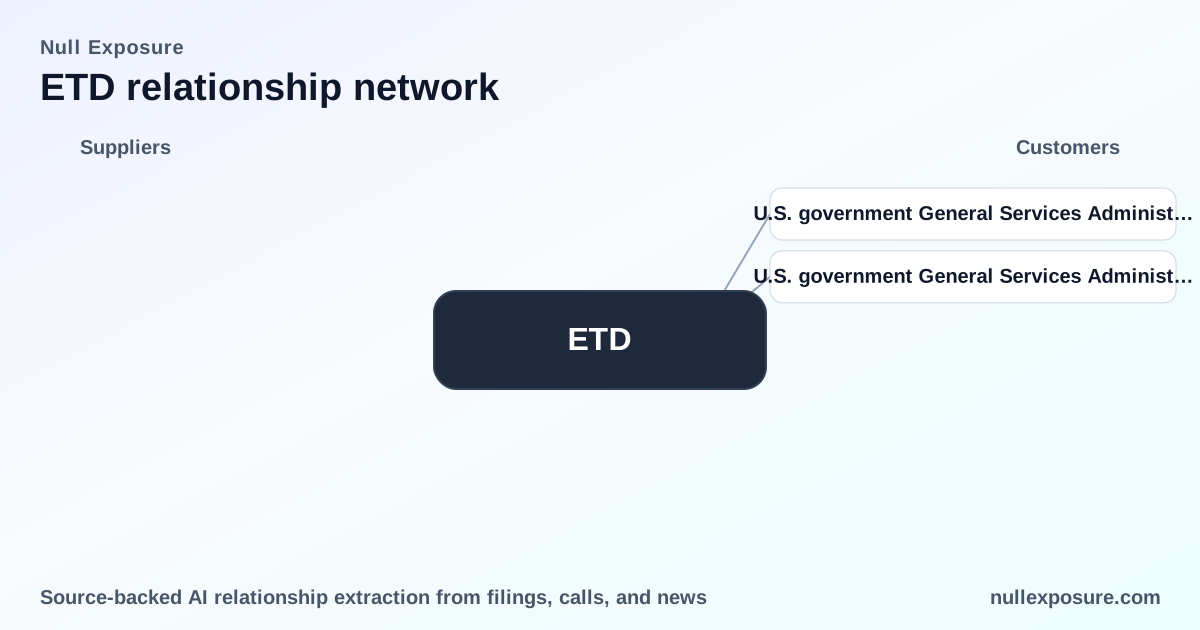
Ethan Allen Interiors (ETD): Government Customers, Concentration, and What Investors Should Watch
Ethan Allen monetizes its business by designing, manufacturing and retailing home furnishings through company-operated design centers and a wholesale channel to independent dealers and institutional buyers. The company generates nearly all revenue from North America, mixes retail design services with product sales, and supplements retail margins with wholesale contract work — including periodic government orders. Revenue is therefore exposed to cyclical consumer demand, wholesale contract timing, and a small number of material customer relationships. For a deeper look at counterparties and how they influence ETD’s commercial posture, visit https://nullexposure.com/.
Why customer relationships matter for a vertically integrated home furnishings operator
Ethan Allen’s operating model is retail-first with a meaningful wholesale tail. The firm runs 142 company-operated design centers (137 U.S., 5 Canada) and fulfills wholesale orders to 45 independent design centers internationally. That structure produces three investor-relevant dynamics:
- Short contract duration and execution risk: The company discloses most contracts are less than one year, which reduces lock-in and increases revenue volatility between reporting periods.
- Geographic concentration: Over 97% of sales are U.S.-attributed, creating single-region exposure to U.S. housing cycles and government procurement patterns.
- Customer concentration: Certain institutional buyers — explicitly the U.S. General Services Administration (GSA) and a small set of independent dealers — have represented material portions of sales historically, creating episodic revenue sensitivity.
These are company-level signals drawn from management disclosures; they drive contracting posture (short term), concentration risk (high for select buyers), and low structural stickiness that investors should factor into revenue forecasts.
What the filings and press coverage show about named government customers
Below I list every customer relationship surfaced in the coverage and summarize the takeaways for investors.
U.S. government — General Services Administration (GSA), FY2026
Ethan Allen’s wholesale net sales declined partly because of lower contract sales, including shipments to the U.S. General Services Administration, a sign that GSA order volume is a meaningful swing factor for the wholesale segment. This was noted in TradingView’s coverage of the company’s SEC 10‑Q filing in March 2026. (TradingView, SEC 10‑Q summary, Mar 2026)
U.S. State Department, FY2026
Management specifically highlighted a reduction in business with the U.S. State Department as a headwind to third-quarter results, along with weaker international sales and weather-related disruptions; the comment came from CEO Farooq Kathwari in early-May 2026 reporting. (Intellectia/press coverage, May 2, 2026)
U.S. government — General Services Administration (GSA), FY2025
Ethan Allen’s prior-year disclosure shows a decline in contract sales that included shipments to the GSA, and the company explicitly reported that the GSA — alongside nine independent retailers — individually represented 6% of consolidated net sales in fiscal 2025. That level of concentration makes GSA a material, named customer for FY2025. (Company disclosure summarized in TradingView’s reporting on the SEC filing, Mar 2026)
Constraints and what they signal about ETD’s customer franchise
The company’s own language and disclosures provide actionable signals about the operating model:
- Short-term contracting posture: Management states contracts are typically under one year and lack significant financing components; this drives revenue timing risk and reduces contractual renewal visibility across fiscal periods.
- Government counterparty presence: The firm lists the GSA explicitly as a named government customer and reports it as a material contributor in FY2025; government business is a defined segment of wholesale sales rather than a core recurring retail stream.
- North America dominance: Consolidated sales are heavily U.S.-weighted (97.3% U.S. in fiscal 2025), and the retail footprint is essentially domestic (137 U.S. design centers out of 142). That geographic profile concentrates macro and policy risk in the U.S.
- Seller-first commercial role: Ethan Allen positions itself principally as a seller — running retail design centers and supplying independent dealers — rather than as a services contractor with long-term embedded revenue.
- Buyer-facing design service: The company bundles complimentary interior design services with product sales in retail channels, which supports retail conversion but does not materially lengthen contract duration.
None of these characteristics imply permanent revenue stability; instead they define an operating profile that is sensitive to order timing, macro demand, and a handful of material wholesale clients.
Key investor takeaways and material risks
- Concentration risk is real and quantifiable. The GSA accounted for a reported 6% of consolidated net sales in fiscal 2025, a non-trivial single-counterparty exposure for a sub-$600M revenue company. Loss or reduction of such contracts creates near-term topline pressure.
- Short contract terms amplify volatility. With most contracts under one year, quarter-to-quarter swings in government or dealer orders translate directly into reported revenues.
- Geographic and macro exposure is concentrated. With ~97% U.S. sales and a dense domestic store base, ETD is highly cyclical and tied to U.S. housing and discretionary spending trends.
- Operational offsets exist but are limited. Retail design services and vertically integrated manufacturing provide margin control, but they do not eliminate dependence on large one-off wholesale orders.
Investors should monitor order flow from the GSA and State Department, wholesale booking activity, and sequential wholesale vs retail revenue trends.
How to monitor the relationships going forward
- Track quarterly SEC filings and management commentary for explicit references to GSA and State Department order levels and for disclosure of any new independent retailer relationships.
- Watch quarterly wholesale segment performance relative to retail trends; persistent weakness in wholesale tied to government customers will pressure consolidated margins.
- Observe macro indicators for U.S. housing and discretionary spending; these correlate strongly with demand at company-operated design centers.
For a concise, actionable feed of named counterparty signals, analysts can reference curated coverage at https://nullexposure.com/ (company overview and relationship alerts).
Final read for investors
Ethan Allen runs a domestic, retail-led business with a meaningful wholesale channel that includes periodic government contracts. The firm’s short-term contracting and a handful of material government and dealer customers create episodic revenue swings that are visible in reported results. For valuation and downside analysis, model both the probability and potential magnitude of reductions in government orders — particularly the GSA — while crediting retail design services for steadier margin support.