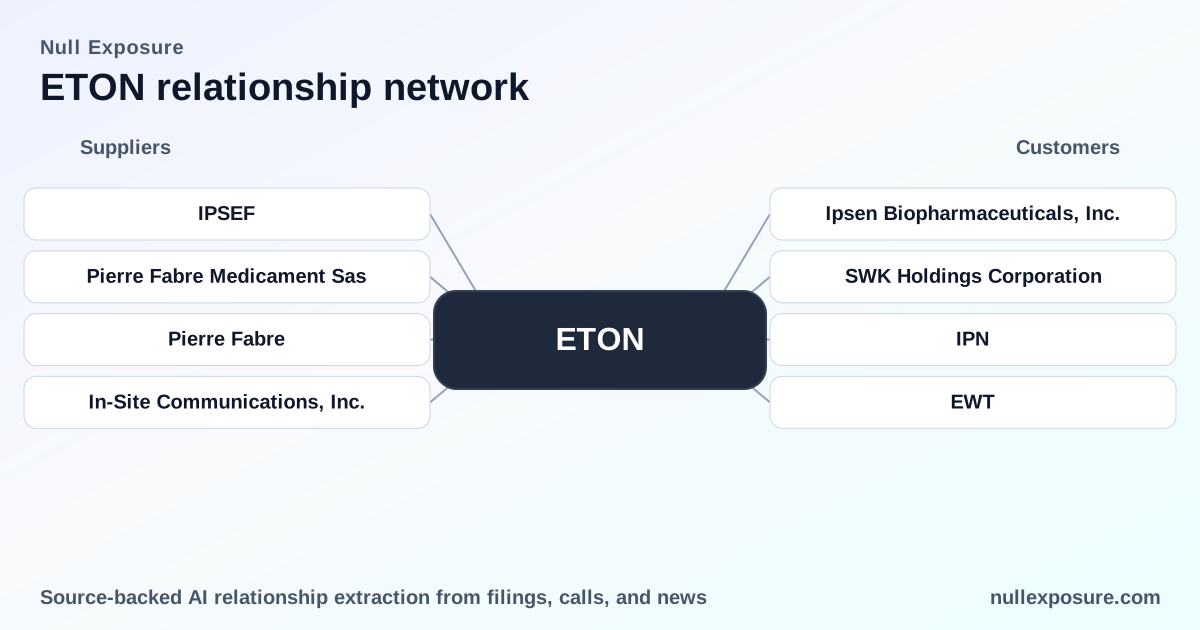
ETON: A concentrated commercial play on rare-disease medicines
Eton Pharmaceuticals monetizes a focused commercial model: it acquires and commercializes branded orphan and specialty products in the United States, driving revenue through direct sales to pharmacy distributors and exclusive specialty-pharmacy arrangements while supporting uptake with a patient-assistance platform. Revenue generation is product-led and partner-dependent — Eton’s cash flows come from a small portfolio of marketed therapies supported by concentrated channel relationships and targeted patient services. For a concise mapping of Eton’s customer relationships and what they imply for risk and upside, read on. For access to more relationship intelligence, visit https://nullexposure.com/.
How Eton runs the commercial engine
Eton operates as a specialty pharmaceutical merchant‑seller: it acquires approved drugs (including through asset purchase agreements), brings them under its label, and sells into the U.S. market through wholesale distributors and exclusive specialty-pharmacy partners. The company reports seven marketed rare‑disease products and leverages an internal sales force and the Eton Cares patient-support program to reduce barriers to therapy initiation. According to the FY2024 Form 10‑K, all reported revenues are U.S.-derived, which concentrates regulatory, pricing and reimbursement exposure geographically (FY2024 10‑K).
Eton’s contracting posture is transactional but governed by master terms: sales to wholesalers are executed via purchase orders under a broader master agreement, indicating standardized commercial terms and recurring order-based fulfillment rather than bespoke long‑term supply contracts (10‑K excerpt). The company is actively commercial — not in pure development mode — and several late‑stage candidates sit behind the marketed franchise, supporting a growth narrative tied to successful launches and partner execution.
The ledger: every customer and partner relationship in the filings and press coverage
Ipsen Biopharmaceuticals, Inc.
Eton executed an Asset Purchase Agreement to acquire Increlex (mecasermin injection) from Ipsen, positioning Ipsen as the seller in that transaction and expanding Eton’s marketed portfolio. This acquisition was disclosed in the company’s FY2024 10‑K (filed December 31, 2024).
Source: FY2024 Form 10‑K (Eton Pharmaceuticals, asset purchase agreement with Ipsen, Oct 2, 2024).
SWK Holdings Corporation
The FY2024 10‑K records arrangements tied to the company’s credit facilities that reference SWK Credit Agreement members, indicating financing or covenant relationships with SWK‑related parties. The mention signals Eton’s engagement with external capital providers in its funding architecture.
Source: FY2024 Form 10‑K (credit agreement references to SWK Holdings Corporation, 2024 fiscal period).
Anovo Specialty Pharmacy
Eton has established exclusive specialty-pharmacy distribution for Hemangeol and other launches through Anovo Specialty Pharmacy, with Anovo handling therapy initiation and streamlined access under Eton’s patient-support framework. Multiple press releases in 2026 confirm exclusive distribution and that Anovo administers the Eton Cares program for selected products.
Source: GlobeNewswire press releases (March–May 2026) announcing exclusive Hemangeol relaunch and specialty distribution through Anovo Specialty Pharmacy.
Anovo
Eton’s regulatory and launch communications name Anovo as the exclusive channel for newly approved products such as DESMODA (desmopressin acetate oral solution), with Anovo responsible for dispensing and patient-support execution at product launch. This underscores a strategic reliance on a single specialty partner for initial access workflows.
Source: GlobeNewswire release (Feb 25, 2026) announcing DESMODA availability exclusively through Anovo and administration of Eton Cares in partnership with Eton Pharmaceuticals.
IPN
Eton’s Q3 2025 earnings call notes a discrete revenue line that included approximately $0.9 million of finished‑product sales to IPN, reflecting transactional transfers of inventory to facilitate ownership transitions in certain European markets for the INCRELEX asset. The IPN reference appears in the Q3 2025 earnings-call disclosures.
Source: Eton Q3 2025 earnings call transcript (reference to product revenue from sales to IPN, 2025Q3).
Ipsen (as referenced in earnings call)
The same Q3 2025 earnings narrative shows product transfers to Ipsen to facilitate the INCRELEX ownership transition in select European countries, reflecting operational coordination with Ipsen during the asset migration process and temporary revenue recognition tied to inventory transfers.
Source: Eton Q3 2025 earnings call transcript (2025Q3).
Esteve
Eton reported sales of finished product inventory to Esteve alongside Ipsen in Q3 2025 as part of logistical steps to support the ownership transition of INCRELEX in European territories; those transfers generated approximately $0.9 million in product revenue in the quarter.
Source: Eton Q3 2025 earnings call transcript (2025Q3).
What the relationship map means for investors
-
High counterparty concentration: The FY2024 Form 10‑K explicitly identifies AnovoRx as a dominant revenue source — AnovoRx accounted for 93.6% of net revenues in 2024 (10‑K). That level of concentration creates single‑counterparty exposure where Anovo’s commercial and administrative performance directly drives Eton’s topline stability and collections.
-
U.S.-centric revenue and distribution model: Management reports all external revenues as U.S.-derived (FY2024 10‑K). Geographic concentration limits diversification but simplifies regulatory oversight to a single market; it also means any U.S. payer or specialty-pharmacy reimbursement shifts will have outsized impact.
-
Framework contracting with distributors: Sales are structured via purchase orders under master agreements with wholesalers, which supports operational predictability but limits negotiating leverage relative to fully integrated long‑term supply contracts. This setup typically implies predictable terms but potential price pressure in distributor negotiations.
-
Critical role of specialty pharmacy and patient support: Exclusive distribution deals and the Eton Cares program are core to product uptake and affordability for patients; these arrangements are strategically material and operationally critical to launch success and sustained demand.
-
Commercial maturity with concentrated product set: Eton is in full commercial mode with seven marketed products and several late‑stage candidates. That profile delivers near‑term cash generation but leaves upside dependent on successful launches and the durability of a small product base.
Risk / opportunity synthesis and investor takeaway
Key risk: Revenue concentration through Anovo/AnovoRx and narrow product breadth create meaningful counterparty and product‑concentration risk; a disruption to the specialty‑pharmacy relationship or a reimbursement setback would directly pressure Eton’s topline and receivables.
Key opportunity: The company’s strategy of acquiring approved, niche orphan products and consolidating distribution with specialty partners can generate strong margin expansion if Eton controls pricing and retains channel exclusivity. The FY2024 revenue concentration also implies that incremental diversification of distribution partners would materially de‑risk valuation multiple compressions.
Bottom line: Eton is a specialty‑pharma commercial operator whose valuation and cash flow trajectory are tightly coupled to a small set of marketed assets and a concentrated set of distribution partners — evaluate counterparty stability, specialty‑pharmacy execution, and pipeline launch readouts as primary drivers of upside or downside.
For a deeper dive into Eton’s partner map and risk heat map, visit https://nullexposure.com/ for relationship intelligence and monitoring.