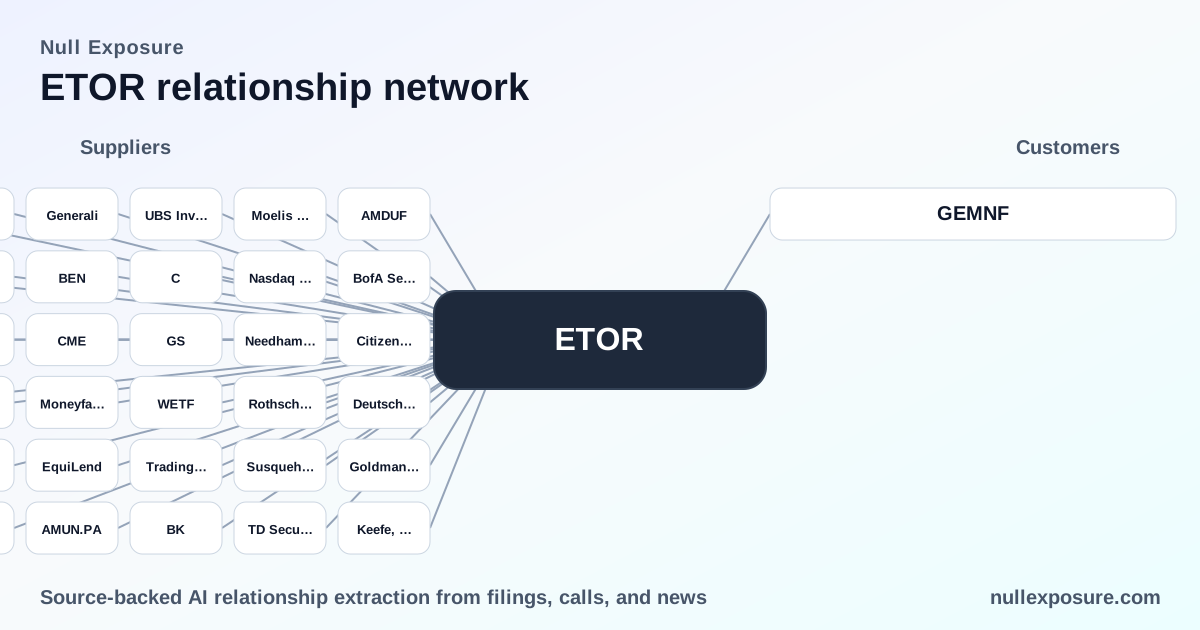
eToro and Gemini: Why a customer offboarding deal matters for investors
eToro Group Ltd. operates an online trading and social investing platform and monetizes primarily through trading spreads, fees, and ancillary services tied to asset transfers and custody. The company’s large revenue base and modest profit margins make operational continuity and partner relationships central to valuation and risk assessment. Learn how this specific customer relationship with Gemini changes the operational risk profile and what investors should price into ETOR today: https://nullexposure.com/
Quick investor snapshot: scale, profitability, and market positioning
eToro delivers scale and thin margins. Revenue TTM is $13.7 billion while gross profit is $384.7 million and EBITDA is $214.5 million (latest reported period ending 2025-12-31). Market capitalization sits near $3.05 billion, with a trailing P/E of 16.2 and forward P/E near 12.6, reflecting a market that expects margin improvement or multiple expansion. Analyst coverage skews positive (10 total Buy/Strong Buy vs. 5 Hold), indicating a consensus tilt toward constructive sentiment.
These metrics underscore two structural facts that shape how partnerships matter for eToro’s business: (1) revenue is sensitive to trading volumes and asset custody flows, and (2) modest operating margins make execution failures and reputational hits disproportionately costly.
Why the Gemini relationship is strategically important
The reported relationship centers on eToro acting as a receiving platform for customers moved off Gemini in certain geographies. This is operationally consequential because offboarding large groups of retail users involves identity verification, asset transfer mechanics, and customer support scale. For a trading platform with thin margins, successful migration converts directly into fee-bearing accounts; conversely, execution problems create churn, regulatory scrutiny, and negative press that compress margins.
Below are the media touchpoints that document and contextualize this relationship.
Three reported touchpoints covering the same engagement
-
Gemini — Sahm Capital report (Feb 2026): eToro is handling the offboarding process for Gemini customers in the UK, EU, and Australia, positioning itself as the receiving platform for displaced customers. According to a Sahm Capital note from February 2026, the arrangement puts both execution capability and public perception under scrutiny.
Source: Sahm Capital note (Feb 2026). -
GEMNF — Sahm Capital report (Feb 2026): The same Sahm Capital coverage repeats that eToro is supporting Gemini’s customer migration across the UK, EU and Australian markets, emphasizing the operational lift required for cross-jurisdictional transfers. The write-up highlights the optics of a high-profile brokerage offboarding and the execution risk for the receiving platform.
Source: Sahm Capital note (Feb 2026). -
GEMI — MEXC news release (Mar 2026): A MEXC news item likewise reports that Gemini has partnered with brokerage platform eToro to help customers transfer their assets, framing the relationship as an explicit customer-transfer partnership. This coverage underscores the commercial opportunity for eToro to capture transferred balances and customers.
Source: MEXC news release (Mar 2026).
All three media references document the same commercial dynamic: eToro is the designated recipient for certain Gemini customers in selected jurisdictions, and the story is reported across industry outlets in early 2026.
What this tells investors about eToro’s operating model and business constraints
From a company-level perspective, the Gemini offboarding relationship signals several operational characteristics investors must incorporate into valuation and risk frameworks:
-
Contracting posture: eToro acts as a buyer of customer flows and a services provider for migrations rather than a passive market counterparty. That positions the firm in active commercial arrangements where contractual SLAs, onboarding timelines, and customer support commitments carry immediate economic consequences.
-
Concentration and scalability: The company’s ability to ingest groups of customers at short notice tests scaling of KYC/AML controls and support operations. High-volume transfers compress margins when onboarding costs spike, and reliance on episodic inflows from third parties introduces concentration risk in growth sources.
-
Criticality: Custody, transfer integrity, and perception are core inputs to eToro’s revenue model. Operational failures in a high-visibility migration would have outsized consequences for trading volumes and brand trust; successful migrations directly increase fee-bearing accounts.
-
Maturity of operations: eToro’s financials show solid revenue scale but thin operating margins, indicating that operational excellence and cost control are critical to converting customer inflows into durable profitability. The company’s institutional ownership (~54%) and relatively established market cap signal investor confidence but also set expectations for professional execution.
These are company-level signals and should be read as broad constraints shaping how eToro approaches partnerships, not as relationship-specific guarantees.
Risk and catalyst checklist for near-term investors
- Execution risk: Successful technical and compliance execution on large-scale customer migrations is binary—either the transfers proceed smoothly and revenue follows, or friction creates churn and negative PR. This is the primary near-term risk tied to the Gemini arrangement.
- Regulatory scrutiny: Cross-jurisdictional transfers increase exposure to local regulatory requirements; any misstep could prompt inquiries or fines that compress margins.
- Revenue upside: If eToro converts migrating customers into active traders, the company captures incremental fee and spread revenue with relatively low marginal acquisition costs compared to retail marketing.
- Sentiment catalyst: Positive post-migration metrics (retention rates, traded volumes per transferred user) would be immediate catalysts for the stock; conversely, reports of failed migrations would be a material negative.
Bottom line for investors
The Gemini offboarding relationship is a near-term operational lever for eToro: it offers a pathway to accelerate account growth but also raises execution and reputational stakes. Given eToro’s sizable revenue base, modest margins, and institutional ownership, investors should treat partner-driven customer flows as a measurable growth driver that is highly dependent on operational execution.
For a deeper read on partner relationships and how they reshape eToro’s risk profile, visit NullExposure for ongoing coverage: https://nullexposure.com/