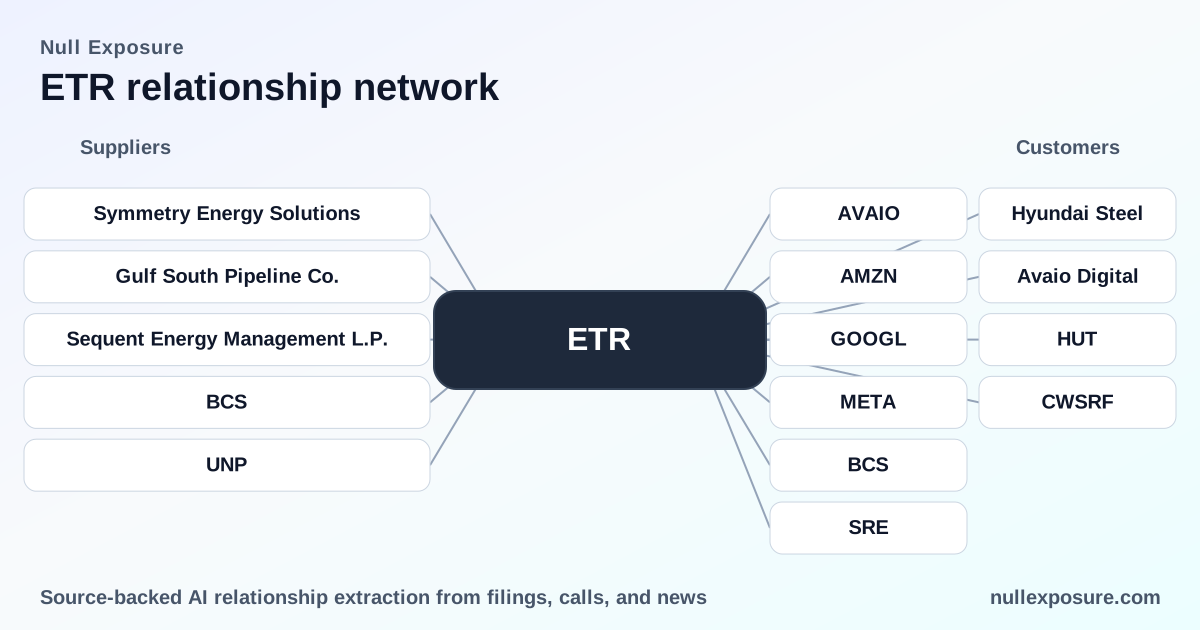
Entergy (ETR): Customer Relationships Rewriting the Utility Growth Trajectory
Entergy operates as a vertically integrated, regulated electric utility in the U.S. Deep South; it monetizes through regulated retail rates, wholesale contracts, and bespoke electric service agreements (ESAs) with large industrial and technology customers that fund or accelerate grid and generation investments. Recent evidence shows Entergy is using long-term customer contributions and regulatory riders to de-risk large capital projects while capturing outsized load growth from data‑center and industrial investments — a structural demand driver that underpins the company’s enlarged capital plan and revenue outlook. For further situational analysis, see Null Exposure’s coverage at https://nullexposure.com/.
A concise investor thesis
Entergy’s core earnings remain rate-regulated and predictable, but incremental upside is coming from a small number of large enterprise customers whose ESAs and direct contributions fund generation, transmission and distribution expansion. Those agreements both lower incremental customer cost and shift financing/execution requirements onto Entergy, creating execution and regulatory recovery risk that investors must price alongside the growth opportunity.
Relationship-by-relationship roundup (plain-English, source-backed)
-
AVAIO / Avaio Digital — Entergy referenced a colocation data center investment by AVAIO in the Entergy Mississippi service area and multiple Avaio campus announcements across the region supporting Entergy’s load growth. According to the company’s Q3 2025 earnings call and regional reporting, Avaio is among the technology customers expanding firm demand in Entergy territory (Q3 2025 earnings call; Finviz March 2026).
-
Evest LLC — Evest LLC, a Meta subsidiary, is the counterparty for a 20‑year electric service agreement referenced in Entergy’s FY2026 filings and filings with the Louisiana Public Service Commission under the Lightning Initiative. Entergy’s Q1 2026 press materials point to regulatory submissions tied to this long-term contract (Entergy Q1 2026 financial results, May 2026).
-
Meta Platforms, Inc. (Meta / META) — Entergy has executed long-term ESAs with Meta for large AI data‑center campuses in north Louisiana; management has valued customer “fair‑share” benefits at roughly $2 billion and has raised its multi‑year capital plan to support generation/transmission to serve Meta load. Meta’s projects are central to Entergy’s expanded $57B capital plan and rate-recovery discussions (Entergy Q1 2026 press release; EnergyConnects April 2026; Globe and Mail/Reuters coverage, Mar–May 2026).
-
Google / GOOGL — The Arkansas Public Service Commission approved a special rate contract for Google’s West Memphis campus; Entergy management noted Google will underwrite full incremental power costs at that site to protect affordability for existing customers. This was discussed on Entergy’s Q4 2025 earnings call and reiterated in March 2026 press coverage (ETR Q4 2025 earnings call; Finviz March 2026).
-
Amazon / AWS / AMZN — AWS projects in Mississippi (multiple campuses) are contributing incremental revenues and enabling grid investments “at no additional cost” to incumbent customers, according to Entergy commentary; Entergy highlighted AWS as a contributor to reduced rates during replacement plant construction in Entergy Mississippi (ETR earnings calls; Finviz and InsiderMonkey coverage, 2024–2026).
-
Hut 8 (HUT) — Hut 8’s West Feliciana Parish campus is receiving utility capacity from Entergy Louisiana (Phase I ~330 MW of utility capacity supporting ~245 MW IT); Entergy and third‑party developers are cited as partners for additional generation to serve Hut 8’s ramp (Blockspace.media and regional coverage; Cantechletter, May 2026).
-
EAI / Entergy Services, LLC (EAI) — Entergy Services, LLC is the administrative services company referenced as a provider of services to the operating companies; filings describe Entergy Services as a material internal counterparty for administrative support (news sentiment referencing EDGAR filings, 2026).
-
Barclays Bank PLC / BCS — Barclays was added as an agent/forward seller and forward purchaser to Entergy’s at‑the‑market (ATM) equity Sales Agreement via a joinder on Feb 20, 2026, reflecting the company’s capital markets execution and liability management arrangements (TradingView report, March 2026).
-
Hyundai Steel — Hyundai Steel’s planned $5.8 billion investment in Ascension Parish, LA, was highlighted in Entergy commentary as a large industrial win that follows the Meta project and contributes to regional industrial load growth (ETR Q4 2025 earnings call).
-
Sempra (SRE) — Sempra reached final investment decision for Phase 2 of Port Arthur LNG; Entergy’s earnings commentary referenced Sempra-related customer growth news as part of broader industrial and energy market activity (ETR Q3 2025 earnings call).
-
Chartwell / CWSRF — Entergy’s digital LIHEAP platform earned a Chartwell Silver Best Practices Award; company remarks during the Q3 2025 earnings call tied this to improved service for vulnerable customers and digital program recognition (ETR Q3 2025 earnings call).
-
Port Fourchon / Lafourche Parish projects — Federal grants and local investments to harden lines in Lafourche Parish will benefit about 13,700 customers including critical infrastructure like Port Fourchon; regional reporting cites Entergy Louisiana as a beneficiary of those resilience funds (Daily Energy Insider, May 2026).
(Each relationship above is drawn directly from Entergy public commentary and contemporaneous news releases referenced in the company filing and press cycle, Q3 2025 through Q1 2026.)
How Entergy’s contracts and customers shape the operating model
Entergy’s customer relationships reveal a blended contracting posture and capital-recovery strategy:
-
Contract mix: The company runs short‑term market sales (day‑ahead energy) alongside framework regulatory mechanisms (LPSC-approved resilience plan with a five‑year, ~$1.9B initial investment recovered via a forward‑looking rider) and long‑term ESAs with major data‑center customers that include termination provisions but do not fully eliminate counterparty risk. These contract types collectively permit revenue recovery while concentrating capital obligations.
-
Counterparty composition: Entergy’s growth is driven by large enterprise customers (data centers, heavy industry) that supply direct contributions or usage commitments; residential and small-business segments remain sizeable but offer limited incremental load. The company discloses that no single customer exceeded 10% of revenues in recent years, which is material but not concentrated to a single counterparty.
-
Role and criticality: Entergy predominantly acts as the seller of regulated electricity and capacity; for some projects Entergy also shoulders construction and transmission upgrades financed through customer contributions and regulatory riders. Certain wholesale arrangements (Unit Power Sales Agreement) are critical to some subsidiary revenue streams.
-
Maturity and stage: Most large ESAs and infrastructure projects are active (under construction or approved), with selected pilots for emerging technology programs (e.g., backup-generator pilots) preserved as smaller, controlled experiments.
-
Spend and scale: Multiple projects fall in the $100M+ category (combined‑cycle plants, major transmission) while discrete rider recoveries and program investments occupy the $10M–$100M band; the aggregate multi‑year capital program expands Entergy’s absolute exposure to execution and regulatory outcomes.
Investment implications: upside vs. execution risk
- Upside: Meaningful regulated revenue and rate base growth from data centers and large industrial customers materially support Entergy’s elevated capital plan and justify multiple expansion if projects deliver on load and regulatory recovery.
- Risk: Execution, regulatory recovery, and counterparty performance are the primary risks: long lead times on generation/transmission, rider approval timing, and incomplete termination protection in ESAs create event risk that can stress near-term cash flow metrics despite long-term upside. Storm restoration and securitization outcomes also retain the potential for material P&L impact.
For a detailed merchant‑grade view of how customer contracts alter balance‑sheet risk and capital plans, visit Null Exposure: https://nullexposure.com/.
Bottom line
Entergy’s recent customer relationships — dominated by large tech and industrial ESAs — create a clear growth vector funded through both customer contributions and regulatory recovery mechanisms. Investors should value that growth premium against execution and regulatory recovery risk, and monitor progress on the $57B capital program, LPSC and PSC filings, and the status of each major ESA for signs of timetable slippage or unexpected cost shifts.
If you need transaction‑level summaries or a modeled sensitivity on ESA counterparty outcomes, Null Exposure can provide a tailored briefing at https://nullexposure.com/.