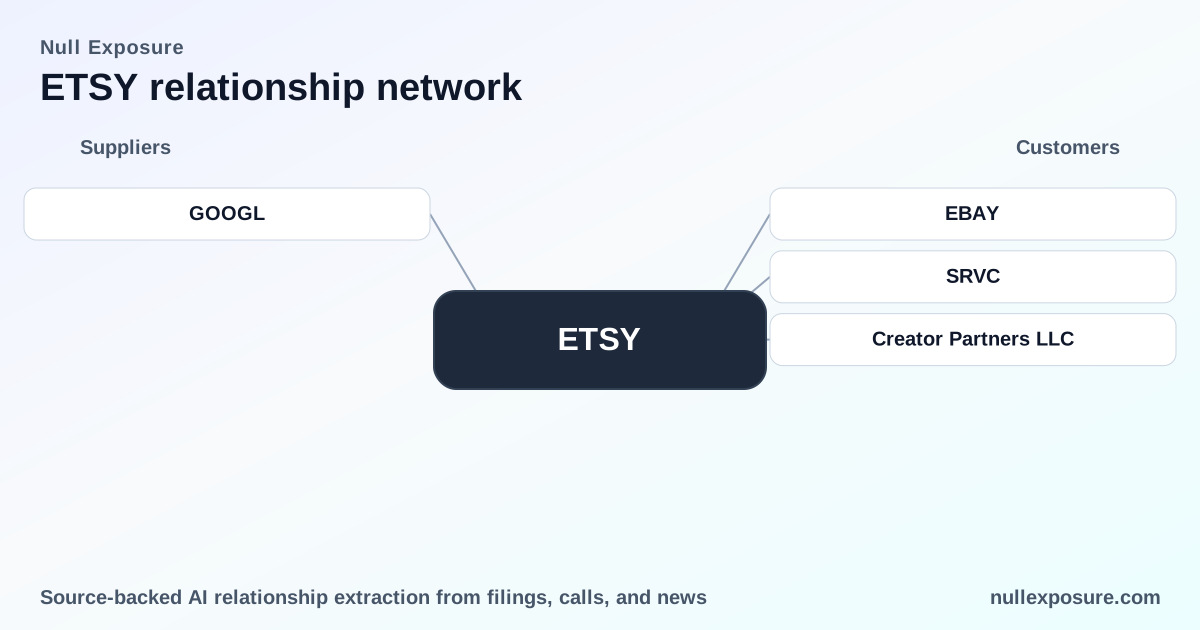
Etsy’s customer relationships after a strategic portfolio purge: what investors need to know
Etsy operates a two-sided e-commerce marketplace that connects millions of individual and small-business sellers with buyers seeking handcrafted, vintage and unique goods, and it monetizes primarily through usage-based transaction and payments fees, fixed short-term listing fees, and optional seller services such as advertising and shipping labels. The company is actively reshaping its portfolio—selling Depop and divesting Reverb—to concentrate capital and product development on the core Etsy marketplace, improve margins, and simplify the buyer/seller ecosystem. For a concise, commercial view of how this repositioning affects counterparty exposure, see https://nullexposure.com/.
Business model in plain language: durable marketplace economics, short contract horizons
Etsy’s revenue mix is predominantly variable and transaction-driven: sellers pay a percentage transaction fee (inclusive of offsite ads transaction fees) and payments processing fees that are recorded when transactions consummate, while listing fees are charged per item and amortized over a short, four-month listing period unless sold sooner. That structure creates high operating leverage to GMV, rapid revenue recognition tied to buyer activity, and a predictable sensitivity to macro-driven buyer demand.
The seller base is overwhelmingly individuals and small businesses rather than long-term enterprise contracts, which produces a low-contractual lock-in profile but a broad base that supports resilience—stickiness derives from community, discovery, and seller tools rather than long-term contractual commitments.
Operating constraints that shape revenue and counterparty risk
- Usage-based commercial posture. Variable fees (transaction and payments processing) are the primary revenue drivers and link top-line directly to buyer transaction volume.
- Short-term listing economics. Fixed listing fees are recognized over a four-month window, so revenue from listings is near-term and sensitive to listing velocity.
- Counterparty composition: individuals and small businesses. Etsy’s seller population is heterogeneous and includes many micro-sellers; revenue concentration risk by counterparty is low, but aggregate sensitivity to seller economics and policy changes is material.
- Geographic concentration and global reach. Etsy generates the majority of GMS from U.S. buyers (company disclosures show ~74–86% U.S. buyer concentration across marketplaces in recent years), yet it operates globally with tens of millions of international users—this produces both concentration risk and optionality from international growth.
- Two-sided role: both buyer and seller flows matter. Etsy’s unit economics depend on both buyer acquisition/retention and seller satisfaction; deterioration on either side constrains marketplace liquidity.
- Services-led revenue segment. Optional seller services (on-site advertising, shipping labels) supplement transaction revenue and amplify margins when seller demand for services is strong.
These are company-level structural signals derived from Etsy’s disclosures and public commentary and should inform underwriting of counterparty exposure and revenue sensitivity rather than being mapped to any single external counterparty.
Recent counterparties and M&A counterpart relationships you must price
Etsy’s recent headlines compress into two counterparties tied to disposals: eBay (EBAY) on Depop, and the buyer group that took Reverb. Each relationship below is summarized with the primary public source.
eBay / EBAY — Depop sale
Etsy signed a definitive agreement to sell Depop to eBay for approximately $1.2 billion in cash as part of a portfolio simplification to concentrate resources on Etsy’s core marketplace, with public reporting indicating a targeted close in mid‑2026 and customary working capital adjustments. Source: Finviz reporting on March 9, 2026 (https://finviz.com/news/316916/etsy-q4-deep-dive-core-marketplace-refocus-and-early-ai-gains-amid-buyer-headwinds) and multiple contemporaneous press summaries noting the $1.2B all‑cash transaction.
eBay (multiple market reports)
Market coverage from outlets including Investing.com, TradingView and others reiterated that the Depop sale excludes Depop from Etsy’s results going forward and cited an expected closing window in 2026, describing the transaction as strategic refocus capital for Etsy and product consolidation for investors to consider. Source: Investing.com coverage of Etsy’s FY2026 results (https://www.investing.com/news/stock-market-news/etsy-beats-revenue-estimates-as-marketplace-growth-returns-4644494) and TradingView reporting (https://www.tradingview.com/news/tradingview:746c323396996:0-etsy-to-sell-depop-to-ebay-for-1-2-billion-in-cash-closing-targeted-q2-2026/).
Creator Partners LLC — Reverb buyer group
Creator Partners LLC joined a buyer syndicate that completed the acquisition of Reverb Holdings from Etsy, removing that specialist music marketplace from Etsy’s portfolio to streamline focus on core categories. Source: SimplyWallSt coverage noting the completion of Reverb’s sale (https://simplywall.st/stocks/us/retail/nyse-etsy/etsy).
Servco Pacific Inc. / SRVC — Reverb acquirer (ticker referenced)
Servco Pacific Inc. (appearing in filings and coverage under SRVC) participated in the acquisition of Reverb alongside Creator Partners, completing the divestment and handing off a speciality marketplace that had delivered non-core GMS to Etsy’s consolidated totals. Source: SimplyWallSt (https://simplywall.st/stocks/us/retail/nyse-etsy/etsy/future) and related press summaries.
Strategic and risk implications for investors
-
Capital redeployment and margin tailwinds. The Depop sale generates substantial cash ($1.2B) that Etsy can deploy to product investment, buybacks, or deleveraging; this transaction cleans up a non-core exposure and increases management focus on improving buyer retention and advertising monetization on the main marketplace. Public analyst commentary and investor reaction around March 2026 reflected that framing. Source: Investing.com and market writeups in March–May 2026 (https://www.investing.com/news/insider-trading-news/etsy-executive-chair-josh-silverman-sells-338-million-in-shares-93CH-4624762?ampMode=1).
-
Regulatory and operational frictions on deal timelines. Coverage flagged regulatory checks in the U.K. and Australia for eBay’s acquisition of Depop, which can delay cash flows and any associated working‑capital adjustments; investors should model closing timing conservatively where quarter-to-quarter comparability matters. Source: TS2.tech reporting on regulatory tracking and market reaction (https://ts2.tech/en/ebay-stock-gets-a-jolt-q1-beat-gmv-surge-and-gamestop-offer-report-put-marketplace-back-in-play/).
-
Reduced secondhand-fashion exposure; sharper core focus. Selling Depop reduces Etsy’s exposure to the youthful resale fashion segment and concentrates growth bets on handcrafted, vintage, and craft-supply verticals where Etsy’s brand and seller community are strongest.
If you want an investor-grade cut of these counterparty transitions and how they reweight Etsy’s revenue exposure and counterparty concentration, explore our coverage and modeling tools at https://nullexposure.com/.
Bottom line: cleaner balance sheet and more concentrated marketplace risk profile
Etsy’s disposal activity transfers two non-core marketplaces to external buyers and returns cash to the corporate balance sheet while sharpening the company’s operating focus. For investors, the headline is simple: the firm’s monetization stays variable and short-horizon, but its counterparty exposure becomes more concentrated on the core buyer/seller community and U.S. demand, increasing the importance of buyer retention, advertising monetization, and product improvements as drivers of future revenue and margin expansion.
Key takeaway: the Depop sale to eBay and the Reverb divestiture to Servco/Creator Partners convert non-core GMS into liquidity, reduce product complexity, and center future returns on marketplace execution rather than portfolio management.