enCore Energy (EU): Customer Relationships, Contracts and What Investors Should Price In
enCore Energy sells uranium concentrate produced in the United States and monetizes through a mix of multi-year supply agreements and market-linked contracts with utilities and traders; the company’s economics depend on committed forward pounds, periodic spot-linked pricing collars, and occasional asset-level monetizations. For investors evaluating customer risk and revenue durability, the key facts are simple: enCore is a seller of a single core product (U3O8), with a predominantly North American customer base, significant multi-year contract coverage, and active project-level transactions that shift capital structure and operational optionality. Learn more about how we source and present this relationship intelligence at https://nullexposure.com/.
The operating model in one sentence: long-term seller with spot overlay
enCore operates extraction, recovery and sales of uranium in the United States, packaging yellowcake for shipment to North American conversion facilities where title and sale frequently occur. Company filings show 4.455 million pounds of committed sales from 2025–2029 and a slate of agreements extending sales through 2033, indicating a deliberate contracting posture that balances revenue visibility and price exposure through hybrid contracts that include spot-linked pricing with floors and ceilings.
How the contracts and constraints shape cash flow and risk
Company-level signals from enCore’s disclosures present a clear commercial profile:
- Contracting posture: predominantly long-term. As of December 31, 2024, enCore reported committed sales covering 2025–2029 and contracts through 2033, reflecting a revenue-horizon strategy that supports project financing and production planning.
- Price exposure: hybrid long-term with spot components. Several contracts include pricing tied to the uranium spot price but incorporate minimum floors and maximum ceilings adjusted for inflation, creating a limited but material exposure to commodity cycles.
- Customer type and concentration: utilities and traders in North America. The company executed eleven uranium sales agreements to U.S. nuclear plants plus a legacy trader agreement, establishing a concentrated base of large-enterprise counterparties for its core product.
- Geographic concentration and operational criticality: North America. enCore’s operations and customer deliveries are organized around U.S. extraction and North American conversion facilities, making regional regulatory and logistics factors salient.
- Relationship stage and role: active seller of core product. Contracts are live and execution continues, consistent with the company’s stated role as supplier of packaged yellowcake to conversion points.
These characteristics point to predictable physical delivery risk (transport, conversion inventory) and market risk (spot-linked collars), with counterparty credit risk skewed toward large utilities and traders.
Public customer relationships: the actionable signals investors should track
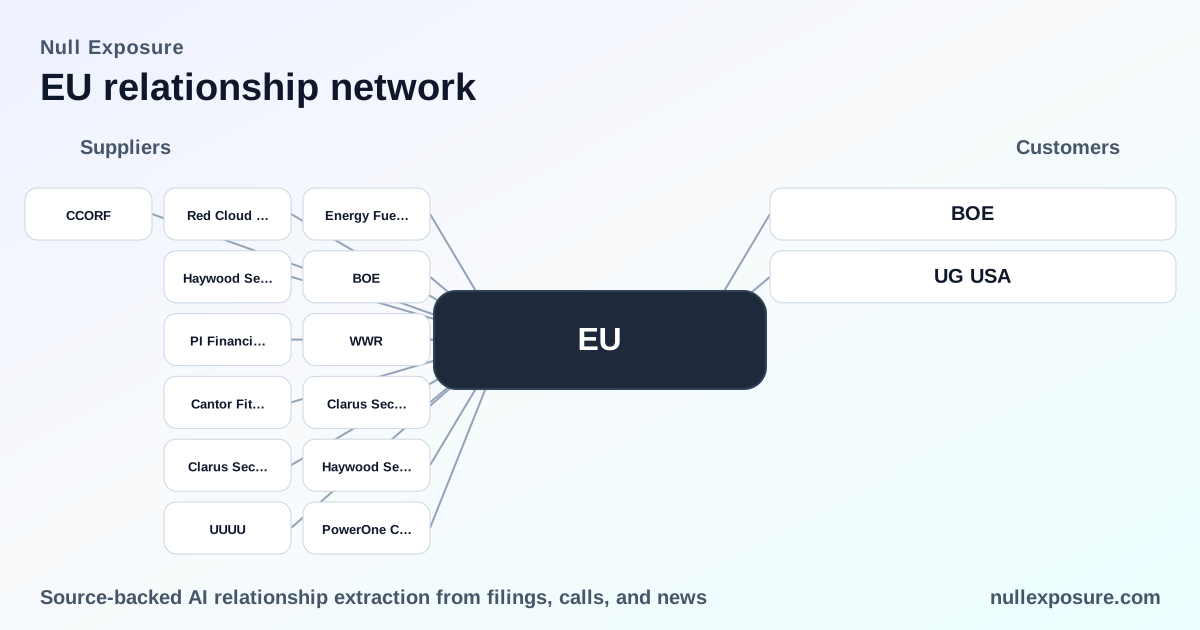
Boss Energy / BOE — minority stake in Alta Mesa and capital infusion
Boss Energy has acquired a minority interest in enCore’s Alta Mesa ISR project in South Texas. According to Mining.com.au (March 9, 2026), Boss Energy secured a 30% stake in Alta Mesa for US$60 million in cash purchased from enCore and its U.S. subsidiary; Cowboy State Daily (March 27, 2024) described the strategic transaction as a $70 million cash-and-stock deal, indicating both direct project monetization and strategic capital partnership. Both reports signal that enCore used an asset-level sale to raise liquidity and share operational risk while retaining exposure to project upside.
IsoEnergy / ISOU — asset transfer activity in sector consolidation
IsoEnergy entered agreements to acquire Anfield Energy from a syndicate of sellers that included enCore among other uranium companies. SimplyWall.st (March 10, 2026) reported that the transaction was valued at CAD 110 million, and enCore was listed as a seller in that broader consolidation, illustrating the company’s participation in portfolio rationalization and secondary market transfers of non-core holdings. This is a non-core asset movement that has implications for balance sheet composition and capital allocation.
UG USA — term supply relationship reported in earlier contracts
enCore disclosed term supply agreements in 2021 that included one with UG USA and another with a U.S. utility, establishing long‑dated offtake counterparties for production. World Nuclear News noted these 2021 term supply agreements and subsequent shipments, confirming enCore’s role as an active supplier into North American utility channels. This long-term offtake relationship underpins baseline revenue expectations from production and supports the company’s commercial credibility with utilities.
What these relationships tell investors about revenue durability and strategic optionality
enCore’s customer profile and recent transaction activity produce a predictable set of investment implications:
- Revenue durability is material but not absolute. Committed pounds through 2029 and contracts through 2033 provide a multi-year revenue backbone, yet the presence of spot-linked pricing collars ensures earnings will be sensitive to uranium market cycles.
- Project-level monetizations are a recurring lever. The Alta Mesa minority sale to Boss Energy demonstrates that enCore will use asset sales and strategic equity partnerships to raise capital and de‑risk projects rather than dilute long-term strategic exposure.
- Concentration and counterparty quality are strengths. Eleven U.S. nuclear plant agreements and a legacy trader agreement concentrate revenue into long‑term counterparties with high operational criticality, reducing small-counterparty credit risk while increasing dependence on the utility/trader segment.
- Regional operations concentrate regulatory and logistical risks in North America. All production and conversion logistics are North American‑centric, so regional policy and conversion capacity are key sensitivity factors.
Quick investor takeaways
- Long-term contract book provides visibility: committed pounds and contracts to 2033 support modeled production cash flows.
- Spot-linked pricing preserves upside and exposes downside: collars and floors moderate extreme volatility but leave commodity cycles consequential.
- Project monetizations alter leverage and optionality: Alta Mesa stake sale to Boss Energy delivered cash and de‑risked development while retaining potential upside through minority interest.
- North American focus simplifies counterparty risk assessment but concentrates regulatory exposure.
For a concise, investor-ready view of enCore’s customer relationships and contract structure, review the company filings and recent transaction notices referenced above; for ongoing tracking and deeper relationship analytics, visit https://nullexposure.com/.
Conclusion
enCore’s commercial story is straightforward: an active seller of U3O8 with multi-year contract coverage, spot-linked pricing mechanisms, and a willingness to use project-level dispositions to optimize capital structure. Investors should underwrite a base of contracted pounds while explicitly modeling commodity exposure, project monetization timing, and North American conversion logistics as the primary value drivers and risk levers.