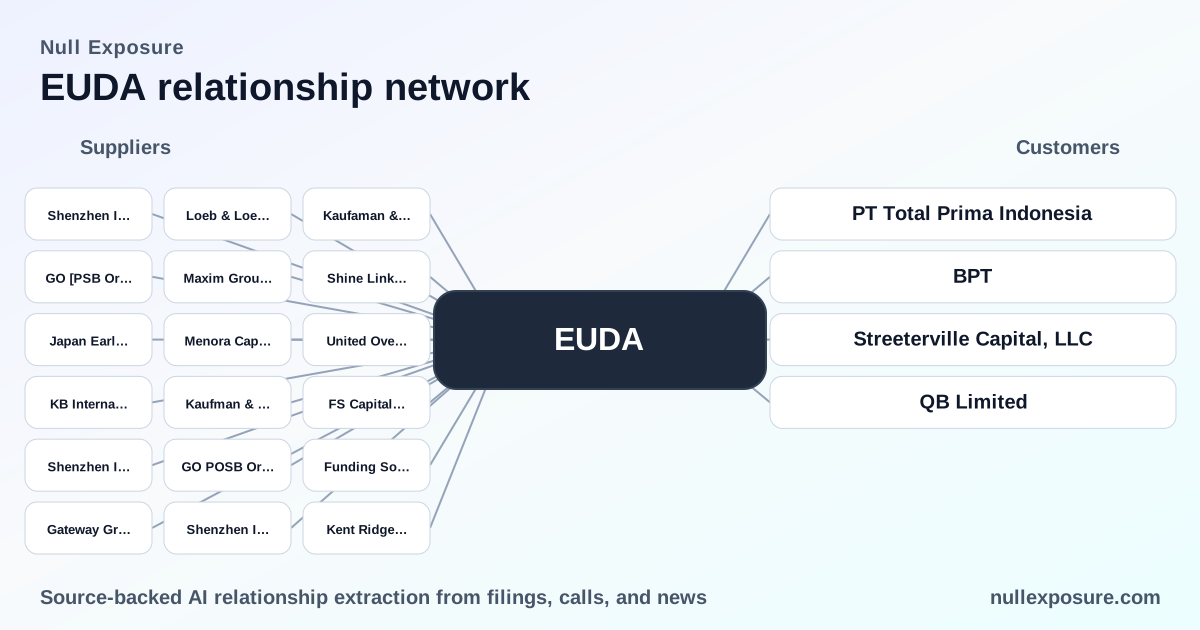
EUDA Health Holdings: customer relationships that reveal a hybrid services and capital strategy
EUDA Health Holdings Limited operates a hybrid healthcare and property-management business in Singapore and Southeast Asia, monetizing primarily through per-visit healthcare revenue and recurring property-management contracts, while supplementing cash flow with occasional financing instruments and strategic investments. Investors should evaluate EUDA as a services-led operator with localized APAC concentration, modest revenue scale (roughly $5.16M TTM) and active use of alternative consideration and convertible instruments to manage liquidity. For a compact, relationship-focused audit, visit https://nullexposure.com/.
How EUDA runs the business and where the money comes from
EUDA is a dual-segment operator: Medical Services (specialty clinics, billed on a per-visit basis) and Property Management Services (contractual, generally straight-line revenue). Revenue recognition practice and contract excerpts indicate a mixture of usage-based billing for clinical visits, spot recognition for equipment installs that are delivered with installation, and short-to-medium-term recurring contracts for property services. The company reports that no single customer accounted for 10% or more of revenue in FY2022, signaling low customer concentration at the top end even as a “limited number of customers” still drive a meaningful portion of sales. Operational scale is small: Market capitalization sits around $42.6M with negative EBITDA and an outsized insider ownership stake (≈37.6%), which makes capital transactions and dilution highly relevant to investor returns.
What the filings and press explicitly show about counterparties
PT Total Prima Indonesia — loan counterparty (FY2022)
EUDA disclosed that it entered into a loan agreement with PT Total Prima Indonesia, an unrelated third party, as reported in its FY2022 10‑K filing. This is a financing arrangement referenced in the company’s annual report and reflects non-operational cash flow activity recorded in that filing (EUDA FY2022 10‑K).
BPT — investment in affordable housing program (FY2022)
EUDA (through UGI) committed to invest approximately US$1.9 million (SGD 2,580,000) into BPT’s affordable home program in Indonesia under an investment agreement disclosed in the FY2022 10‑K. The filing highlights this as a strategic capital deployment outside core clinical or property-management operations (EUDA FY2022 10‑K).
QB Limited — token consideration for product and distribution (FY2025)
Public reporting in December 2025 describes a commercial arrangement where EUDA will receive QB tokens instead of cash for products and services provided to QB Limited, with Helixe supplement distribution called out as exclusive in Hong Kong and Macau. That announcement frames the deal as a non-monetary exchange that expands EUDA’s regional commercial footprint while introducing cryptocurrency-based consideration into the revenue mix (FinancialContent, December 22, 2025; StocksToTrade, December 23, 2025).
Streeterville Capital, LLC — convertible warrant financing (FY2025–FY2026)
EUDA entered a securities purchase agreement with Streeterville Capital for a warrant exercisable into up to 2,000,000 ordinary shares for an aggregate purchase price of US$100,000, announced November 26, 2025 and re‑reported in early 2026. Press coverage frames this as a small, dilutive financing instrument issued to raise immediate capital via a convertible warrant (QuiverQuant; Decatur Daily Democrat; StocksToTrade, Dec 2025–Jan 2026).
Constraints and what they reveal about EUDA's operating posture
EUDA’s disclosed contract types and segment definitions form a coherent story about how the company sells and executes services:
- Contracting posture: EUDA operates as a principal service provider in its medical services, recognizing revenue on a gross basis and controlling service delivery. Installation contracts for devices are recognized at a point in time when control transfers, consistent with spot treatment for equipment-plus-installation bundles.
- Revenue mix and billing cadence: The firm’s primary clinical income is usage-based (per-visit specialist revenue), while property-management income is recurring and recognized straight-line over contract terms, typically around one year.
- Customer concentration and counterparty types: Although no single customer exceeds 10% of revenue (company-level signal), a substantial portion of revenue is derived from government entities and large employers, exposing the company to procurement and payment timing dynamics typical of institutional clients.
- Geographic concentration: Operations and revenues are APAC-focused, concentrated in Singapore with planned expansion across Southeast Asia, which concentrates regulatory and market risk regionally.
- Materiality and spend scale: Revenue bands and segment disclosures place EUDA in the $1M–$10M annual spend/revenue bracket for individual segments, consistent with a small-cap services operator in growth mode.
- Maturity and role: The company is service-centric and early-stage in scale, using non-traditional consideration (token receipts) and convertible warrants as tactical financing tools rather than relying on broad institutional ownership (institutional ownership ~0.09%).
What investors should watch: risk, dilution, and operational leverage
EUDA’s mix of operational revenue and creative financing presents both upside optionality and straightforward risks.
- Revenue resilience: Usage-based clinic revenue provides a direct, transactional cash flow stream; recurring property-management contracts give predictable, contractually defined income. Together they create natural operational leverage as volumes increase.
- Alternative consideration exposures: Acceptance of QB tokens as non-cash payment introduces valuation and liquidity risk for consideration that is not USD-denominated and could affect near-term recognized revenue and convertibility into cash (FinancialContent, Dec 2025).
- Dilution risk: The Streeterville warrant converts up to 2M shares for $100k, a transaction that can be highly dilutive if exercised at low price levels; this is an explicit capital-management tool that investors must model into share-count scenarios (QuiverQuant; Decatur Daily Democrat, Jan 2026).
- Customer mix and counterparty risk: Government and large-employer exposure drives predictable contract enforcement but also exposes the company to procurement cycles and payment delays. At the company level, no customer meets the 10% revenue threshold, which moderates customer concentration risk but does not eliminate it given the “limited number of customers” language found in filings.
For further relationship intelligence and to see how these counterparties fit into EUDA’s broader risk profile, review our platform at https://nullexposure.com/.
Investor takeaway
EUDA is a small-cap, APAC-focused services operator whose core value derives from per-visit clinical economics and recurring property-management fees, supplemented by occasional capital transactions and alternative-payment arrangements. Key risks are token-based consideration, convertible instrument dilution, and geographic concentration in Singapore, while key strengths include diversified service lines and principal-level control of clinical delivery. Monitor financing instruments and token valuation closely as they directly affect cash runway and equity dilution.