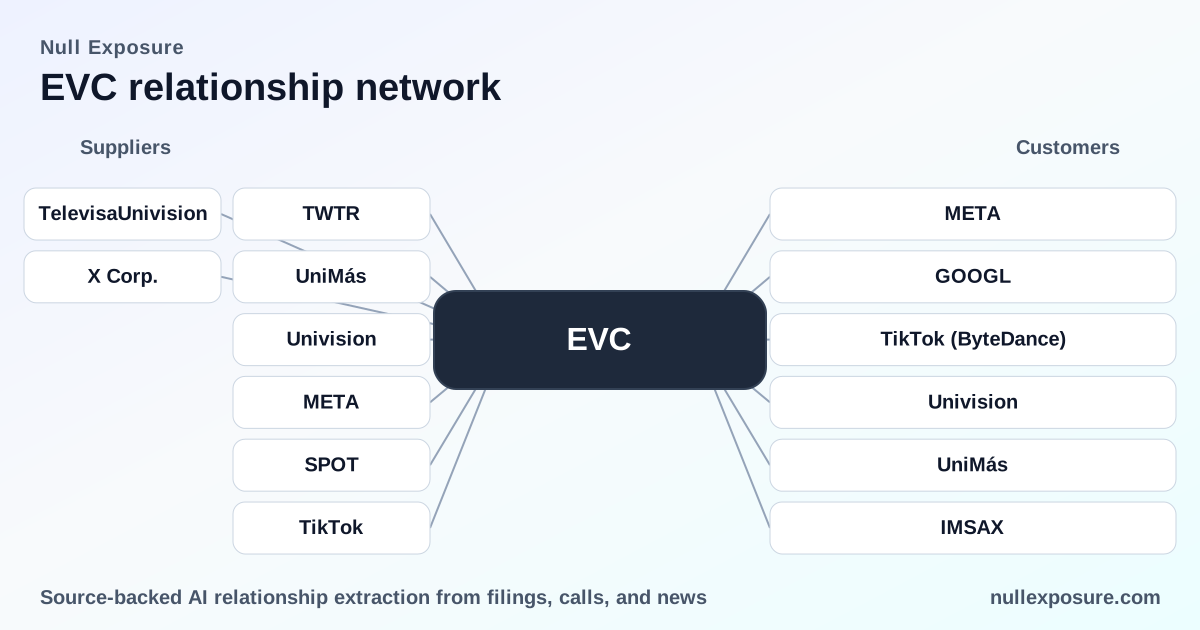
Entravision (EVC) — Customer Map and Commercial Risk Profile
Entravision is a vertically integrated media and advertising-services company that monetizes by selling advertising inventory across U.S. Spanish-language broadcast assets and providing ad-buying and marketing services to digital advertisers internationally through its ad-technology business. Revenue derives from short-duration advertising contracts and service engagements, plus licensing/retransmission fees for broadcast distribution. For investors, the central question is whether Entravision’s client mix and commercial arrangements leave the company exposed to concentrated demand shocks or provide a durable, diversified revenue base. For related diligence and market signals visit https://nullexposure.com/.
How Entravision operates and how that shapes revenue
Entravision runs two operating pillars: a traditional media business (television and radio affiliate sales, retransmission consent) and an advertising-technology & services arm that provides digital ad-buying and performance marketing, including Smadex — the company’s proprietary automated ad buying platform — and agency services. Contracts are generally short-term advertising or services agreements; the company discloses that it does not report unsatisfied performance obligations for contracts with an original expected length of one year or less, which applies to essentially all of its advertising contracts. This is a structural feature of the business: short contract duration creates recurring but spotty revenue flows tied to advertising cycles.
Company-level signals from filings and disclosures:
- Contracting posture: Predominantly short-term advertising/service contracts, recognized as revenue when services are delivered.
- Geographic footprint: Revenues are primarily U.S. dollar-denominated with meaningful international operations (Smadex serves customers across dozens of countries and the company reports European revenue in its “rest of world” bucket).
- Concentration: Official disclosure states no single advertiser represented more than 5% of revenue or trade receivables for 2022–2024, signaling advertiser-level diversification in receivables.
- Role & criticality: Entravision acts as the principal seller in most transactions — controlling fulfillment, pricing discretion and bearing inventory/collection risk — while also functioning as a service provider for digital and local advertisers.
- Segment maturity and activity: Both media and advertising services remain active revenue contributors; Smadex services global app developers and ad buyers, indicating an operationally mature ad-technology presence.
The customer relationships you must know
Below are every customer relationship flagged in the source set and the documented facts an investor should regard as reliable.
Meta Platforms (META)
Entravision disclosed that Meta informed the company it would wind down its Authorized Sales Partner (ASP) program and end relationships with all ASPs, including Entravision, with the ASP program termination communicated on March 4, 2024 and an effective end date of July 1, 2024; press coverage noted Meta accounted for roughly half of Entravision’s revenue in 2023. According to Entravision’s 2024 Form 10‑K, Meta communicated the global termination of the ASP program on March 4, 2024; a March 2024 news release also reported that Meta had been a large revenue source for 2023. (Entravision 2024 Form 10‑K; March 2024 press reporting)
Google (GOOGL)
Entravision historically serves as a local execution partner for major global ad platforms, including Google, and a portion of its digital advertising revenues are derived from executing campaigns for those platforms’ advertisers in international markets. SimplyWall.st coverage summarized Entravision’s role executing for global platforms as of prior reporting. (Market commentary on Entravision’s partner role, public market coverage 2017–2026)
TikTok / ByteDance
Entravision functions as a local execution partner for TikTok (ByteDance) in international digital advertising markets, contributing to the company’s digital ad revenues outside traditional broadcast. This partner role is described in market coverage that outlines Entravision’s fulfillment for multiple global platforms. (Market commentary on Entravision’s partner role, SimplyWall.st)
Univision
Entravision remains one of the largest affiliate groups for the Univision television network, providing broadcast distribution and local ad sales that feed the media segment’s traditional advertising revenue. A May 2023 company press release reiterated Entravision’s status as the largest Univision affiliate group. (Entravision press release / BizWire, May 2023)
UniMás
Entravision is the largest affiliate group of the UniMás network, which complements its Univision affiliation and supports local broadcast advertising and retransmission consent revenues. This relationship was stated in the company’s May 2023 results commentary. (Entravision press release / BizWire, May 2023)
IMS / IMSAX
During Q2 2024 Entravision entered into a definitive agreement to sell substantially all of its EGP business to IMS (IMSAX), a transaction disclosed in the company’s 2024 Form 10‑K. The sale reduces Entravision’s exposure to that specific business line and shifts the company’s portfolio. (Entravision 2024 Form 10‑K)
(Each relationship above is referenced to the company filing or contemporaneous press coverage cited in the text.)
What the relationship map means for risk and upside
- Concentration risk is real but complex. Public reporting and press coverage provide conflicting optics: media reports noted Meta as a very large revenue source in 2023, while Entravision’s 10‑K states no single advertiser exceeded 5% of revenue in 2022–2024. Investors must reconcile the operational impact of losing ASP channel access to Meta with reported advertiser-level diversification in receivables. The Meta ASP wind‑down is a discrete channel termination that reduces Entravision’s authorized partner role, which will likely compress digital revenue associated with that program.
- Short contract lengths limit visibility. Because most advertising contracts are under one year, revenue is sensitive to advertiser budget cycles and platform access; this creates volatility but also faster re‑pricing and re‑allocation opportunities.
- Geographic diversification cushions national swings. Entravision’s ad‑technology services operate across many countries and the company reports non‑U.S. revenue exposure; international clients and broadcast retransmission agreements provide partial offset to U.S. ad market swings.
- Portfolio changes alter operating leverage. The sale of the EGP business to IMS reduces operational complexity and may lower cost or capital requirements in the short term, but it also sells future revenue streams tied to that business line.
Bottom line for investors and operators
Entravision combines legacy broadcast advertising — with retransmission and network affiliation economics — and a global digital ad-services business that executes for big platforms and advertisers. The critical near‑term variable is the commercial fallout from Meta’s ASP program termination and how effectively Entravision replaces that channel with direct-client business, other platform arrangements, or expanded international ad services. For deeper situational intelligence and ongoing customer‑level monitoring visit https://nullexposure.com/.
Key takeaway: Entravision’s model delivers recurring ad revenue with short contract horizons and diversified geographic exposure, but platform-level access changes (such as Meta’s ASP wind‑down) materially reconfigure near‑term revenue mix and require active commercial response.