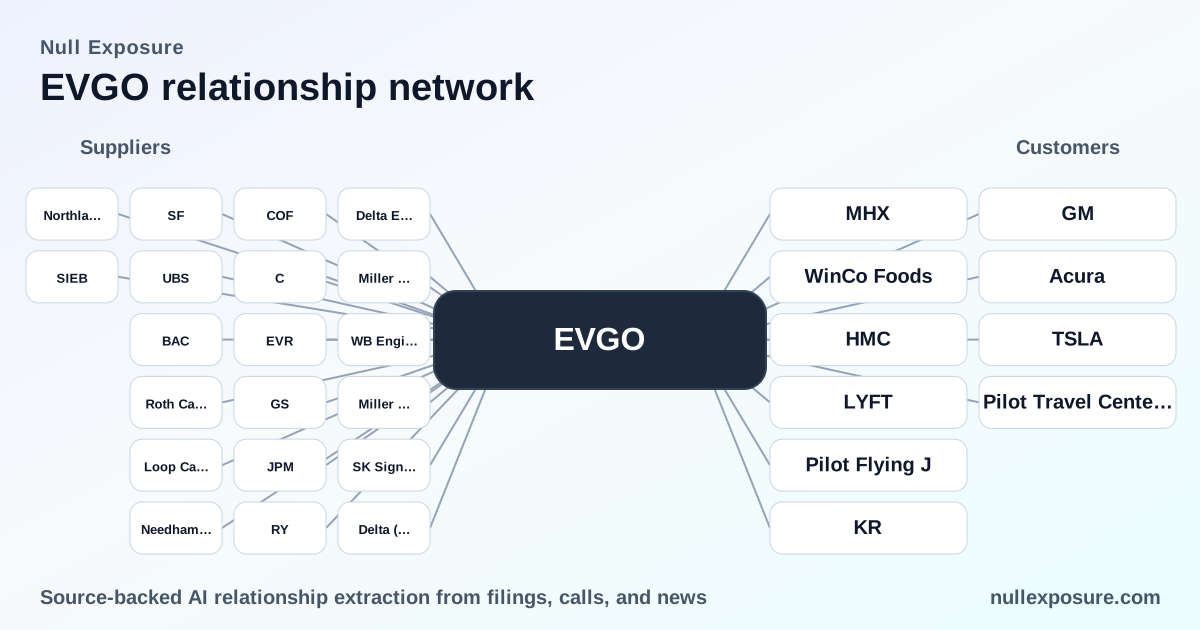
EVgo’s customer footprint: commercial partners, revenue model and investment implications
EVgo builds, owns and operates fast public EV charging stations across the United States and monetizes primarily by selling electricity and commercial charging services to drivers and B2B partners under a mix of subscription and usage‑based pricing. The company pairs station deployment with retailer and automaker partnerships to drive site flow and recurring revenue, while retaining direct retail sales to drivers as its core service. For more contextual intelligence on counterparties and commercial concentration, visit https://nullexposure.com/.
How EVgo actually makes money — the operating model, in plain terms
EVgo’s revenue model is straightforward: it sells charging sessions to drivers and signs commercial site-hosting and network agreements with retailers, fleets and automakers. Pricing is a blend of pay‑as‑you‑go transactions and subscription plans for heavy users; this mixed contracting posture gives EVgo both transactional upside and recurring revenue stability. The business is U.S.-centric, relying on partnerships with real estate hosts and brand-name automakers to scale customer access and utilization. At the same time, customer concentration is material — historically one customer has accounted for a third to nearly half of revenue — which concentrates counterparty risk despite a broad partner roster.
Key operational characteristics investors should note:
- Contracting posture: Mixed subscription and usage‑based pricing supports both volume growth and recurring cash flow.
- Concentration: High single‑customer concentration is a structural risk that elevates counterparty exposure.
- Criticality: EVgo is a seller of electricity and a service provider (fast charging infrastructure), making it operationally critical to retail hosts, fleets and EV OEMs that depend on public charging.
- Maturity and scale: The network is scaling rapidly (hundreds of stalls added in recent quarters), but the company still operates at negative EBITDA and negative EPS, which makes execution on utilization and margin expansion the primary value driver.
What the partner list signals to an investor
The relationships cataloged in public reporting and press show EVgo executing a retail+OEM+fleet strategy: anchor host sites (grocers, travel centers), OEM roaming and branded access deals, and targeted fleet and rideshare programs to drive repeat charging demand. Strategic OEM agreements and retail rollouts accelerate network utility; retail hosts provide real estate and foot traffic; fleet and rideshare deals deliver predictable usage. The tradeoff is execution complexity and continuing capital needs to fund stall buildouts while improving utilization and reducing per‑stall costs.
Explore more partner-level intelligence at https://nullexposure.com/ if you want a tailored partner risk map.
Relationship-by-relationship: what the sources show
Below I list every relationship from the source set with a concise note and the source reference.
-
MHX — EVgo will deploy fast chargers at MHX’s Fontana, California site to support 10 electric trucks, indicating targeted fleet electrification support. Source: TruckingInfo report (first seen Mar 9, 2026): https://www.truckinginfo.com/news/mhx-begins-fleet-electrification-project
-
WinCo Foods — EVgo opened its first public fast charging station at a WinCo Foods store in North Las Vegas, reflecting the company’s push into grocery-hosted retail sites. Source: PerishableNews press release (Mar 2026): https://perishablenews.com/retailfoodservice/winco-foods-partners-with-evgo-to-open-first-evgo-fast-charging-station-at-north-las-vegas-store/
-
American Honda Motor Co., Inc. — EVgo reached an agreement enabling Honda and Acura EV customers to access EVgo’s network (and partners) through integrated roaming, expanding OEM channel distribution for EVgo’s chargers. Source: American Honda/Acura press release (FY2023): https://acuranews.com/en-US/releases/release-cc39196e84787a20ec3cb086fb215129-honda-and-acura-electric-vehicles-will-have-access-to-largest-ev-charging-networks-in-north-america-aided-by-new-agreements-with-evgo-and-electrify-america
-
HMC — Duplicate mention of the Honda/Acura agreement described above; the same press release confirms single-app access for Honda and Acura EV owners to EVgo’s fast chargers. Source: Acura/Honda release (FY2023): https://acuranews.com/en-US/releases/release-cc39196e84787a20ec3cb086fb215129-honda-and-acura-electric-vehicles-will-have-access-to-largest-ev-charging-networks-in-north-america-aided-by-new-agreements-with-evgo-and-electrify-america
-
General Motors — EVgo reports installing 2,850 charger stalls under its agreement with GM, with many designated as higher‑spec “Flagship Stalls,” underlining a deep OEM-backed deployment program. Source: TradingView write‑up referencing EVgo SEC 10‑Q (FY2025): https://www.tradingview.com/news/tradingview:18041e5bc5d25:0-evgo-inc-sec-10-q-report/
-
Pilot Flying J — EVgo’s revenue growth has been attributed in part to execution of the EVgo eXtend contract with Pilot Flying J, a branded travel center rollout tied to GM partnership efforts. Source: Los Angeles Business Journal coverage (FY2023): https://labusinessjournal.com/finance/stocks/evgo-stock-price-drops-more-than-50-in-a-year/
-
Lyft — EVgo launched a charging discount program for Lyft rideshare drivers, targeting high‑frequency users to drive utilization and recurring charging volume. Source: Business Wire via FinancialContent (Dec 2022 press release): https://markets.financialcontent.com/wapakdailynews/article/bizwire-2022-12-13-evgo-and-lyft-launch-new-partnership-to-accelerate-rideshare-electrification-nationwide
-
LYFT — Duplicate listing of the Lyft rideshare discount program; the program is intended to accelerate electrification of rideshare by reducing charging costs for drivers. Source: Business Wire/FinancialContent (Dec 2022): https://markets.financialcontent.com/wapakdailynews/article/bizwire-2022-12-13-evgo-and-lyft-launch-new-partnership-to-accelerate-rideshare-electrification-nationwide
-
KR — EVgo added over 500 DC fast charging stalls in the quarter and is targeting expansion into local retailers including Kroger in 2026, signaling grocery chain rollouts as a strategic distribution channel. Source: GlobeNewswire / Globe and Mail coverage of FY2025 results (reported Mar 2026): https://www.theglobeandmail.com/investing/markets/markets-news/GlobeNewswire/530127/evgo-inc-reports-record-fourth-quarter-and-full-year-2025-results/
-
Kroger — Same as above: Kroger is highlighted as a target retail partner for EVgo’s planned expansions, underlining grocery-hosted charging as a growth vector. Source: GlobeNewswire / Globe and Mail (FY2026 commentary originating from FY2025 results): https://www.theglobeandmail.com/investing/markets/markets-news/GlobeNewswire/530127/evgo-inc-reports-record-fourth-quarter-and-full-year-2025-results/
-
Acura — The Honda/Acura agreement gives Acura owners single‑app access to EVgo chargers, expanding OEM-integrated user experience and lowering friction for charger use. Source: Acura/Honda press release (FY2023): https://acuranews.com/en-US/releases/release-cc39196e84787a20ec3cb086fb215129-honda-and-acura-electric-vehicles-will-have-access-to-largest-ev-charging-networks-in-north-america-aided-by-new-agreements-with-evgo-and-electrify-america
-
Kroger (duplicate) — Another report reiterates Kroger as a focal retailer in EVgo’s 2026 expansion plans following a quarter in which EVgo added more than 500 DC fast chargers. Source: ManilaTimes syndicated GlobeNewswire (Mar 3, 2026): https://www.manilatimes.net/2026/03/03/tmt-newswire/globenewswire/evgo-inc-reports-record-fourth-quarter-and-full-year-2025-results/2292071/amp
-
Tesla — EVgo is activating Autocharge+ at NACS locations so eligible Tesla vehicles (and other NACS-equipped EVs) can start charging automatically without adapters, improving convenience for Tesla drivers. Source: SahmCapital coverage of NACS rollouts (Jan 27, 2026): https://www.sahmcapital.com/news/content/evgo-races-ahead-on-nacs-with-nearly-100-stalls-live-today-hundreds-more-coming-in-2026-2026-01-27
-
TSLA — Duplicate mention reflecting the Tesla/Autocharge+ capability for NACS vehicles enrolling through the EVgo app, enabling adapter-free sessions at NACS sites. Source: SahmCapital (FY2026 NACS reporting): https://www.sahmcapital.com/news/content/evgo-races-ahead-on-nacs-with-nearly-100-stalls-live-today-hundreds-more-coming-in-2026-2026-01-27
-
Pilot Travel Centers — EVgo aims to build and operate up to 2,000 stalls with Pilot under its expansion program, highlighting service deployment in long-distance travel corridors. Source: TradingView report referencing EVgo SEC disclosures (FY2025): https://www.tradingview.com/news/tradingview:18041e5bc5d25:0-evgo-inc-sec-10-q-report/
-
Tesla (compatibility note) — EVgo’s Autocharge expansion to more than 50 EV models includes Tesla models compatible via the CCS Combo 1 adapter, increasing the addressable vehicle base for EVgo stations. Source: AIJournal coverage of model compatibility (FY2024): https://aijourn.com/evgo-expands-autocharge-to-more-than-50-electric-vehicle-models/
-
TSLA (duplicate) — Reiteration that Tesla models with CCS compatibility can use EVgo’s Autocharge feature, extending convenience to a broader set of Tesla owners. Source: AIJournal (FY2024): https://aijourn.com/evgo-expands-autocharge-to-more-than-50-electric-vehicle-models/
Investment implications and risk checklist
- Growth levers: OEM roaming deals (GM, Honda/Acura) and large host builds (Pilot, Kroger, WinCo) accelerate stall count and addressable sessions; rideshare and fleet programs (Lyft, MHX) bring predictable repeat usage.
- Margin and execution risk: EVgo runs negative EBITDA and faces the capital intensity of site builds; utilization improvement and commercial pricing will determine path to profitability.
- Counterparty concentration: One large customer historically represented ~33–45% of revenue — a material concentration risk that investors must monitor.
- Geographic exposure: Revenue is concentrated in North America/United States, which simplifies regulation exposure but increases sensitivity to U.S. EV adoption cycles and infrastructure policy.
Bottom line
EVgo is executing a retail + OEM + fleet playbook: expand stall count via host partnerships, enable OEM-integrated access to boost demand, and capture recurring revenue through subscriptions and usage fees. The model offers scalable demand levers, but execution, utilization and customer concentration are the critical variables for valuation recovery. For a structured partner risk report and counterparty scoring, visit https://nullexposure.com/ to request a tailored briefing.