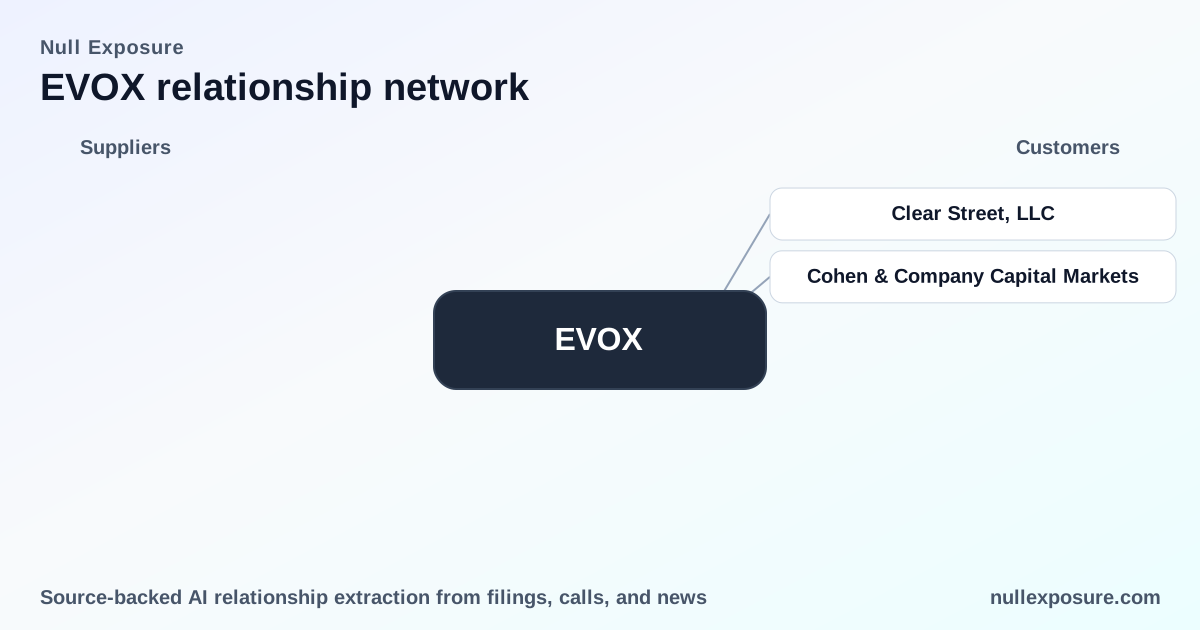
EVOX: A Sponsor-Led SPAC with Transactional Counterparty Relationships
Evolution Global Acquisition Corp (EVOX) is a special-purpose acquisition vehicle that raises capital through a units offering and private placement, holding cash in trust while seeking a business combination; its monetization is primarily transaction-driven (IPO proceeds, sponsor economics, and warrant economics) rather than operating revenue. The company carries a roughly $320 million market capitalization, no reported revenue or EBITDA, and a sponsor/underwriter-driven capital structure that concentrates economic leverage in a few counterparties. For deeper coverage of issuer-counterparty mapping and exposure scoring, visit NullExposure.
The short investor thesis: how EVOX creates — and concentrates — value
EVOX is a classic SPAC: it monetizes through the public offering and related private placements, and its value realization depends on completing a target acquisition or liquidation. Key value drivers are the composition of the sponsor, the distribution and exercise profile of warrants, and access to retail and institutional brokerage channels that determine secondary liquidity. Institutional ownership is meaningful (reported ~70.7% institutional), but the company reports no operating revenues, so execution of a business combination is the sole path to material equity upside.
How to read EVOX’s counterparty footprint
EVOX’s disclosed counterparties to date are transactional and concentrated around warrant purchasers and distribution channels. These relationships are important for execution of the IPO and for secondary trading liquidity, but they are not long-term operating suppliers in the traditional sense. The company’s public disclosures for FY2025–FY2026 show warrant placements to sponsor and intermediaries and routine availability of shares through major brokerages.
- Contracting posture: Sponsor-led and transactional; parties typically engage via underwriting agreements and private placement terms rather than lasting supply contracts.
- Concentration: High concentration risk around a small set of intermediaries and sponsor economics; a failed IPO or inability to place warrants could impair capital structure.
- Criticality: Counterparties are critical for liquidity and deal completion but not operational continuity prior to a merger.
- Maturity: The relationship stack is immature in the recurring revenue sense — value depends on successful deal execution.
For a concise counterparty-risk scorecard and other issuer analyses, see NullExposure.
Counterparty breakdown: the named relationships and what they mean for investors
Clear Street, LLC
Clear Street participated as a purchaser in the IPO private placement, acquiring a portion of the warrants sold alongside the offering; this positions Clear Street as a financial counterparty with direct exposure to EVOX’s warrant economics. According to an Investing.com SEC filing summary dated March 9, 2026, 2.4 million warrants were allocated to Cohen & Company Capital Markets and Clear Street, LLC in the transaction report. (Investing.com, March 9, 2026)
Cohen & Company Capital Markets (division of Cohen & Company Securities, LLC)
Cohen & Company Capital Markets also received warrant allocations in the EVOX offering, reflecting participation by boutique capital markets desks in the private placement tranche; this is a placement-level relationship rather than an ongoing operational supplier. Investing.com’s SEC filing summary from March 9, 2026 documents 2.4 million warrants sold to Cohen & Company Capital Markets alongside sponsor warrant placements. (Investing.com, March 9, 2026)
Charles Schwab
Charles Schwab is listed among popular brokerages through which EVOX shares trade, representing a distribution and retail-access channel rather than a strategic operating partner; Schwab’s listing supports secondary market liquidity for shareholders. MarketBeat’s company summary for EVOX, updated May 2, 2026, explicitly names Charles Schwab as a common retail execution venue for EVOX stock purchases. (MarketBeat, May 2, 2026)
E*TRADE
ETRADE likewise functions as a retail brokerage channel for EVOX shares, enabling investor access and secondary-market turnover; availability on major platforms reduces liquidity friction for retail holders. MarketBeat’s EVOX profile (May 2, 2026) includes ETRADE among the common brokerages used for trading EVOX. (MarketBeat, May 2, 2026)
Fidelity
Fidelity appears in public market references as a standard brokerage venue for EVOX equity, supporting retail and high-net-worth trade flow and thereby contributing to the practical tradability of EVOX post-IPO. MarketBeat’s May 2, 2026 summary lists Fidelity among popular platforms for buying EVOX. (MarketBeat, May 2, 2026)
Vanguard Brokerage Services
Vanguard Brokerage Services rounds out the major retail channels named in public commentary; presence on Vanguard’s platform is a liquidity-enabling feature for index and buy-and-hold investors who execute through that broker. MarketBeat’s EVOX company page (May 2, 2026) includes Vanguard Brokerage Services as a typical execution venue. (MarketBeat, May 2, 2026)
What the counterparty map implies for value and risk
- Warrant placements indicate sponsor economics are already in play. The allocation of sizeable warrant tranches to sponsor and intermediaries concentrates optionality and potential dilution into pockets tied to sponsor and placement terms (Investing.com, March 2026).
- Retail broker distribution reduces friction for secondary market liquidity. Availability across Charles Schwab, E*TRADE, Fidelity, and Vanguard sustains tradability and supports price discovery after listing (MarketBeat, May 2026).
- Execution is binary for investors. EVOX’s upside is contingent on finding a suitable business combination; until that event, counterparties maintain transactional roles rather than contributing recurring cash flows.
Constraints and company-level signals
The provided data set included no explicit contractual constraints or embargoed clauses. As a company-level signal, the absence of constraint disclosures corresponds to a standard SPAC operating posture: capital held in trust, limited long-term supplier commitments, and concentrated economic relationships centered on sponsors and placement agents. This structure produces high event-risk sensitivity (merger outcome) and low operational counterparty risk in the pre-combination period.
Investment implications: concise takeaways
- Event-driven thesis: Equity value depends entirely on securing and executing a business combination; sponsor and warrant-holder dynamics will shape dilution outcomes.
- Concentration risk: Warrant allocations to a small set of counterparties concentrate economic leverage and could influence shareholder voting or post-combination capital structure.
- Liquidity profile: Broad retail brokerage availability supports trading liquidity but does not change the fundamentally transactional nature of the company.
- Due diligence focus: Investors should prioritize the terms of the warrant placements, sponsor roll, and the announced or rumored target (if any) because these elements determine post-merger capitalization.
For a practical counterparty exposure report and ongoing monitoring of EVOX’s transaction counterparties, explore the issuer coverage tools available at NullExposure.