Evergy (EVRG): Hyperscaler load is reshaping a regulated utility's growth profile
Evergy is an investor-owned regulated electric utility serving roughly 1.7 million customers across Kansas and Missouri. The company monetizes through tariffed retail sales to residential, commercial and industrial customers, large bilateral electric service agreements (ESAs) with high-load industrial and data center customers, and cost recovery through rate cases and transmission filings that convert capital spending into regulated revenue. For investors, the key dynamic is how outsized load additions from hyperscalers and advanced manufacturing translate into sustained revenue growth, incremental capital spending and regulatory outcomes that reset the utility’s allowed returns and rates. Learn more at https://nullexposure.com/.
Why the recent headlines matter: 1.9 GW of service contracts and concentrated load growth
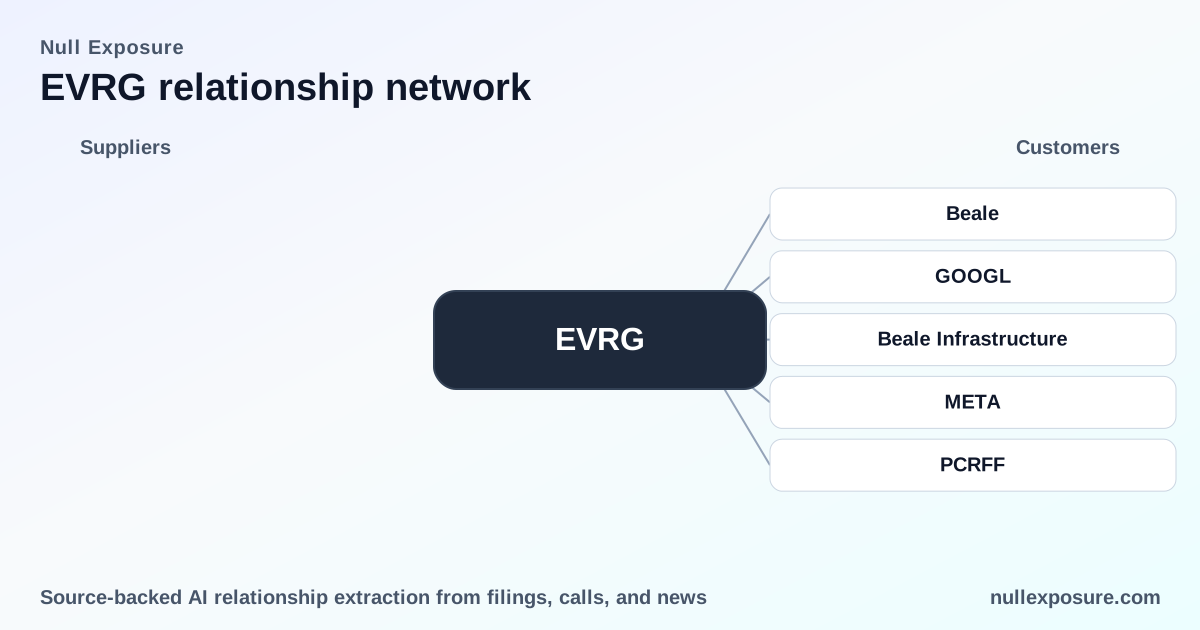
Evergy disclosed new electric service contracts totaling 1.9 GW with Google, Meta and Beale Infrastructure in early 2026, and executives indicated at least one additional contract was expected within the year. Utility Dive reported the aggregate sizing and Evergy’s public remarks on the deals in March 2026, and the company reiterated the same characterization on its Q4 2025 earnings call. This scale of contracted load is material for a utility of Evergy’s footprint and will drive near-term capital deployment and long-term rate base growth.
Company-level operating signals and constraints investors should weight
- Contracting posture: The company operates a hybrid commercial model—retail customers are billed on usage-based, tariffed rates, while the utility negotiates bespoke ESAs with large industrial and data-center customers; those ESAs drive materially different cash-flow and credit dynamics than retail tariffs.
- Counterparty mix and concentration: Evergy’s customer base includes retail, commercial, industrial, municipal and other utilities. Recent disclosures highlight a small number of very large counterparties (hyperscalers and advanced manufacturers) that are driving a significant share of incremental load.
- Geographic and regulatory context: Operations are consolidated across Kansas and Missouri; regulatory filings (rate cases, TFR adjustments) and state commissions are the mechanism by which the company converts capital spending into revenue.
- Contract tenure and cash mechanics: The company references short-term collateralized sales in some places, indicating varied contract tenors and occasional secured-borrowing accounting treatments for certain sales.
- Spend scale and impact on rate base: Public disclosures show multiple revenue adjustments in the $10m–$100m band and several >$100m items, implying sustained capital and rate-base growth that will be determinative for valuation.
If you want a broader view of Evergy’s customer dynamics and how concentrated load additions are priced into the market, visit https://nullexposure.com/ for additional research.
How each reported relationship is described in primary sources
Beale (earnings call, 2025Q4)
Executives on the 2025 Q4 earnings call credited Beale along with Google and Meta as part of the “world-class customers” whose commitments are making Missouri and Kansas premier data-center locations. The remarks were captured in the company’s Q4 2025 earnings call transcript in March 2026.
Google (Utility Dive report, FY2026)
Utility Dive reported that Evergy signed electric service contracts totaling 1.9 GW that include Google, with company officials saying at least one more contract was expected in 2026. The article summarized company comments about capital spending tied to these hyperscaler contracts (Utility Dive, March 2026).
GOOGL (Utility Dive report, FY2026)
The same Utility Dive coverage identifies Google by ticker and repeats the 1.9 GW aggregate signing across Google, Meta and Beale Infrastructure; Evergy executives framed the wins as multi-customer capacity commitments (Utility Dive, March 2026).
Meta (Utility Dive report, FY2026)
Utility Dive lists Meta as a counterparty to the ESAs contributing to the 1.9 GW total and described Evergy’s characterization of these agreements as catalysts for increased capital spending (Utility Dive, March 2026).
Beale Infrastructure (Utility Dive report, FY2026)
Utility Dive explicitly named Beale Infrastructure as one of the contracting parties in Evergy’s 1.9 GW announcement, noting that the deals are expected to drive near-term investment (Utility Dive, March 2026).
META (InsiderMonkey coverage of earnings call, FY2026)
An earnings-call transcript republished by InsiderMonkey quoted management describing an expansion with Meta as part of the recent ESA activity, confirming Meta’s role in incremental load growth (InsiderMonkey, March 2026).
Beale Infrastructure (InsiderMonkey coverage, FY2026)
InsiderMonkey’s transcript coverage repeats Evergy management’s statement that Beale Infrastructure (a Blue Owl-affiliated company) was part of the new agreements, describing it as a distinct counterparty in the portfolio of ESA customers (InsiderMonkey, March 2026).
GOOGL (InsiderMonkey coverage, FY2026)
InsiderMonkey noted that Evergy reached agreements with Google for two projects—one new build and one expansion—underscoring Google’s multi-site presence in Evergy territory (InsiderMonkey, March 2026).
Google (earnings call, 2025Q4)
On the Q4 2025 earnings call, management again emphasized Google as a cornerstone customer among the ESA commitments that are reshaping the company’s service territories (Q4 2025 earnings-call transcript, March 2026).
Meta (earnings call, 2025Q4)
Evergy’s Q4 2025 earnings call highlighted Meta alongside Google and Beale as evidence that Missouri and Kansas are attracting large data-center tenants, reinforcing the operational importance of these relationships (Q4 2025 earnings-call transcript, March 2026).
GOOGL (earnings call, 2025Q4)
The Q4 2025 call specifically referenced Google in the context of the new ESA commitments that underlie the company’s revised capital plan and regional positioning (Q4 2025 earnings-call transcript, March 2026).
PCRFF (InsiderMonkey coverage, FY2026)
InsiderMonkey’s transcript notes that exceptional load growth is driven in part by the ramp of the Panasonic advanced manufacturing facility; PCRFF is listed as the inferred ticker for the Panasonic entity referenced in the call (InsiderMonkey, March 2026).
PCRFF (Utility Dive report, FY2026)
Utility Dive separately reported that Evergy sells power to Panasonic Energy’s De Soto, Kansas lithium-ion battery plant and that this facility continues to ramp, contributing to material load growth (Utility Dive, March 2026).
Panasonic (InsiderMonkey coverage, FY2026)
InsiderMonkey’s coverage reiterated that Panasonic’s advanced manufacturing facility is a primary driver of exceptional load growth in Evergy’s territory, alongside hyperscaler data centers (InsiderMonkey, March 2026).
Panasonic (Utility Dive report, FY2026)
Utility Dive described Evergy’s commercial relationship as a supplier to Panasonic Energy’s EV battery factory in De Soto, Kan., noting the plant’s continued ramp and its contribution to increased electricity sales (Utility Dive, March 2026).
Investment implications: what to watch and why it matters
- Growth catalyst: The hyperscaler and Panasonic load ramps create a clear organic growth runway for Evergy’s rate base and retail revenues; these customers convert to durable earnings when regulators approve cost recovery.
- Capital intensity and regulatory path: Expect elevated capex and a multi-year cycle of rate cases/TFR adjustments that will drive spending but also offer recovery mechanisms—valuation depends on the regulatory outcomes and allowed ROE.
- Concentration risk: A small number of large counterparties materially influence load growth and capital plans; investors should price counterparty concentration into scenario analyses.
- Cash-flow character: The coexistence of usage-based tariffs and bespoke ESAs produces a mix of predictable tariff receipts and negotiated commercial terms that affect billing, collateral arrangements and near-term working capital.
Bottom line: Evergy’s recent ESA wins and the Panasonic ramp transform the company’s load profile and justify a higher growth multiple if regulators consistently permit recovery of incremental capital. Monitor rate-case filings, transmission revenue adjustments and the cadence of ESA signings for the clearest signals on earnings trajectory.
For deeper customer-mapping and ongoing monitoring of counterparties that move Evergy’s needle, visit https://nullexposure.com/.