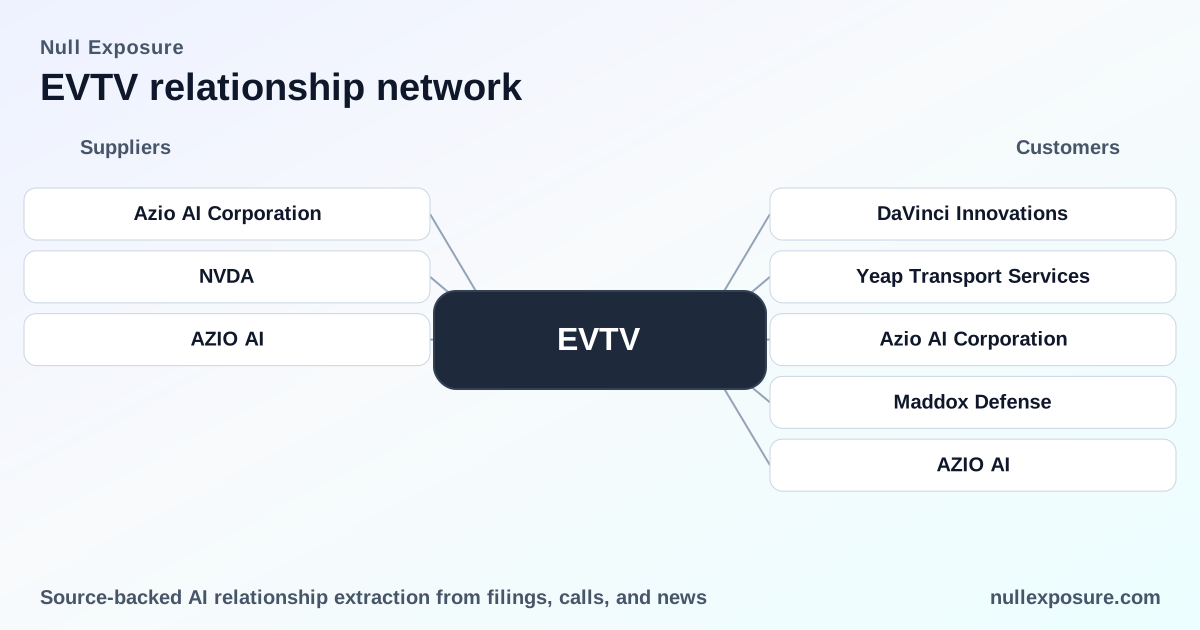
Envirotech Vehicles (EVTV): Customer Map and Commercial Signals for Investors
Envirotech Vehicles sells purpose-built zero-emission commercial vehicles and industrial drones and monetizes through hardware sales, aftermarket maintenance services, and confirmed customer deposits that convert to production orders. Revenue is highly concentrated, driven by a small set of large buyers and by strategic deposit-backed orders for its new heavy-capacity drone business. For deeper coverage and transaction-level tracking visit https://nullexposure.com/.
How Envirotech makes money and what that implies for risk/reward
Envirotech’s core revenue model is hardware-led: purpose-built electric light- to heavy-duty vehicles, complemented by vehicle maintenance and safety-inspection services. The company recognizes sales from new vehicles and service revenue from its service centers, and it also converts customer deposits for drone and vehicle programs into production revenue as certifications and manufacturing milestones are achieved. According to the FY2024 10‑K filing, the company reported a backlog of two Class 4 trucks and 42 Class 4 cargo vans as of December 31, 2024, indicating active, contract-backed demand in its fleet segment.
This operating posture produces several investor-relevant characteristics:
- Concentration risk is material. The company discloses that eight customers accounted for approximately all of its 2024 revenue, which creates customer-dependency dynamics that dominate credit and growth risk.
- Public-sector and fleet customers are central. Envirotech targets municipalities, school districts, and commercial fleets, reflecting a sales pipeline that relies on government procurement cycles and incentive programs rather than broad retail adoption.
- Geographic concentration in North America. Management has invested in a New Jersey service center to support its largest customer base in the New Jersey–New York–Philadelphia corridor, pointing to regional clustering of sales and after-sales exposure.
- Mixed maturity across product lines. Vehicle sales are ongoing with service revenue, while drone operations are moving from development into production after deposit receipts—this creates a hybrid revenue profile with near-term service/vehicle cash and nascent but higher‑leverage drone orders.
Customer relationship snapshots (documented sources)
DaVinci Innovations (10‑K, FY2024)
Envirotech disclosed an anticipated vehicle purchase arrangement with DaVinci Innovations that involved early-stage dealership activity, but there was no final binding purchase order received as of the FY2024 filing. This is recorded in the company’s FY2024 10‑K.
Yeap Transport Services (10‑K, FY2024)
Envirotech entered a right‑hand drive electric school bus development initiative with Yeap Transport Services, a Southeast Asia–based transportation provider, positioning the company for overseas engineering and localized product variants. This engagement is noted in the FY2024 10‑K.
Venture Air Solutions Inc. (Galesburg press release, May 2026)
A May 2026 press announcement referencing confirmed deposits states that Venture Air Solutions (Opa‑Locka, Florida) placed deposits for 80 heavy‑capacity drones, supporting AG Drone Inc.’s move into production and certification. The report explicitly cites confirmed deposits from Venture Air Solutions.
Studio di Agronomia Baffetti (Galesburg press release, May 2026)
The same May 2026 announcement reported confirmed deposits from Studio di Agronomia Baffetti (Siena, Italy) for 80 heavy‑capacity drones, signaling international demand for Envirotech’s drone product line as it advances certification. The Galesburg release lists Studio Baffetti among depositors.
Studio di Agronomia Baffetti (Coloradoan press release, May 2026)
An alternate press release carried by the Coloradoan in May 2026 reiterates that Studio di Agronomia Baffetti confirmed deposits for 80 heavy‑capacity drones as AG Drone Inc. advances production and civil aviation certification. The Coloradoan item confirms the same deposit detail.
Venture Air Solutions Inc. (Coloradoan press release, May 2026)
The Coloradoan coverage of the May 2026 announcement also lists Venture Air Solutions as a confirmed depositor for the heavy‑capacity drone program, reinforcing the press narrative of two institutional customers underwriting production entry.
Azio AI Corporation (Intellectia, March 2026)
Intellectia reported that Envirotech secured a first purchase order from Azio AI Corporation for twenty‑eight next‑generation ASIC compute systems, indicating the company is selling compute racks/systems to non‑automotive customers as part of infrastructure validation work. The Intellectia item dated March 2026 describes this purchase order.
Maddox Defense (Intellectia, March 2026)
Intellectia’s March 2026 coverage notes that Envirotech’s medical supplies segment consists solely of sales to Maddox Defense, a related party, under a cost‑plus agreement to supply refurbished medical gowns—an atypical revenue line outside core vehicle and drone operations. This was referenced in the same March 2026 report.
AZIO AI (StocksToTrade, March 2026)
A March 2026 StocksToTrade article reported market reaction to an order attributed to AZIO AI for 256 Nvidia GPUs and quoted expectations for substantial added revenue (the article cited an expectation of $107M in added revenue), which drove a sharp share price move. That article frames investor sentiment around the AZIO AI headline order.
What these relationships say about commercial strategy and execution
- Dual play: fleet vehicles + industrial drones. Customer deposits from Venture Air Solutions and Studio Baffetti signal that Envirotech is converting drone R&D into funded production, shifting the company from concept to manufacturable output. The company documents deposits for 160 drones across two named customers in press coverage dated May 2026.
- Non-core revenue lines exist. The Maddox Defense related-party transactions for medical gowns and the Azio/AZIO reported compute orders reflect one-off or opportunistic revenue that inflate top-line variability and complicate revenue quality analysis.
- Sales concentration is a dominant risk factor. The FY2024 disclosure that eight customers comprised nearly all revenue is an explicit materiality flag that constrains valuation multiples and increases downside if any single large customer pauses orders.
Strategic risks and what investors should monitor
- Customer concentration and counterparty exposure are primary risks; any slowdown by top customers will produce outsized revenue volatility given the small buyer base.
- Execution on drone certification and delivery timelines is critical. The commercial case for the drone business depends on FAA/ENAC certification and timely fulfillment of deposit-backed orders.
- Geographic concentration in the Northeast U.S. creates localized service and incentive dependencies, while select international partners introduce export and regulatory execution risk.
- Revenue quality is mixed; vehicle and service contracts underpin recurring revenue, but related-party and compute/systems transactions introduce non-recurring elements that investors should separate when modeling sustainability.
Bottom line — what investors should do next
Envirotech is a small‑cap, high‑concentration manufacturer transitioning into higher‑margin drone production while still reliant on a handful of fleet buyers and opportunistic non‑core sales. Monitor the conversion of deposits into firm production orders, certification milestones for AG Drone Inc., and the composition of the top eight customers in quarterly disclosures. For ongoing tracking of customer-level developments and deposit conversions, see additional coverage at https://nullexposure.com/.
Key interim triggers for re‑rating: confirmation of binding purchase orders from major depositors, transparent separation of core vehicle revenue from one‑off related‑party sales, and steady service‑center utilization in the New Jersey corridor.