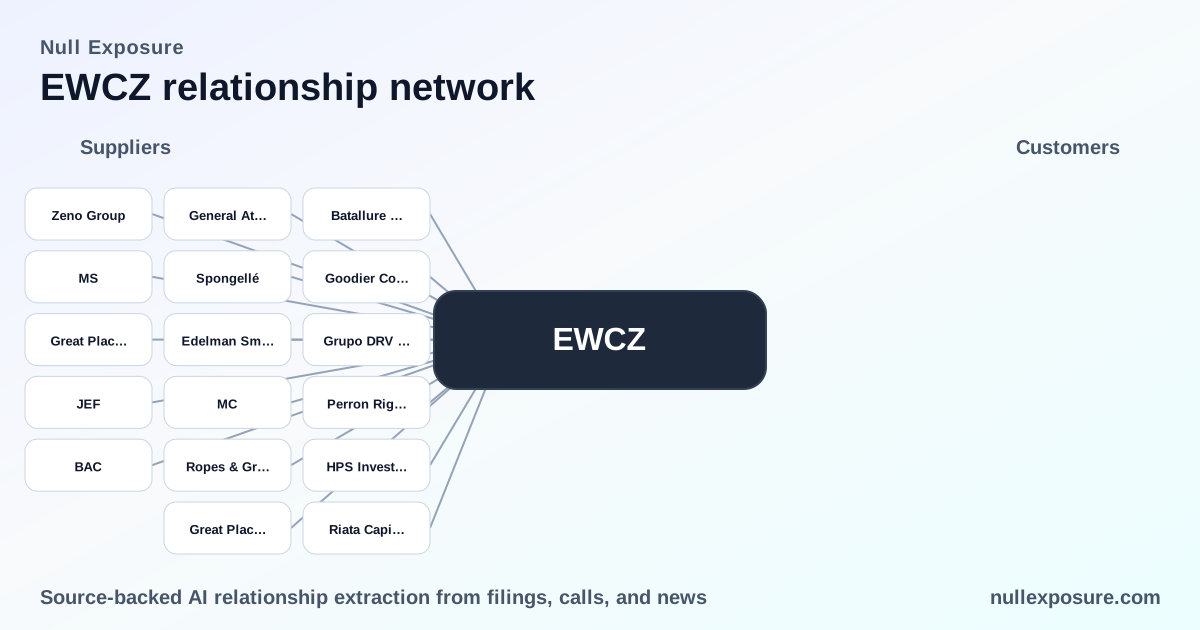
European Wax Center (EWCZ): Asset-light franchising, product-led revenue, and a General Atlantic exit
European Wax Center operates as an asset-light franchisor that monetizes through upfront franchise license fees, recurring usage-based royalties and marketing fees, and the sale of branded waxing products to its franchise network. Its cash flow profile is dominated by product distribution and percentage-of-sales royalties from more than 1,000 U.S. centers, and the company’s recent agreement to be acquired by General Atlantic crystallizes full control of those recurring revenue streams. For a mapped view of counterparty relationships and primary commercial flows, visit https://nullexposure.com/.
Quick investor thesis: predictable revenue, concentrated commercial logic
European Wax Center delivers recurring and predictable revenue through three principal channels: product sales ($121.5M in the latest reporting period), franchise royalties ($53.1M), and marketing fund contributions ($30.2M), all of which together produced roughly $206.6M in trailing revenue. The business is capital-efficient because franchisees operate nearly all centers (99%), while the company retains the high-margin role of licensor, distributor, and brand operator. Investors should treat the business as a royalty-and-distribution system rather than a traditional retail operator.
How the franchise economics actually work — terms, timing, and cash mechanics
The company’s contracting posture is long-dated and recurring: franchise agreements are generally ten-year licenses, with initial franchise fees amortized over the term and royalties paid weekly as a fixed percentage of gross sales (6.0%) plus a marketing contribution (3.0%). Franchisees are the front-line revenue generators and also the primary product customers — European Wax Center is both licensor and vendor to its network. The U.S.-only footprint (1,067 centers across 45 states and DC as of January 4, 2025) concentrates country risk but simplifies distribution and brand consistency.
- Contract type and revenue cadence: licensing arrangements with usage-based royalties and marketing fees create recurring cash flow that scales with same-store sales.
- Counterparty profile: many franchisees are individual operators with multi-year experience; this yields decentralized operational risk but increases sensitivity to local labor and consumer conditions.
- Scale and spend scope: the company reported product sales exceeding $120M, placing aggregate franchise-derived revenue squarely in a high spend band.
For a deeper relationship map and customer-level analytics, see https://nullexposure.com/.
Operational signals and constraints investors should model
Treat the constraints in aggregate as company-level signals that define risk, concentration, and maturity:
- Maturity and durability: the business model is mature — long franchise terms and a large installed base drive durable cash flow and high unit-level economics (mature centers deliver strong cash-on-cash returns).
- Counterparty concentration: no single customer accounted for more than 10% of revenue, so counterparty concentration is low at the account level, but the franchise network collectively is the critical revenue source.
- Revenue composition risk: while no individual franchisee is material, product sales and royalties together represent the majority of revenue, so operational disruptions to product distribution or major declines in franchise sales would be material.
- Geographic concentration: operations and assets are U.S.-centric; macro and consumer trends in the U.S. directly drive the top line.
- Contracting posture: long-term license arrangements with standardized terms (10-year terms, renewal options) favor predictability but require continued support services and brand management from the corporate center.
Modeling implications: prioritize scenarios that stress franchise same-store sales and product purchase rates, and include a discrete outcome for the planned take-private transaction.
Every identified customer/transaction relationship in the record
The results in the provided set all reference a single, material corporate event: General Atlantic’s acquisition of European Wax Center. Below are the individual items found in the record, each summarized with its source.
AccessWire — definitive agreement and deal valuation
European Wax Center announced it had entered into a definitive agreement to be taken private by General Atlantic in an all-cash transaction with an implied equity value of approximately $330 million, a corporate action that resolves public-market liquidity for shareholders. (AccessWire, reported May 2, 2026: https://www.accessnewswire.com/newsroom/en/business-and-professional-services/bronstein-gewirtz-and-grossman-llc-encourages-european-wax-cente-1137620)
PR Newswire — shareholder investigation into deal fairness
A shareholder law firm, Levi & Korsinsky, LLP, has commenced an investigation into the fairness of General Atlantic’s acquisition of European Wax Center, signaling potential legal friction around process and valuation that could affect timing or consideration. (PR Newswire, reported May 2, 2026: https://www.prnewswire.com/news-releases/shareholder-alert-levi--korsinsky-llp-notifies-stockholders-of-an-investigation-into-the-fairness-of-the-acquisition-of-european-wax-center-inc-302713627.html)
Sahm Capital — per-share cash consideration cited
Market commentary and investor alerts described the per-share deal consideration as $5.80 in cash, which is the working figure investors should use when reconciling market reaction and deal valuation metrics. (Sahm Capital blog, April 6, 2026: https://www.sahmcapital.com/news/content/are-ewcz-stel-rlyb-ctra-obtaining-fair-deals-for-their-shareholders-2026-04-06)
IndexBox — market reaction and trading behavior
Financial news coverage observed that shares surged on the acquisition announcement, reflecting immediate market repricing to the offered cash consideration and the reduced public float post-transaction. (IndexBox analysis, May 2026: https://www.indexbox.io/blog/european-wax-center-acquired-by-general-atlantic-in-330-million-deal/)
What investors should do with this information
- Reprice liquidity and take-private risk: with General Atlantic’s $330M implied equity purchase, public comparables and investor returns should be adjusted for a likely de-listing event.
- Model the core cash engines: build base and stress cases around franchise same-store sales and product purchase volumes, which together account for the majority of revenue.
- Incorporate legal/timing risk: the Levi & Korsinsky investigation introduces a near-term procedural risk that could delay closing or affect the ultimate consideration. Monitor filings and proxy materials closely.
- Focus on operational leverage: given the asset-light model, upside derives from growth in center openings, product penetration, and improved per-center sales rather than capital investment.
Bold takeaway: EWCZ is a franchisor whose primary value lies in recurring royalties and product distribution to an established U.S. network; General Atlantic’s acquisition consolidates those cash flows under private ownership while introducing short-term legal and timing risks.
For a complete map of counterparties, contract types, and the downstream implications for suppliers and partners, explore the full relationship profile at https://nullexposure.com/.