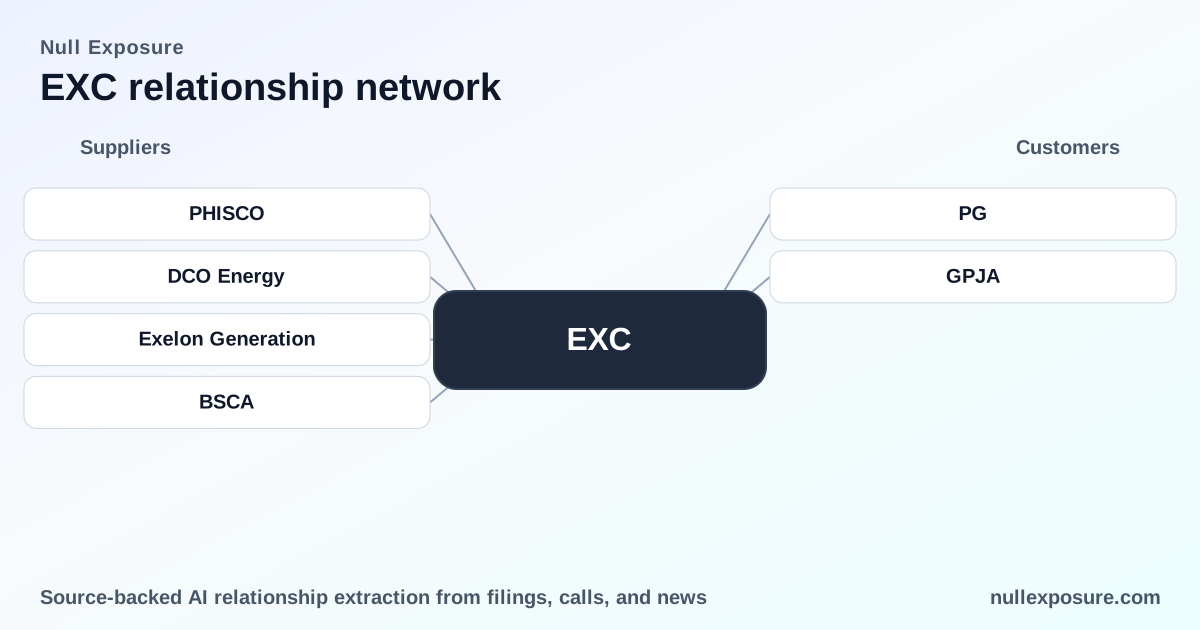
Exelon’s customer footprint: regulated cash flows, usage-based delivery, and a distributed counterparty mix
Exelon is a regulated utilities holding company that monetizes through electricity and natural gas delivery, distribution, and regulated tariff services across its six segments (ComEd, PECO, BGE, Pepco, DPL and ACE). The company generates predictable cash flow from regulated tariffs and transmission/distribution fees while operating generation and energy services that settle on delivered volumes; Exelon’s FY2025 figures show a substantial revenue base (roughly $24.3B TTM) and a market capitalization in the mid‑$40B range, underpinned by regulated earnings and recovery mechanisms. For a customer‑level mapping and commercial exposure analysis, see https://nullexposure.com/.
The operating model investors need to price
Exelon’s customer relationships reflect a regulated, usage‑driven commercial posture rather than long bespoke contracts typical of large industrial suppliers. Several firm-level signals drive how investors should think about revenue stability and counterparty risk:
- Contracting posture: short‑term and volume-driven. Revenue recognition is tied to physical delivery of power and gas “over time” (daily delivery and tariff sales), so economic activity is directly correlated with consumption patterns and weather. This establishes predictable billing cycles but leaves volume exposure to demand fluctuations.
- Pricing mechanics: cost pass‑through and regulatory recovery. Distribution and transmission revenues are governed by state regulatory commissions; hedging and fuel‑cost programs are designed to stabilize volatility and are largely recovered via regulatory mechanisms, preserving margins in normal operating conditions.
- Counterparty mix: broad and diverse. Exelon serves residential, small business, large commercial & industrial, and government customers in North America. The business shows low customer concentration, with no single customer representing over 10% of Utility Registrants’ revenues as of year‑end 2025.
- Geographic concentration: North American regulated territories. Primary operations are in Northern Illinois, Southeastern Pennsylvania, Central Maryland, the District of Columbia, portions of Delaware and Southern New Jersey — a geographically concentrated but regulatory‑protected footprint.
- Role profile: seller and distributor with in‑house service functions. Exelon operates both as the regulated distribution/transmission utility and, through subsidiaries, as a service provider for back‑office functions; it is also a counterparty in forward financing transactions as a buyer of capital markets services.
- Maturity and criticality: stable, utility‑grade. The distribution segment is mature, rate‑regulated, and critical to local economies; service disruption risk is meaningful operationally but addressed through franchise obligations and regulated recovery for investments and costs.
Investment takeaway: Exelon is a regulated utility with low counterparty concentration, usage‑based revenue drivers, and regulatory levers that limit earnings downside in normal conditions, while exposing the company to rate case and regulatory timing risk.
Identified customer relationships in public reporting
Below are every customer relationship identified in the reviewed results, summarized in plain English with source attribution.
Procter & Gamble (PG)
Exelon’s related reporting references a Constellation Energy‑operated plant that supplies steam to Procter & Gamble’s Albany, GA paper manufacturing facility while exporting electricity to the local utility (Georgia Power), indicating a commercial arrangement where a third‑party generator provides combined steam and power services connected to P&G’s operations. Source: Constellation Energy press release describing the Albany, GA plant (2017), https://www.constellationenergy.com/news/2017/powered-by-partnership-procter-and-gamble-and-constellation-complete-50-megawatt-renewable-energy-plant.html.
The Procter & Gamble Company (PG) — duplicate entry
The record repeats the P&G relationship under the full corporate name, restating that the Constellation‑owned plant provides steam to P&G’s Albany, GA facility and generates electricity that flows to the local grid (Georgia Power). This is the same commercial linkage described above and confirms P&G as the industrial steam counterparty in that project. Source: Constellation Energy press release (2017), https://www.constellationenergy.com/news/2017/powered-by-partnership-procter-and-gamble-and-constellation-complete-50-megawatt-renewable-energy-plant.html.
Georgia Power
Georgia Power is identified as the local utility receiving electricity generated by the Constellation‑operated plant associated with P&G’s Albany, GA facility, demonstrating an upstream generation‑to‑grid flow where Exelon‑affiliated generation assets (via Constellation) sell or deliver power into the regional grid that Georgia Power operates. Source: Constellation Energy press release (2017), https://www.constellationenergy.com/news/2017/powered-by-partnership-procter-and-gamble-and-constellation-complete-50-megawatt-renewable-energy-plant.html.
How these relationships influence credit and commercial risk
The three flagged relationships do not change Exelon’s core commercial profile: they illustrate asset‑level generation and industrial offtake linkages rather than customer concentration risks on the utility side. The plant‑to‑P&G arrangement demonstrates Exelon’s (through affiliates) capability to participate in industrial energy solutions and to place generation into regional grids, but official constraints show that no single utility customer drives material revenue concentration. Regulatory cost‑recovery frameworks and tariff structures keep earnings largely tied to approved rates and volumes rather than bespoke long‑tenor commercial contracts.
Risk factors and operational constraints investors should price
- Rate‑case timing and regulatory decisions remain the primary earnings catalyst and risk; changes to approved tariffs affect cash flow trajectories more than isolated industrial contracts.
- Volume sensitivity to weather and economic activity influences short‑term revenue because tariff sales are usage‑based and recognized at delivery.
- Service obligation and operational criticality impose capital intensity and reliability requirements; franchise obligations create operational commitments that translate into predictable capital spending and regulatory filings.
- Limited single‑counterparty exposure reduces credit concentration risk, but Exelon carries typical utility operational and regulatory risks that require active monitoring.
For a structured view of customer exposure and relationship mapping, investors and operators can explore the platform at https://nullexposure.com/, which consolidates public relationship signals for due diligence.
Bottom line
Exelon’s value proposition is regulated, stable cash flows backed by tariff recovery and a diversified customer base; asset‑level generation partnerships such as the P&G/Constellation project demonstrate the company’s participation in industrial energy solutions but do not materially alter the centralized risk profile driven by rate regulation, usage volatility, and operational reliability. Investors should focus on regulatory outcomes, rate case progress, and volume trends when modeling Exelon’s near‑term earnings and credit metrics.