Exelixis (EXEL): Customer Footprint and Commercial Leverage — what investors need to know
Exelixis monetizes oncology innovation primarily through the sale of small‑molecule cancer therapies (notably the cabozantinib franchise sold as CABOMETYX and COMETRIQ), royalties and collaboration revenues from ex‑U.S. commercialization partners, and direct sales into specialty distributors and pharmacies. The company recognizes product revenue at the point of delivery to customers and relies on a small set of large pharmacy/distributor counterparties and government payers for the bulk of cash collection, making customer composition a determinative input for near‑term cash flow and valuation.
For a concise, signal-driven view of corporate relationships and concentration, visit https://nullexposure.com/.
How Exelixis sells and where value comes from
Exelixis sells finished oncology products to specialty distributors and specialty pharmacy providers, recognizing revenue when control transfers to the customer at delivery. Product sales of cabozantinib account for the majority of company revenues, while collaboration and royalty receipts from international partners augment top line and diversify geographic exposure. According to Exelixis' FY2026 Form 10‑K (filed Jan 2026), the company generated $2,122.8 million in net product revenues in 2025 and reports distinct concentration of revenues among large downstream distributors and pharmacy benefit managers.
- Commercial posture: predominantly spot product sales (point‑in‑time revenue recognition) to large, repeat purchasers.
- Concentration and criticality: cabozantinib is the core product and is critical to Exelixis’ growth and cash generation.
- Geography: revenues are heavily weighted to North America, while the cabozantinib franchise has global approvals and partner revenue streams.
The customer roster that drives revenue and receivables
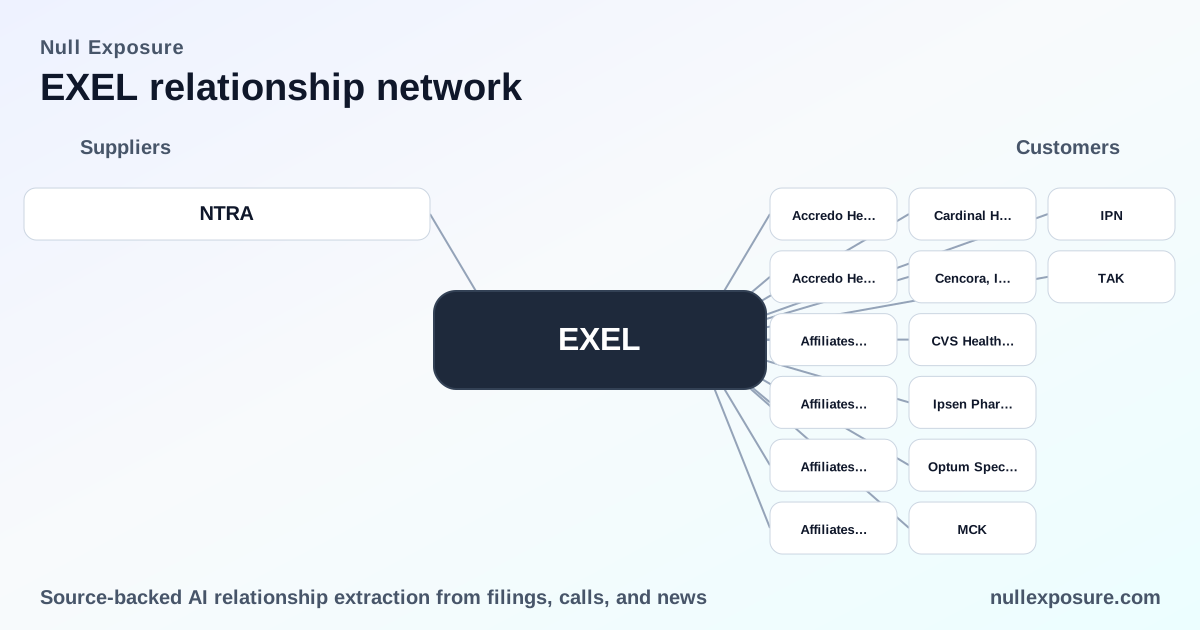
Below are each of the customer relationships reported in Exelixis' FY2026 disclosures and related press coverage, with concise takeaways and source citations.
Affiliates of Cencora, Inc.
Affiliates of Cencora accounted for 22% of total revenues in FY2025, representing Exelixis’ single largest revenue customer group. According to Exelixis’ FY2026 Form 10‑K, this level of concentration is material to results and cash flow.
Affiliates of McKesson Corporation / McKesson Corporation (MCK)
Affiliates of McKesson were responsible for 19% of total revenues in FY2025; the filing lists McKesson (ticker MCK) explicitly as a top revenue customer. This places McKesson among the top two commercial counterparties for Exelixis, with outsized influence on collections and channel inventory levels (FY2026 10‑K).
Affiliates of CVS Health Corporation / CVS Health Corporation
Affiliates of CVS accounted for 15% of total revenues in FY2025, per Exelixis’ FY2026 Form 10‑K, making CVS another dominant channel partner and payer in the U.S. market.
Cardinal Health, Inc.
Cardinal Health is listed among customers that individually accounted for 10% or more of trade receivables (12% of trade receivables). This signals both material revenue flows through Cardinal and meaningful working capital exposure tied to its payment cycle (FY2026 10‑K).
Accredo Health, Incorporated / Accredo Health Incorporated
Accredo is reported both as a 10%+ trade receivable counterparty (12% of receivables) and as a named customer in Exelixis’ customer concentration schedule. Accredo’s dual appearance in revenue and receivable disclosures underlines its role as a material specialty pharmacy customer (FY2026 10‑K).
Optum Specialty Pharmacy / Affiliates of Optum Specialty Pharmacy
Exelixis lists Optum Specialty Pharmacy and its affiliates as customers accounting for 10% or more of trade receivables (10% reported in the Form 10‑K). Optum’s inclusion reflects the integration of large specialty pharmacies into Exelixis’ commercial channel (FY2026 10‑K).
Ipsen Pharma SAS (Ipsen) / IPN
Ipsen is Exelixis’ primary international commercialization partner for cabozantinib outside the U.S.; royalty revenues from Ipsen increased collaboration revenues in the most recent quarter, per Exelixis’ corporate release. Ipsen’s sales are a key non‑U.S. revenue stream and contribute to the global cabozantinib franchise (PharmiWeb press release, Feb 11, 2026).
Takeda Pharmaceutical Company Limited / Takeda / TAK
Takeda is a commercial partner for cabozantinib in select territories (notably Japan) and is included in industry commentary as a collaborator that, together with Ipsen, helped generate $2.9 billion in global cabozantinib franchise net product revenues in 2025 across Exelixis and its partners (PharmiWeb press release, Feb 11, 2026).
Notable news references (market commentary)
Market and industry reports reiterate Exelixis’ strategic alliances with Ipsen and Takeda to maximize international penetration of cabozantinib, and highlight collaboration revenue dynamics and royalty flows as an important complement to U.S. product sales (Intellectia.ai coverage, Mar 2026; MarketBeat research note, Mar/May 2026).
What the company‑level constraints tell investors about operational risk
The disclosures and extracted constraints provide practical traction on Exelixis’ operating model:
- Contracting posture: revenue is recognized at a point in time—sales are largely spot, delivered into distributors and specialty pharmacies, which concentrates execution risk around shipments and returns.
- Counterparty mix includes government payers: Medicare, Medicaid and other government healthcare payers are explicitly part of the reimbursement ecosystem that determines patient access and realized pricing.
- North American concentration with a global franchise: the company reported U.S. revenues of $2,140,371k against total revenues of $2,320,126k (FY2025 figures in company filings), indicating heavy North American exposure, while cabozantinib maintains regulatory approvals in many international markets and produces partner royalties.
- Materiality and criticality: cabozantinib is core and critical to company performance; the firm’s ability to grow depends materially on continued commercial success of this franchise.
- Seller posture and active relationships: Exelixis functions as the product seller to a stable set of active customers (specialty distributors and pharmacies), which implies predictable demand but also single‑buyer concentration risks.
Investment implications and risk checklist
- Concentration risk is real and measurable. A small number of large pharmacy and distributor counterparties account for a meaningful share of revenues and trade receivables; shifts in channel stocking or reimbursement can rapidly affect cash conversion.
- International partner royalties provide diversification, but they do not replace the revenue sensitivity tied to domestic specialty channels and government payers.
- Working capital sensitivity: multiple customers show material shares of trade receivables, which makes days‑sales‑outstanding and collection performance an active monitoring point.
- Regulatory and reimbursement exposure: because cabozantinib is central to revenue, regulatory actions, formulary placements, or payer coverage changes will translate directly to earnings volatility.
For portfolio managers focused on commercial execution and counterparty risk, the customer disclosures in the FY2026 Form 10‑K are the definitive source; complementary press releases and industry notes provide color on partner royalties and international scale. For a quick, signal‑oriented dashboard of relationships and concentration, visit https://nullexposure.com/.
Bold decisions about Exelixis require weighing the durability of cabozantinib revenue against distributor concentration and payer dynamics — the company’s filings make both strengths and vulnerabilities plainly visible.