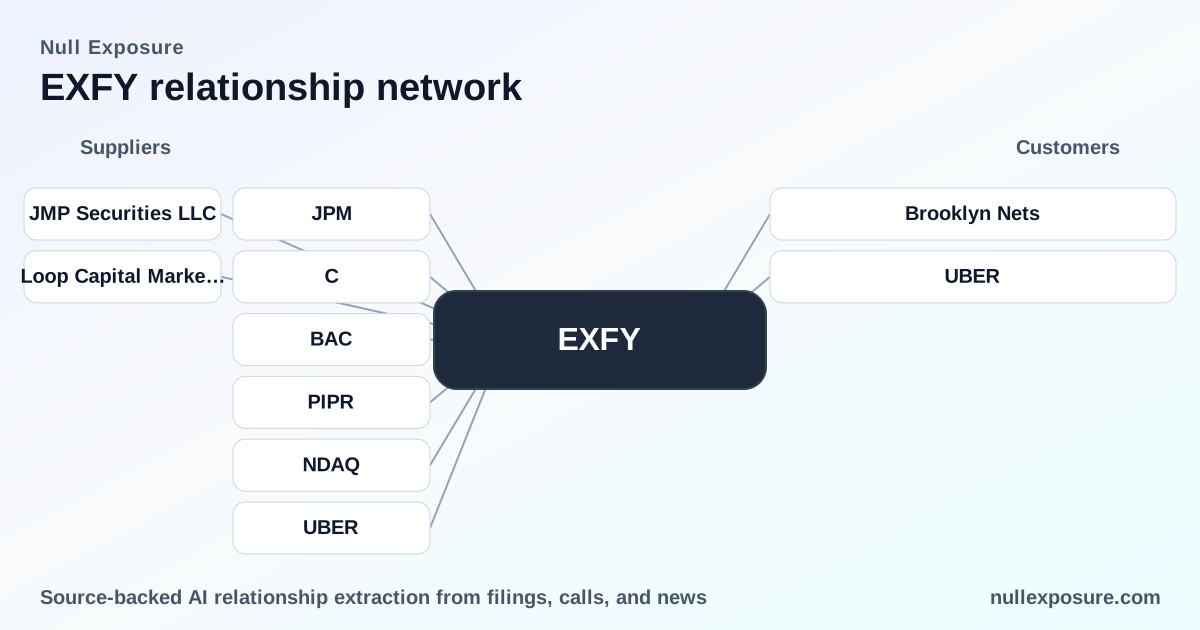
Expensify (EXFY) — Customer Relationships, Contracting Signals, and What They Mean for Investors
Expensify operates a cloud-native expense management platform that monetizes primarily through subscription licensing and per-active-member pricing, supplemented by usage-based billings for higher-fee pay-per-use activity and ancillary card-related cashbacks. The business combines self-service SMB sales with enterprise integration deals that drive product expansion (for example, travel capabilities), and its revenue profile is global but concentrated in the U.S.; no single customer accounted for 10%+ of revenue in the latest reporting period. For a concise view of the customer lens and commercial constraints, see more at https://nullexposure.com/.
Executive thesis: simple pricing, mixed contract tenure, and product-led expansion
Expensify’s core value proposition is to replace manual expense workflows with a SaaS platform sold on a per-active-member subscription basis, with optional pay-per-use features that carry higher marginal fees. Investors should value the company as a subscription software business with a meaningful usage component and a mixed-tenor book of business — a profile that supports predictability from annual/committed members and upside (and volatility) from usage spikes or declines.
The customer relationships called out in filings and public statements
Brooklyn Nets — an anchor sports partnership and product expansion
Expensify disclosed that the Brooklyn Nets, a long-time expense product customer, adopted Expensify Travel and was appointed the team’s Official Travel and Expense partner in Q3 2025, underscoring the company’s ability to upsell travel functionality to existing customers. This was discussed on the company’s 2025 Q3 earnings call and reiterated in the company press release covering Q3 results. (Source: Expensify 2025 Q3 earnings call; Q3 FY2025 press release as reported via The Globe and Mail.)
UBER — multiyear integration with Uber for Business to automate receipts
Expensify announced a multiyear integration partnership with Uber for Business to automate travel and meal receipts and strengthen policy controls across travel and expense workflows, signaling strategic distribution and product integration with a major travel/ride provider. The company referenced this as a commercial integration in its 2025 Q4 earnings remarks. (Source: Expensify 2025 Q4 earnings call.)
Uber for Business — same tie, called out by name for workflow automation
Expensify specifically named Uber for Business in the disclosure, emphasizing the integration point: automated receipts and policy enforcement in corporate travel and expense flows. This repeats the same commercial thrust as the UBER mention but frames it through Uber’s B2B channel. (Source: Expensify 2025 Q4 earnings call.)
What the company-level constraints tell investors about operating risk and revenue quality
Several contract- and customer-related signals in company disclosures translate into clear commercial characteristics investors should price into the model:
-
Contracting posture — mixed tenure with fast churn risk: Expensify sells both month-to-month contracts (terminable without penalty) and annual arrangements billed monthly against a minimum member count, so revenue predictability is a hybrid of committed and cancellable flows. Typical payment terms are 30 days, which limits receivable duration but exposes the company to churn on short-tenor customers. (Company disclosure covering contract types and payment terms.)
-
Primary monetization is subscription-led, with a material usage tail: Management states revenue is primarily from annual subscriptions driven by paid members, while pay-per-use billable activity captures higher average fees per member and can materially move reported revenue, as seen in year-over-year declines tied to reduced billable activity. Use-driven revenue introduces both upside in high-activity periods and downside in weak spending environments. (Company statements on subscription and usage mix; year-over-year billable activity commentary.)
-
Customer mix is broad across firm sizes and geographies: The platform serves individuals, SMBs, mid-market and large enterprises, with SMBs representing the majority of customers. The company reports large global reach — an average of 687,000 paid members across ~47,600 companies in over 200 countries and territories for the year ended December 31, 2024 — but also discloses significant U.S. revenue concentration in the reporting period. (Company disclosures on customer composition and paid member counts.)
-
Low concentration by revenue but reliance on scaled adoption for product expansion: No single customer represented 10% or more of revenue in the recent periods reported, which reduces single-counterparty concentration risk, yet scale within customers is important for upsell (e.g., travel adoption by existing large customers like the Nets or integration deals with channel partners such as Uber for Business).
-
Regulatory and vendor-dependency operational risks: The company highlights potential costs and operational changes tied to data transfers and vendor/tool usage under evolving privacy and regulatory frameworks, which introduces execution risk for the service provider role. (Company disclosure on regulatory and data-transfer risks.)
Commercial implications: concentration, criticality, and monetization dynamics
-
Concentration: Financials and filings indicate immaterial single-customer concentration; the business is revenue-diversified across thousands of customers but U.S. revenue dominates per the geographic breakpoint disclosed by the company. Investors benefit from lower customer concentration risk but must recognize regional macro sensitivity.
-
Criticality & stickiness: Integrations with platforms like Uber for Business and the launch of Expensify Travel for existing enterprise customers increase product stickiness and create cross-sell pathways, which lifts lifetime value if adoption scales inside larger accounts.
-
Contract maturity & churn exposure: The presence of month-to-month contracts imposes higher renewal risk than pure annual-only SaaS vendors; valuation models should include a higher baseline churn assumption offset by upsell potential from travel and integrations.
-
Revenue volatility: The usage-based element (pay-per-use billings, Expensify Card cashback dynamics) contributes to revenue volatility; recent commentary linked lower billable activity to weaker revenue performance, which investors should treat as a non-trivial swing factor.
Bottom line for investors
Expensify is a subscription-first software company with an important usage component and clear product expansion playbooks via travel and integrations. The company’s customer disclosures show a broad, global install base with U.S. revenue concentration and immaterial single-customer concentration, but investors must price in churn potential from month-to-month contracts and revenue volatility from usage dynamics. The Uber for Business integration and the Nets travel partnership are constructive signals that management can upsell and embed travel use cases — important for long-term monetization and retention.
For a concise dossier on counterparty relationships and contract signals relevant for underwriting or competitive due diligence, visit https://nullexposure.com/ for sourcing and analysis.