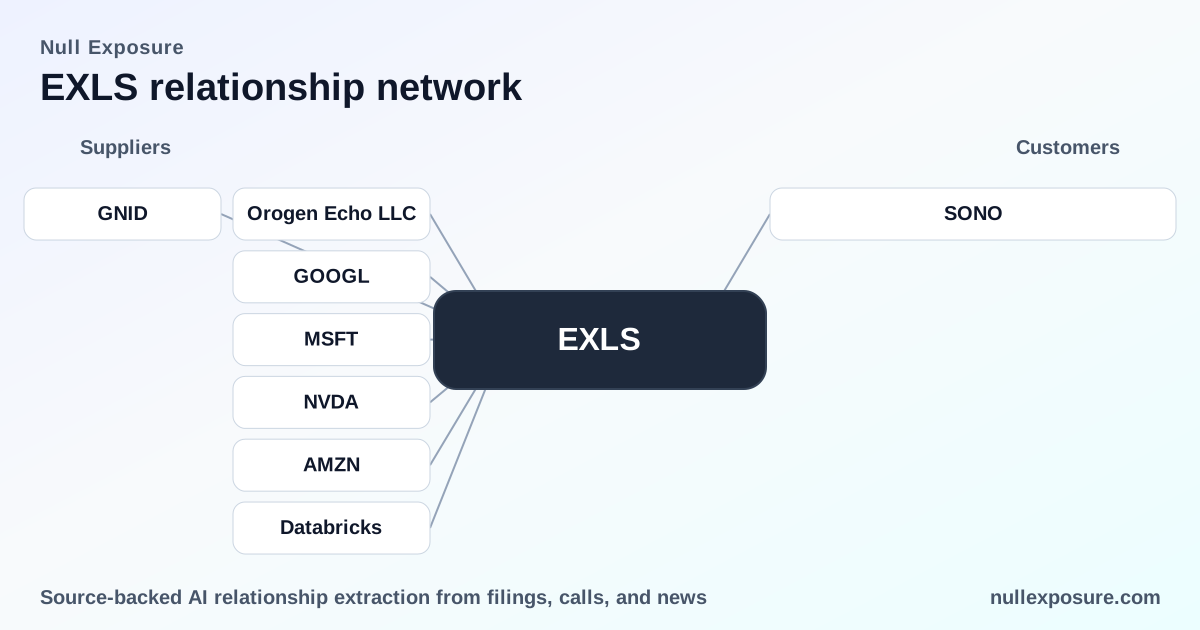
EXLS Customer Landscape: Where revenue convoys and AI partnerships intersect
Thesis — ExlService (EXLS) operates as a global data- and AI-led services firm that monetizes through multi-year managed operations, analytics engagements, and cloud-delivered solutions, supplemented by shorter-term consulting and contingent-fee arrangements in specialized verticals. The company sells a mix of long-term contracts (3–5 years) and subscription-style deployments, with selective usage-based revenue in payment integrity, creating a revenue profile tied to client retention, scale of migration investments, and success-based collections. For a concise view of the platform and market positioning, visit https://nullexposure.com/.
Why EXLS’s customer relationships matter to investors
ExlService’s economics are built on durable client commitments and a productized-services mix. Long initial contract terms require upfront investments in people and infrastructure and compress gross margins in year one, while successful migrations increase lifetime customer value through cross-sell into analytics and AI offerings. The company reports strong exposure to large enterprise buyers—targeting Fortune 500 and Forbes Global 2000 clients—while also cultivating mid-market accounts for scale.
Financial context supports this model: EXLS generated approximately $2.16 billion in trailing revenues with an operating margin near 16% and profit margin around 11.7%, demonstrating the leverage available once delivery platforms scale. Concentration and geography matter: the U.S. and U.K. constitute the lion’s share of revenues (82.6% and 11.7% in fiscal 2024), which focuses go-to-market execution but also concentrates geopolitical and currency exposure.
What the press is recording about specific customer ties
Below are each of the relationship mentions surfaced in the coverage set; every item is presented with a concise, plain-English takeaway and its source.
-
SONO / Sonos — InsiderMonkey Q4 2025 earnings call transcript (Mar 9, 2026). EXL disclosed a collaboration with AWS and Sonos to deploy agentic AI for Sonos IT service management workflows, positioning the engagement as an efficiency and risk-mitigation benchmark for IT operations. Source: InsiderMonkey earnings call transcript (Mar 9, 2026) — https://www.insidermonkey.com/blog/exlservice-holdings-inc-nasdaqexls-q4-2025-earnings-call-transcript-1704017/
-
Sonos — InsiderMonkey Q4 2025 earnings call transcript (Mar 9, 2026). The same earnings commentary reiterates EXL’s role alongside AWS in deploying agentic AI at Sonos, underscoring a joint cloud-and-AI execution for ITSM modernization. Source: InsiderMonkey earnings call transcript (Mar 9, 2026) — https://www.insidermonkey.com/blog/exlservice-holdings-inc-nasdaqexls-q4-2025-earnings-call-transcript-1704017/
-
KURA — SahmCapital industry coverage (Apr 17, 2026). An industry note on Kura Oncology’s FIT-001 study references Exelixis Inc. (listed in that item as NASDAQ: EXLS) as the marketer of cabozantinib under the brands Cabometyx and Cometriq, linking EXLS into a pharmaceutical commercialization context in that story. Source: SahmCapital report (Apr 17, 2026) — https://www.sahmcapital.com/news/content/kura-oncology-advances-kidney-cancer-program-with-solid-early-stage-results-2026-04-17
-
SONO / Sonos — Finviz earnings preview (Mar 9, 2026). Market reporting ahead of EXL’s quarterly release cites the EXL–AWS initiative with Sonos as a headline example of how EXL is deploying agentic AI to reshape IT service management for a customer. Source: Finviz news item (Mar 9, 2026) — https://finviz.com/news/318185/earnings-to-watch-exl-exls-reports-q4-results-tomorrow
-
Sonos — Finviz earnings preview (Mar 9, 2026). A parallel Finviz mention reiterates the agentic AI collaboration, emphasizing the public-market narrative that EXL’s AI work is not purely internal but client-facing and anchored by cloud partnerships. Source: Finviz news item (Mar 9, 2026) — https://finviz.com/news/318185/earnings-to-watch-exl-exls-reports-q4-results-tomorrow
These mentions cluster around one clear commercial example—EXL’s AI collaboration with Sonos (reported across transcripts and market news)—and a discrete industry reference tying the ticker label to drug commercialization in separate coverage.
For further context and to cross-reference the broader relationship set, see https://nullexposure.com/.
What the company-level constraints tell investors about the operating model
The disclosures provide a consistent set of operational constraints that explain EXL’s growth and margin dynamics:
-
Contracting posture: EXL’s core digital operations and solutions are structured as long-term agreements (typical initial terms of three to five years), which creates predictable revenue streams but requires upfront investment. The company explicitly discloses higher cost of revenues in the first 12–18 months of such contracts due to infrastructure build-out and workforce onboarding.
-
Commercial variability: The firm also delivers shorter-term consulting engagements (six to twelve months) and usage-contingent fee arrangements—notably in payment integrity—where revenue recognition depends on collections, introducing variable upside and collection risk.
-
Delivery model: EXL uses SaaS and cloud-deployed solutions, either via partners’ cloud networks or on-client cloud implementations, creating recurring revenue potential and platform lock-in once migrations complete.
-
Counterparty mix and concentration: The company targets large enterprises heavily (Fortune 500 / Global 2000) while also serving mid-market clients, and it warns that the loss of any of its ten largest clients could be materially adverse, signaling notable client concentration risk.
-
Geography and scaling: Revenue concentration in North America and the U.K. implies concentrated market risk but a focused addressable market for deep industry solutions and regulatory familiarity.
-
Role & stage: EXL functions as both service provider and buyer in certain transactions, and the corporate narrative emphasizes active, evolving engagements that grow from single services to integrated processes across business lines.
These constraints translate into an operating profile where growth depends on successful migrations and cross-sell to existing clients, margins expand after initial contract years, and downside risk centers on client concentration and execution during the early phases of long-term contracts.
Investment takeaways: risks, optionality, and action
-
Upside drivers: EXL’s combination of managed operations, analytics, and cloud-AI delivery creates clear cross-sell pathways and margin expansion after migration phases; its FY figures show substantive scale with room to operationally leverage AI initiatives like the Sonos engagement.
-
Primary risks: Client concentration among the top accounts and front-loaded investment cycles in long-term contracts create near-term margin pressure and revenue sensitivity to client churn.
-
Catalysts to watch: renewal cadence and terms on major multi-year contracts, the pace of SaaS adoption versus on-prem deployments, and measurable outcomes from client AI initiatives that translate into repeatable offerings.
For further reading and to monitor where these relationships evolve, visit https://nullexposure.com/.
Bold judgment: EXL is a services-led platform with durable recurring revenue characteristics that rewards patient investors when migrations scale and cross-sell converts; the company’s near-term performance will hinge on execution against long-term contracts and the management of client concentration.