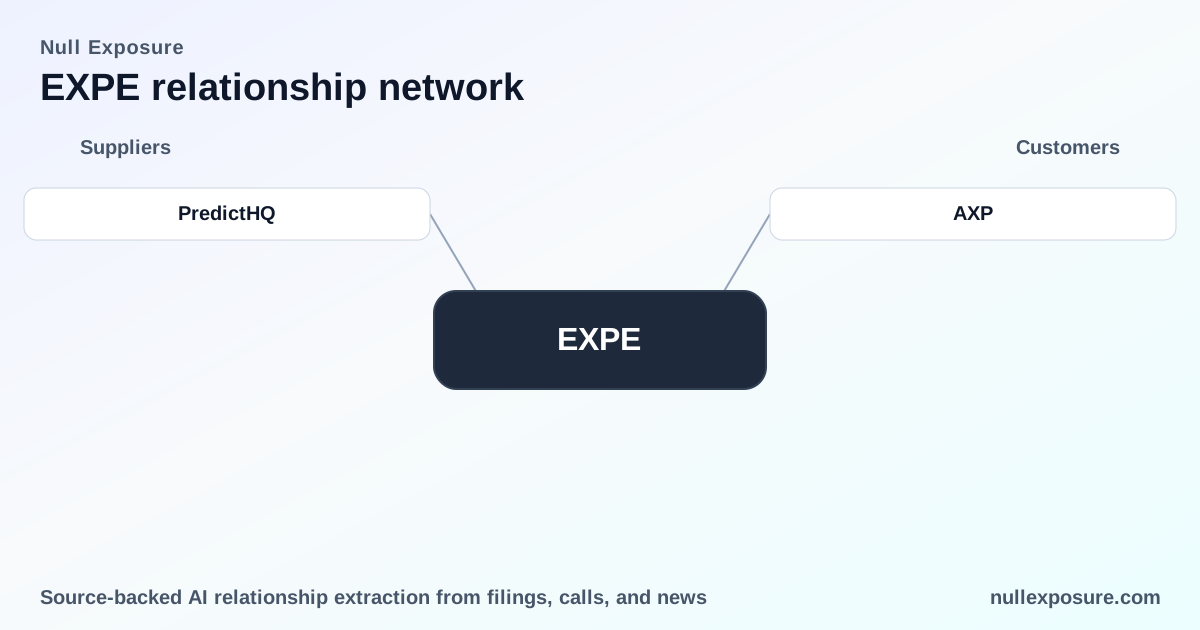
Expedia Group (EXPE): Customer relationships that define distribution and revenue optionality
Expedia Group operates a global travel marketplace that monetizes through a mix of transactional booking fees, merchant margins, advertising, and ancillary subscription services (Vrbo listings and related owner services). The company sells inventory directly to consumers across its consumer brands and supplies hotel, flight and advertising products to partners and financial institutions that embed Expedia’s rates and availability into their own customer experiences — creating both direct booking revenue and recurring B2B flows that amplify distribution and yield. For investors, the relevant lens is distribution scale plus product mix: bookings-driven revenue remains primary while advertising and B2B partnerships provide margin and retention levers.
If you want a concise, machine-free intelligence view of Expedia’s partner exposures for model input, see NullExposure for a structured breakdown: https://nullexposure.com/
How Expedia’s commercial model shapes partner risk and upside
Expedia’s revenue model is not a single-contract business. Evidence indicates mixed contracting postures: the company operates subscription-style services (Vrbo listings and ancillary services for property owners) alongside clear usage- or transaction-based revenue for lodging bookings. Expedia is a service provider at scale to a broad set of B2B customers — airlines, banks, retail loyalty programs and other platforms — which both diversifies distribution and introduces counterparty concentration and execution risk.
- Contracting mix: subscription revenues (Vrbo owner services) coexist with pay‑per‑booking payments for lodging, producing different revenue stability and margin characteristics.
- Geographic scale: operations and partner relationships are global, so macro travel cycles and regional recoveries will show up unevenly across the book.
- Role and criticality: Expedia functions as a third‑party technology and distribution provider for many partners; its platform can be core to a partner’s travel offering but is replaceable if commercial terms shift.
- Segment maturity: B2C platforms are mature brands, while the B2B distribution and advertising products are the primary growth engines for margin expansion.
Explore a partner-level breakdown and how it maps to these signals at NullExposure: https://nullexposure.com/
Customer relationships that matter — plain-English summaries and sources
Uber
Expedia supplies the hotel inventory powering Uber’s new in‑app hotel booking feature, extending Expedia’s reach into ride‑hailing user sessions and giving Uber immediate scale for lodging bookings. According to Phocuswire (May 2026), the integration brings Expedia’s inventory and pricing into Uber’s app and offers Uber One members discounts across 700k+ properties. (Phocuswire, May 2026)
Magnite (MGNI)
Expedia Group Advertising has partnered with Magnite to route large volumes of traveler intent — reported as 200 petabytes of signals — into streaming, video, display and audio programmatic channels, expanding advertising distribution and monetization of traveler demand. (PPC.Land coverage of the partnership, May 2026)
American Express (AXP)
Expedia powers travel bookings for a large set of partners that includes financial institutions such as American Express, enabling AmEx cardholder travel experiences and co‑branded distribution that drives bookings and loyalty benefits. FinancialContent noted Expedia’s role in powering bookings across 60,000 partners, explicitly including financial institutions like American Express. (FinancialContent, March 2026)
CIBC (CM)
CIBC expanded its “CIBC by Expedia” offering across multiple CIBC credit cards, giving customers access to Expedia’s global inventory and integrated rewards/redemption mechanics, a box‑out example of white‑label distribution for banks. (SimplyWall.st coverage of CIBC’s expansion, March 2026)
Despegar (DESP)
Despegar signed a 10‑year lodging outsourcing agreement with Expedia effective January 1, 2025, moving its lodging fulfillment to Expedia’s platform and positioning the arrangement as a profitability lever through scale and outsourcing efficiencies. (Investing.com report on the Despegar agreement, FY2024–2025 reporting)
Alaska Air Group (ALK)
Alaska’s Atmos Rewards program includes partner perks such as Expedia VIP hotel discounts, illustrating Expedia’s placement inside airline loyalty programs as a marketing and distribution partner that boosts traveler value propositions. (Alaska Air press release on Atmos Rewards, FY2026)
Avidia Bank / AVBC
Avidia Bank card products advertise bonus points on Expedia bookings (for example, 2 bonus points per $1), reflecting co‑branded reward mechanics that channel cardholder bookings to Expedia inventory. (CardRates profile of Avidia Bank card benefits, 2026)
Albertsons Companies (ACI)
Albertsons has rolled out a travel offering (“for U Travel”) powered by Expedia that lets loyalty members earn up to 10% cash back on travel bookings redeemable toward groceries, representing cross‑category loyalty integration to increase engagement and monetize grocery loyalty with travel inventory. (Albertsons Form 10‑Q / Marketscreener summary, FY2025)
Southwest Airlines (LUV)
Southwest’s distribution changes referenced an Expedia distribution partnership as part of efforts to diversify channels and lift revenue per passenger; Expedia’s distribution is positioned as a tactical channel to expand fare and ancillary options outside ticketing direct sales. (SimplyWall.st analysis referencing Southwest’s distribution and Expedia partnership, March 2026)
Strategic implications and investor takeaways
- Distribution advantage with margin nuance: Expedia’s ecosystem approach — direct consumer brands plus embedded B2B distribution and advertising — creates scale that underpins pricing power for inventory and ad products, but the mix matters: merchant bookings offer higher margin upside; agency/partner bookings are volume drivers with lower margin.
- Mixed contract stability: subscription components (Vrbo owner services) provide recurring revenue, while pay‑per‑booking flows create revenue cyclicality tied to travel demand. These mixed modalities improve lifetime value but increase short‑term volatility with travel cycles.
- Concentration vs diversification: large platforms and financial partners (Uber, AmEx, banks, airlines) amplify distribution but create dependency on negotiated commercial terms. The Uber partnership expands reach meaningfully, yet it also embeds Expedia into a partner ecosystem where pricing incentives and discounting can compress margins.
- Advertising as margin lever: partnerships like the Magnite ad routing deal point to expansion of Expedia’s addressable ad inventory and monetization of traveler intent beyond transactions — a structural path to higher margin revenue streams.
Bottom line for investors
Expedia’s partner map is a core competitive asset: scale of inventory plus pervasive embedding into loyalty and platform experiences drives bookings and advertising economics. The recent partnerships — notably with Uber and programmatic ad partners like Magnite — are consistent with a strategy to convert distribution into recurring, higher‑margin revenue. At the same time, the company’s hybrid contracting model and heavy dependence on external distribution partners create execution and pricing risk that should be stress‑tested in forecasts.
For a partner‑level exposure report and to map these relationships into revenue and counterparty risk models, visit NullExposure for the structured analysis: https://nullexposure.com/