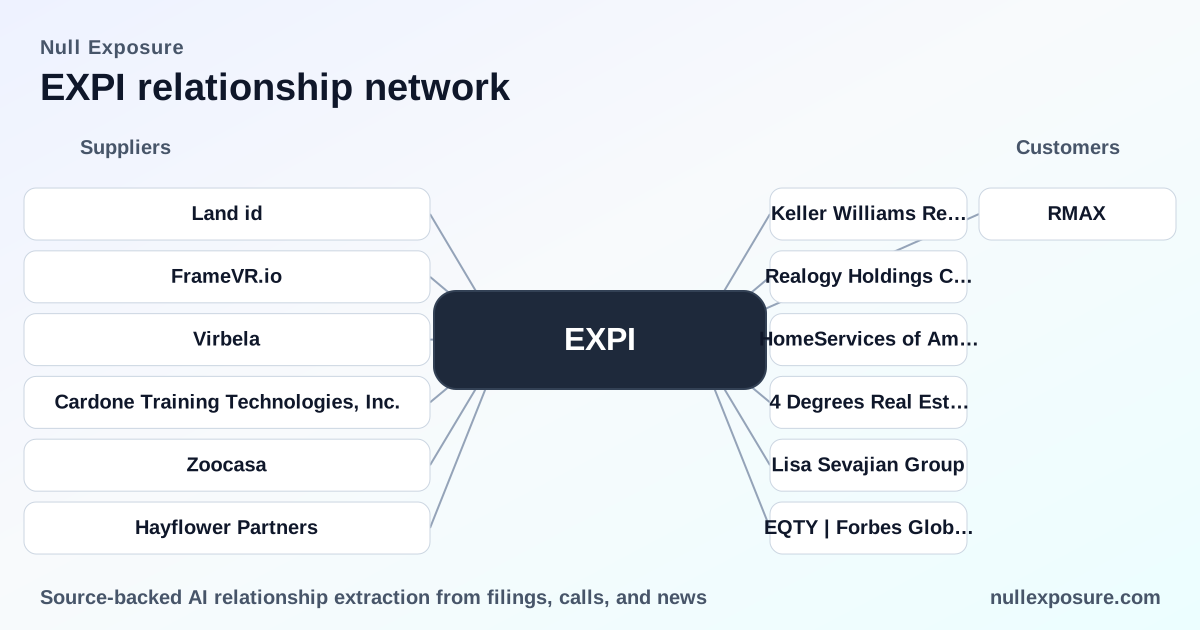
eXp World Holdings (EXPI): Customer Relationships that Drive Growth and Concentration Risk
eXp World Holdings operates a cloud-native real estate brokerage that monetizes through two primary means: transactional commissions earned when real estate deals close and subscription fees for access to its virtual collaboration and agent services platform. The business combines a high-volume, commission-led services engine in North America with a growing software and media portfolio that supports agent productivity and recurring revenue. For investors and operators, the key trade-off is rapid agent and team acquisitions that scale revenue against geographic concentration and exposure to industry-wide regulatory and competitive dynamics. Learn more about relationship signals and implications at https://nullexposure.com/.
Why customer relationships matter for EXPI’s model
EXPI is fundamentally a service provider that relies on independent agents and migrating teams to generate transaction volume; its economics depend on closing rates, agent productivity and the breadth of distribution partnerships that increase listing visibility. The company also extracts recurring value from software and branded services that make agent onboarding stickier. That dual model delivers optionality—growth from agent recruitment plus margin improvement from software adoption—but it also concentrates risk: 98.1% of revenue comes from North America, and commissions are recognized on a spot basis when transactions close, so cash flows are lumpy and tied to housing cycles.
Customer and partner relationships: the complete picture
Below I summarize every relationship mention surfaced in EXPI’s public materials and press coverage. Each entry is a concise, investor-focused read with a source citation.
-
Keller Williams Realty, Inc.
eXp’s 2024 10‑K cites broad industry pressure from private lawsuits and DOJ antitrust investigations that name Keller Williams among other large brokerages, underscoring competitive and regulatory dynamics that affect EXPI’s market environment. According to EXPI’s 2024 Form 10‑K, these matters are industry-wide factors impacting brokerages. (EXPI 2024 10‑K) -
Realogy Holdings Corp.
Realogy is referenced in the same 10‑K passage as an example of major franchisors named in historical antitrust litigation, highlighting sector-level legal risk that competes with EXPI for agents and listings. (EXPI 2024 10‑K) -
HomeServices of America, Inc.
HomeServices appears in EXPI’s 10‑K as part of the industry antitrust discussion, which frames competitive and regulatory headwinds in the U.S. brokerage market that influence EXPI’s strategy. (EXPI 2024 10‑K) -
Homes.com
EXPI announced syndication that permits eXp agents to place “Coming Soon” listings on Homes.com starting April 15, expanding listing distribution and potential lead capture for agents. The change increases listing visibility beyond MLS channels. (EXPI press release, April 2026) -
Realtor.com
EXPI’s press release confirms Realtor.com is included in the syndication allowing eXp agents to post “Coming Soon” listings, a tactical move to enhance marketing reach for sellers represented by EXPI agents. (EXPI press release, April 2026) -
ComeHome.com
EXPI’s announcement includes ComeHome.com in the “Coming Soon” syndication, extending the company’s ability to syndicate pre-market inventory across consumer portals. (EXPI press release, April 2026) -
The Martin Group / Cobalt Realty Group
Veteran broker Lance Martin moved his team from Coldwell Banker to eXp Realty after a 24‑year tenure, demonstrating EXPI’s ongoing recruitment of established teams to lift transactional volume. The migration was reported by The Globe and Mail. (The Globe and Mail, May 2026) -
FIG Team
FIG Team formalized a strategic alignment with returning producers in Tampa to scale within EXPI, showing EXPI’s ecosystem-centric growth via team partnerships that drive local market share. This was announced in an EXPI press release. (EXPI press release, May 2026) -
Maximum Tampa Group
Maximum Tampa Group returned to eXp Realty and will partner with FIG Team under a co‑branding arrangement, illustrating EXPI’s use of team-level partnerships to amplify agent recruitment and localized market penetration. (EXPI press release; Business Insider/Yahoo coverage, May 2026) -
4 Degrees Real Estate
4 Degrees Real Estate, one of Spokane’s top brokerages, joined eXp Realty—an example of EXPI consolidating regional leaders to increase closed‑transaction volume in target U.S. markets. (EXPI press release, March 2026) -
Lisa Sevajian Group
The Lisa Sevajian Group, a top‑producing Massachusetts team, joined eXp Realty, reinforcing a pattern of wins among high‑producing teams that directly boost EXPI’s commission base. (Markets/Business Insider reporting, March 2026) -
Alumbra International
Miriam Valencia, founder and CEO of Alumbra International, brought 50 agents to eXp in a move that reinforces EXPI’s ability to onboard international or multi‑market brokerages and grow its agent count quickly. (EXPI press release, May 2026) -
EQTY | Forbes Global Properties
EXPI provides a private‑label arrangement enabling EQTY | Forbes Global Properties to elevate a luxury real estate offering while leveraging EXPI’s back‑end services—an example of white‑label partnerships that extend EXPI’s service footprint beyond standard agent recruitment. (EXPI press release, March 2026) -
RMAX / RE/MAX
EXPI’s 2024 10‑K cites RE/MAX (RMAX) in the same antitrust context as other major franchisors, signaling that EXPI monitors litigation and regulatory developments affecting franchised competitors and the broader listing/commission landscape. (EXPI 2024 10‑K)
Operating-model constraints and what they signal for investors
-
Contracting posture: mixed — spot and subscription. Commission revenue is recognized at transaction close, which creates spot, event-driven cash flows; EXPI also reports subscription revenue from agent access to its virtual collaboration platform that is recognized ratably. This blend means cash flow predictability is constrained until subscription adoption materially scales.
-
Counterparty concentration: individual retail clients plus teams. EXPI’s core customers are residential homeowners and homebuyers served through a global network of independent agents; this emphasizes volume-driven economics rather than large anchor customers.
-
Geographic concentration: North America is critical. North America represented 98.1% of consolidated revenue in 2024, establishing concentration risk—international expansion is real but remains a secondary and ramping source of revenue.
-
Relationship role: service provider across the transaction lifecycle. EXPI functions as a licensed broker obligated to process transactions and provide related services; it acts as both the representative for buyers and sellers and as the platform operator that enables agent activity.
-
Maturity and growth stage: domestic scale, international ramping. International revenue growth is accelerating from a small base—EXPI reported a 63% increase in international realty revenue in 2024—so global operations are in a ramping stage and contribute to the company’s diversification strategy.
-
Business segments: services-first with strategic software/tech assets. The company’s model remains services-dominant, while FrameVR.io and other platform assets are positioned to generate recurring revenue and improve agent retention and productivity.
Investment implications — concise takeaways
- Growth lever: team and elite agent recruitment continues to be the primary engine for near‑term revenue expansion; recent team wins validate the playbook.
- Risk lever: heavy North American revenue concentration and industry‑level legal risks (antitrust litigation cited in the 10‑K) are principal downside exposures.
- Optionality: software and private‑label partnerships create a pathway for margin improvement if recurring revenue scales.
If you want a structured, quantitative readout of these customer relationships and how they map to EXPI’s revenue streams, visit https://nullexposure.com/ for investor-targeted relationship analytics and market commentary.
Bold, direct, and transactional—EXPI’s customer relationships show a company that scales via people and listings, while software and syndication deals aim to make that growth stick; investors should weigh recruitment momentum against concentration and regulatory context when sizing risk.