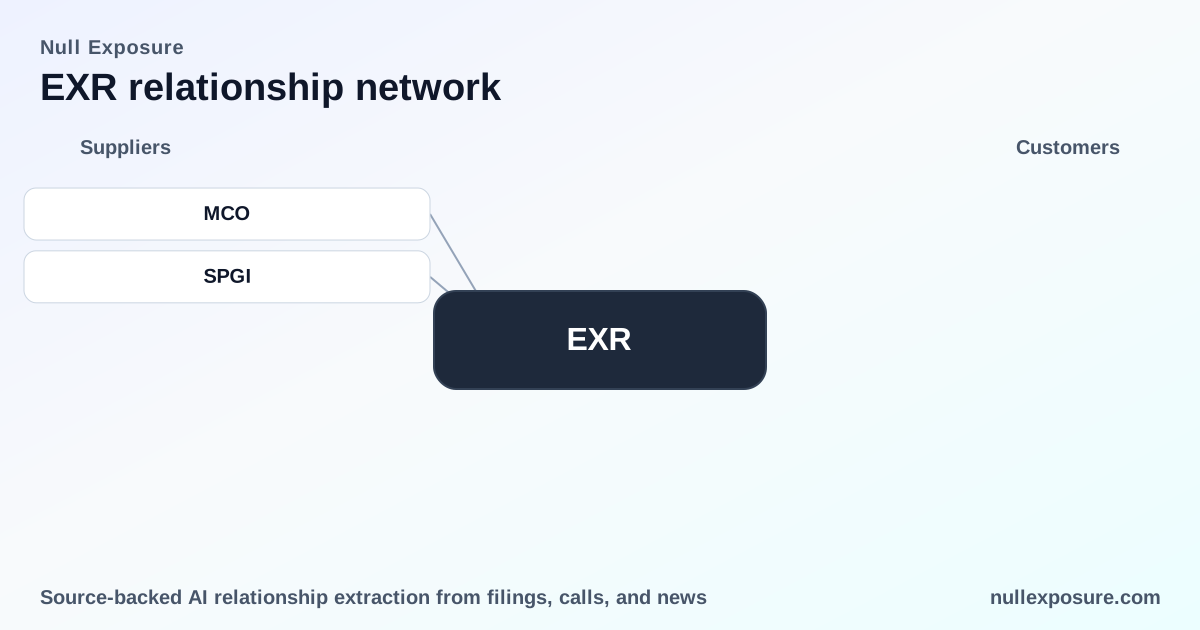
Extra Space Storage (EXR): Customer Relationships and operator signals that drive value
Extra Space Storage is a large-cap self-storage REIT that owns and operates thousands of facilities while also monetizing management and ancillary services for third‑party owners. The company captures core rental economics through predominantly month‑to‑month leases, expands at low capital cost by managing other owners’ stores, and layers adjacent services — tenant insurance and bridge lending — on top of footprint scale to generate fee and finance income. For investors, the combination of recurring short‑term revenue, management fee leverage, and ancillary finance exposure defines both growth levers and distinct risk vectors. Visit https://nullexposure.com/ for more coverage and relationship intelligence.
The business model in plain English: where the cash flows come from
Extra Space is fundamentally a hybrid operator-REIT. Primary cash flow comes from tenant rental income on owned stores, which the company recognizes as amounts due from tenants and collects on largely month‑to‑month leases. That short-term contracting posture delivers pricing agility and cash conversion but also produces tenant churn and sensitivity to local demand cycles.
A second, strategic revenue stream is management fees from third‑party owners. Extra Space manages thousands of non‑owned stores under management services agreements that provide operating, marketing, and lease services for a percentage of collected revenues — a capital‑light growth channel that expands reach and data scale without owning the real estate.
The firm also operates adjacent commercial lines: tenant reinsurance and a bridge lending program that provide incremental margin and diversify revenue. These activities increase per-store monetization and embed financial exposure to small‑owner credit and claims experience. According to company disclosures through FY2024–FY2026, Extra Space manages over 1,500 third‑party stores and owned/operated a roughly 4,000‑store portfolio across 42 states and D.C., giving it national scale and operating leverage.
What the public relationship mentions actually show
A named partner relationship appears in news coverage: NXDT‑P‑A.
- An ADVFN Brasil news report (May 3, 2026) notes that “A key Partner is Extra Space Storage, who will manage all wholly owned facilities,” indicating a contractual operating role where Extra Space acts as the manager for that issuer’s properties. (Source: ADVFN Brasil article, 2026‑05‑03 — https://br.advfn.com/noticias/EDGAR/2022/artigo/87532619)
This reference is the sole explicit customer/partner listing in the collected results and reinforces Extra Space’s role as an operational manager for other owners’ portfolios in addition to its ownership activities.
How the extracted constraints describe the operating posture and investor implications
The relationship extraction yields multiple firm-level signals about how Extra Space runs the business. Treat these as company‑level operational constraints that shape economics:
- Short‑term contract bias: Leases are predominantly month‑to‑month, which creates pricing flexibility and faster upside capture in inflating markets while increasing churn and sensitivity to local demand deterioration. This is a foundational characteristic — not an isolated product feature — that defines revenue volatility and re‑tenanting economics.
- North America concentration: The footprint is U.S.‑centric across 42 states and Washington, D.C., providing geographic diversification within one regulatory and macro environment but limited international hedging. Scale across many states reduces single‑market concentration risk while leaving national economic cycles as the dominant macro lever.
- Dual role as seller and service provider: Extra Space collects rental revenues as an owner and earns management fees and other services income when acting for third‑party owners. This mixed role produces both capital‑intensive returns on owned assets and high‑margin, capital‑light fee streams that improve return on invested capital and margins as the management business scales.
- Adjacent products: Tenant reinsurance and bridge lending are complementary monetization lines, adding margin but also introducing insurance claims and credit risk into the company’s P&L and balance sheet exposure.
- Maturity and scale signal: With market capitalization near $30.7 billion and trailing EBITDA around $2.28 billion, Extra Space is a mature, large REIT with institutional ownership and a dividend yield in the mid single digits (Dividend per share and yield reported through FY2026). Those metrics underline the company’s ability to deploy scale into fee businesses and to return cash to shareholders.
Relationship dynamics that matter for valuation and risk
The way Extra Space blends ownership and services creates clear valuation implications:
- Revenue quality is mixed: Owned-store rents provide a predictable base, but the heavy reliance on month‑to‑month leasing compresses forward‑look visibility compared with multi‑year commercial leases.
- Fee businesses de‑risk capex and accelerate geographic expansion, improving EBITDA margins without proportionate increases in real estate assets. That is a structural advantage for scaling returns.
- Credit and insurance lines add uncorrelated but material risk: Bridge loans bring interest margin and risk of losses if owner counterparties underperform; tenant reinsurance introduces claims volatility that is not perfectly correlated with rental performance.
Investors should weigh these tradeoffs when applying growth rates, cap rates, and credit reserves in valuation models. The company’s sizable market cap and institutional ownership indicate market confidence in the mixed model, but sensitivity to occupancy cycles and credit/claims trends is a persistent risk factor.
Risk checklist that flows from customer relationships
- Short‑term leases → higher churn and sensitivity to demand shocks.
- Manager role with third‑party owners → revenue tied to third‑party performance and contractual MSAs (management services agreements).
- Bridge lending exposure → credit risk and capital allocation tradeoffs.
- Tenant reinsurance → insurance reserve and claims volatility.
- U.S.-only footprint → concentration to domestic macro and regulatory conditions, albeit diversified across many states.
Bottom line and action steps for investors
Extra Space Storage is a scale operator that leverages short‑term leasing flexibility and a growing management services franchise to expand margins with limited capital intensity. The company’s hybrid model creates differentiated earnings drivers and exposes the firm to credit and claims risk that warrant explicit modeling when assessing downside scenarios.
For analysts focused on customer relationships, the NVX mention of NXDT‑P‑A illustrates how Extra Space’s management role gets documented in partner filings and news coverage — a reminder that management agreements are a core driver of fee revenue and geographic reach. For deeper relationship mapping and ongoing monitoring, explore relationship analytics at https://nullexposure.com/.
Key takeaway: Extra Space converts real estate scale into recurring rental cash flow plus high‑margin service fees, but investors must underwrite churn from month‑to‑month leasing and credit/insurance exposures when modeling long‑term returns.