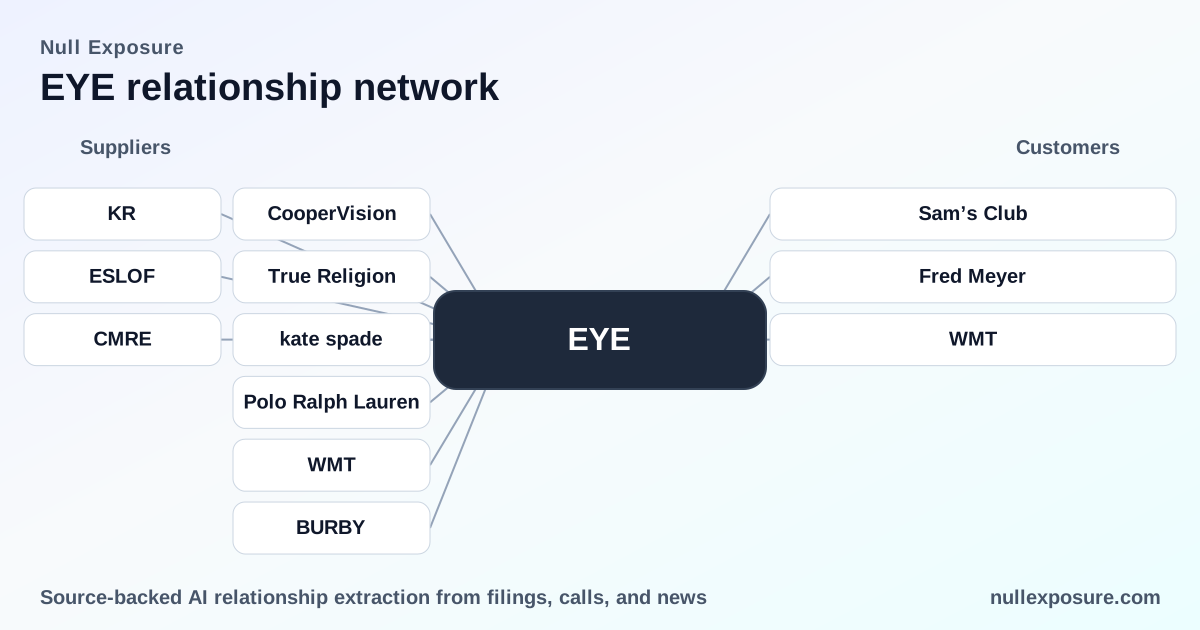
National Vision (EYE): The customer map that underpins margins and risk
National Vision monetizes a high-volume, value-oriented optical retail model: a national store footprint and complementary online channels sell eyeglasses, contact lenses and eye exams while recurring products (three-year eyecare club memberships) and short-term warranty offerings add recurring revenue and customer lock-in. The company also participates as a provider into managed vision care programs that accounted for roughly 40% of revenues in FY2024, creating a revenue stream that is both material and operationally critical. For investors and operators, the question is simple: how stable are the distribution and hosted-op relationships that feed same-store sales and managed-care volume — and what counterparty exposures or contract-tenor dynamics could change the cash flow profile? Learn more at https://nullexposure.com/.
How National Vision actually sells — the operating constraints that matter
National Vision’s go-to-market is anchored in a broad retail and services mix, and the company’s disclosures reveal a clear set of operating characteristics that should drive diligence.
- Contracting posture and tenor: The business uses a mix of contract types — short-term warranties (typically one year), multi-year subscription-style eyecare club memberships (three years) and spot point-of-sale recognition for walk-in non-prescription eyewear — creating a hybrid revenue base that blends recurring and transactional economics.
- Customer counterparty and geography: The end-customers are individual consumers in the United States; the company states it is “one of the largest optical retailers in the U.S.”, so geographic concentration is domestic.
- Revenue concentration and criticality: Participation in managed vision care programs is material and operationally critical, representing roughly 40% of revenue in FY2024 and therefore a major determinant of growth and margin stability.
- Role flexibility and maturity: National Vision operates as both seller (retail stores and digital channels) and buyer/provider in managed-care and host operating relationships (e.g., FirstSight and hosted Vision Centers). Its portfolio approach — stores, hosted operations inside other retailers, lab services, and online channels — signals a mature retail operator with diversified customer access points but exposure to partner contract renewal cycles.
These characteristics frame firm-level risk: revenue mix sensitivity to managed-care terms, partner renewal cycles at hosted locations, and the interplay between short-term sales and multi-year membership economics. For further context on partner exposure and named counterparties, see the relationship-level rundown below.
Relationship rundown — every match in the public record
Below I cover every relationship result in the file, one by one, with a concise explanation and source reference.
Sam’s Club
AC Lens (an affiliate channel referenced in National Vision filings) delivered notices of non‑renewal of agreements covering wholesale contact lens distribution and related services with Sam’s Club, indicating an end to that distribution channel as disclosed in EYE’s filings. Source: National Vision Form 10‑K (filed Dec. 28, 2024; FY2024 disclosure).
Fred Meyer (Sahm Capital earnings overview)
National Vision’s Host operating model includes Fred Meyer as a partner that provides eye exams through independent optometrists; Fred Meyer is identified as one of the Host operators that support inventory and lab processing to Legacy Vision Centers. Source: Sahm Capital earnings overview (Mar 3, 2026).
Fred Meyer (CityBiz coverage of management change)
CityBiz reported National Vision’s footprint includes Vista Opticals inside select Fred Meyer stores and on select military bases, and noted the company’s ancillary e-commerce channel DiscountContacts.com as part of the broader retail mix. This confirms Fred Meyer as a physical-host channel for National Vision operations. Source: CityBiz news (Mar 9, 2026).
TPG
A news item referenced EY acting as exclusive financial advisor to Altimetrik and TPG; the excerpt in the relationship results refers to that advisory engagement rather than a National Vision customer contract and therefore does not describe a direct customer relationship for EYE in the provided text. Source: Economic Times article (May 2026).
BNTX (BioNTech)
A governance notice cited EY’s proposed appointment as auditor and capital motions for BioNTech; the source item references EY in an audit context and does not reflect a customer-level contract with National Vision based on the excerpt. Source: Ad-hoc-news (May 2026).
BL (BlackLine)
A BlackLine press release listing partner awards included “EMEA: EY” in its text; the referenced firm is EY and the press release is an external partner mention rather than a National Vision customer engagement in the disclosed excerpt. Source: GlobeNewswire press release (Feb 26, 2026).
EVAX (first mention)
A company AGM notice listed the reappointment of EY as auditor alongside governance items; the language in the public notice concerns auditor reappointment and capital authorizations, not a National Vision customer relationship in the excerpt. Source: The Globe and Mail / EVAX press release (Apr 2026).
OGI (Yahoo Finance announcement)
Organigram’s acquisition announcement names EY as financial and tax advisor in connection with the deal; the cited passage documents advisory services to Organigram and does not describe a commercial customer relationship with National Vision in the available snippet. Source: Yahoo Finance press release (Feb–Mar 2026).
OGI (Markets FinancialContent duplicate)
A Markets FinancialContent release repeats that Organigram engaged EY for financial and tax advisory work related to a proposed acquisition, again an advisory reference in an M&A context rather than a National Vision customer contract. Source: Markets FinancialContent (Feb 18, 2026).
EVAX (duplicate AGM notice)
A second press item for EVAX reiterates the reappointment of EY as auditor; as above, the excerpt concerns EY’s audit role for EVAX and does not establish a National Vision customer link in the excerpted text. Source: The Globe and Mail / EVAX press release (Apr 2026).
Walmart
National Vision’s 10‑K notes that AC Lens delivered notices of non‑renewal of agreements with Walmart regarding wholesale contact lens distribution and related services, highlighting the loss or change in a third‑party distribution relationship tied to Walmart. Source: National Vision Form 10‑K (filed Dec. 28, 2024; FY2024 disclosure).
WMT (Walmart duplicate)
The same 10‑K disclosure is captured again under the ticker WMT entry: AC Lens’s notices of non‑renewal with Walmart and its affiliate Sam’s Club were recorded in National Vision’s FY2024 filing, underscoring the same counterparty impact on wholesale contact lens distribution. Source: National Vision Form 10‑K (filed Dec. 28, 2024; FY2024 disclosure).
Investment implications and what to watch
- Partner renewal risk is tangible. The 10‑K disclosure that AC Lens issued notices of non‑renewal with Walmart/Sam’s Club is an actionable signal: loss or modification of major wholesale channels compresses contact-lens volume and could pressure near-term gross margins.
- Managed-care concentration is a central operational lever. With roughly 40% of revenue tied to managed payors, changes in reimbursement schedules, payer networks or FirstSight agreements will move top-line growth and store throughput.
- Contract mix supports both stability and volatility. Three-year membership products and short-term warranties create recurring cash flow, while point-of-sale, spot transactions inject volatility tied to traffic and promotions. This hybrid model supports profitability when membership uptake is strong but exposes the company to shorter-cycle retail risk when foot traffic softens.
- Host relationships matter for distribution and service economics. The presence of Vista Opticals inside Fred Meyer and host operations on military bases expands reach but creates dependency on third-party retail partners and their lease/operating decisions.
For operators and diligence teams, the near-term priority is reconciling hosted-channel renewal schedules, managed-care contract terms, and the cadence of membership sales to model sustainable cash conversion. For active investors, track quarter-to-quarter changes in managed-care revenue share, and monitor contract renewal announcements for Fred Meyer, Walmart/Sam’s Club and equivalent host operators.
If you want a consolidated view of these counterparty disclosures for portfolio analytics and monitoring, visit https://nullexposure.com/ for additional resources and ongoing coverage.