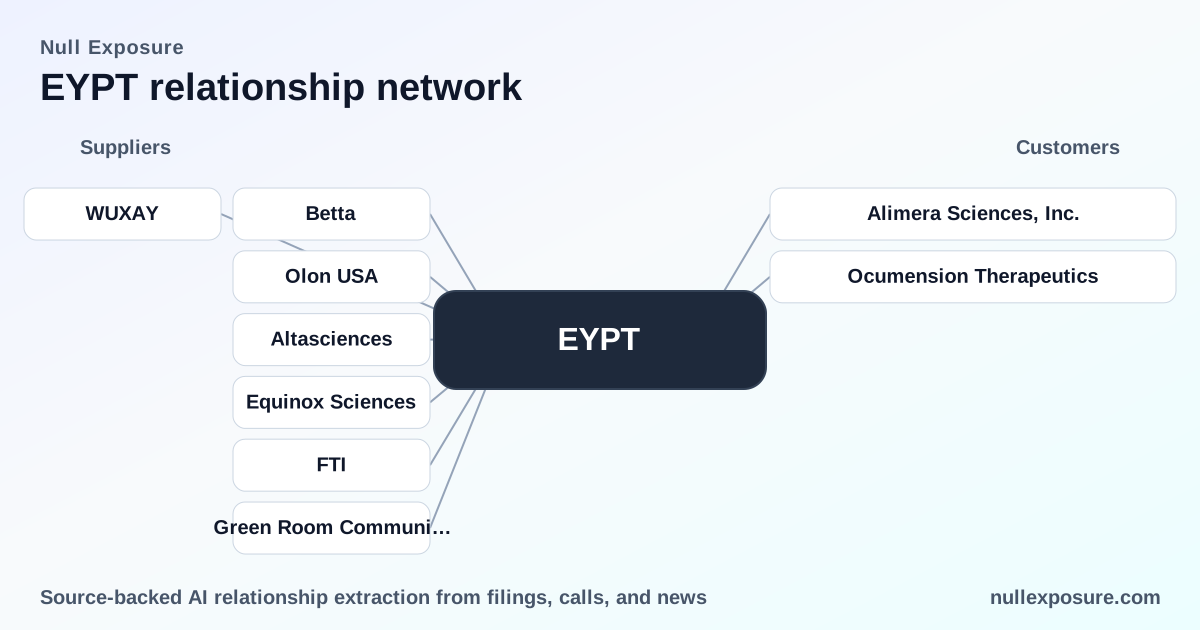
EyePoint Pharmaceuticals (EYPT): Customer Relationships and Commercial Posture
EyePoint Pharmaceuticals develops and commercializes ophthalmic pharmaceuticals and monetizes through a combination of product sales (notably YUTIQ and DEXYCU), commercial supply agreements with third parties, and occasional licensing/collaboration revenue. The company’s FY2024 disclosures show a business model that mixes direct product economics with partner-led distribution for certain assets, producing modest license receipts and concentrated U.S. sales. For a concise source of relationship-level intelligence, see https://nullexposure.com/.
How EyePoint sells and where revenue comes from
EyePoint’s commercial footprint is a hybrid model: product revenues from its ophthalmic portfolio are supplemented by licensing and supply agreements that transfer selling or distribution responsibilities to third parties. This structure reduces direct commercial cost for specific products but creates dependency on partner execution and contractual terms.
Key operating characteristics drawn from company disclosures:
- Contracting posture: licensing and supply agreements are active. The company recorded license and collaboration revenue tied to an Eyebio agreement and explicitly cites supply agreements for YUTIQ with external companies in FY2024.
- Channel concentration: partial shift to third‑party distributors. Effective January 2023, DEXYCU commercial sales are fulfilled only through specialty distributors rather than company-supported direct sales.
- Revenue scale and materiality: license income is immaterial to consolidated revenue. An upfront license payment of $0.5 million in 2024 is recorded as license and collaboration revenue, consistent with a spend band in the low‑six‑figure to sub‑million range.
- Geographic concentration: U.S. sales dominate reported commercial lines. The FY2024 disclosure shows the U.S. as the primary regional contributor to the applicable revenue line items.
These characteristics together define a capital-light commercialization posture for selected products while maintaining direct exposure to the economics of drug ownership and regulatory risk.
The named commercial partners in the filing (what to know)
The FY2024 Form 10‑K identifies two named partners for YUTIQ commercial supply. Below are concise, plain-English takeaways for each relationship, followed by the citation.
Alimera Sciences, Inc.
YUTIQ has been sold under a commercial supply agreement with Alimera effective May 2023, indicating that Alimera is a named channel partner responsible for commercial activity related to that product. According to EyePoint’s FY2024 Form 10‑K, this arrangement is ongoing. (FY2024 10‑K)
Ocumension Therapeutics
YUTIQ has also been sold under a commercial supply agreement with Ocumension effective May 2023, making Ocumension another named counterparty for the product’s commercialization under those supply terms. The FY2024 10‑K lists Ocumension alongside Alimera as the continuing commercial seller. (FY2024 10‑K)
What the agreements imply for revenue and risk
- Control vs. reach trade-off: By placing YUTIQ under commercial supply agreements with established partners, EyePoint trades incremental sales control for partner reach and lower direct selling expense. This reduces short‑term SG&A burden but heightens exposure to partner execution and contract renewal risk.
- Limited licensing upside in the short term: The company recorded $0.5 million in license and collaboration revenue tied to the Eyebio License Agreement executed May 17, 2024, classifying licensing as currently an immaterial but visible revenue stream rather than a major profit driver.
- Channel concentration risk for DEXYCU: Since January 2023, DEXYCU sales moved exclusively through specialty distributors, which concentrates counterparty risk for that product’s distribution pipeline and reduces EyePoint’s direct market intelligence.
- U.S.-centric revenue profile: Reported figures show U.S. predominance for the cited revenue items, which concentrates regulatory and payer risk geographically.
For investors, the combination of partner-led commercialization and modest licensing receipts positions EyePoint as a company with product ownership and outsourced go-to-market execution, rather than a direct commercial engine for all assets.
Financial context that matters
EyePoint’s FY2024 and TTM metrics underline the scale mismatch between its contractual activity and company-level economics. The company reports roughly $31.4 million in trailing twelve‑month revenue, a negative gross profit figure on the TTM basis, and an operating margin well into negative territory—factors that make partner arrangements economically significant even when the absolute license dollars are small. These numbers frame why the company is using third‑party sellers and distributors to manage cost and reach.
Practical checklist for investors and operators
- Evaluate contract terms: look for minimum purchase obligations, pricing mechanics, termination provisions, and geographic exclusivity in the supply agreements with Alimera and Ocumension.
- Monitor partner performance metrics: penetration, reorder cadence, and specialty distribution throughput will be primary drivers of future product revenue.
- Watch license pipeline: the Eyebio agreement generated a one‑time upfront; recurring or milestone‑based payments will materially change the revenue profile only if they scale beyond the current low‑six‑figure band.
- Consider channel risk: reliance on specialty distributors for DEXYCU and commercial sellers for YUTIQ centralizes operational risk outside the company’s direct control.
Bottom line for investor decision-making
EyePoint operates a mixed monetization model that preserves product ownership while outsourcing significant portions of commercialization. The two named supply partners—Alimera and Ocumension—are central to YUTIQ’s market presence since May 2023, while DEXYCU runs through specialty distributors. License revenues exist but are currently small relative to total company economics. This structure lowers direct selling expense but elevates partner execution and contract renewal risk; diligence should prioritize the terms and performance of those third‑party relationships.
For additional relationship-level reporting and to compare these arrangements across peers, consult NullExposure’s intelligence hub at https://nullexposure.com/.