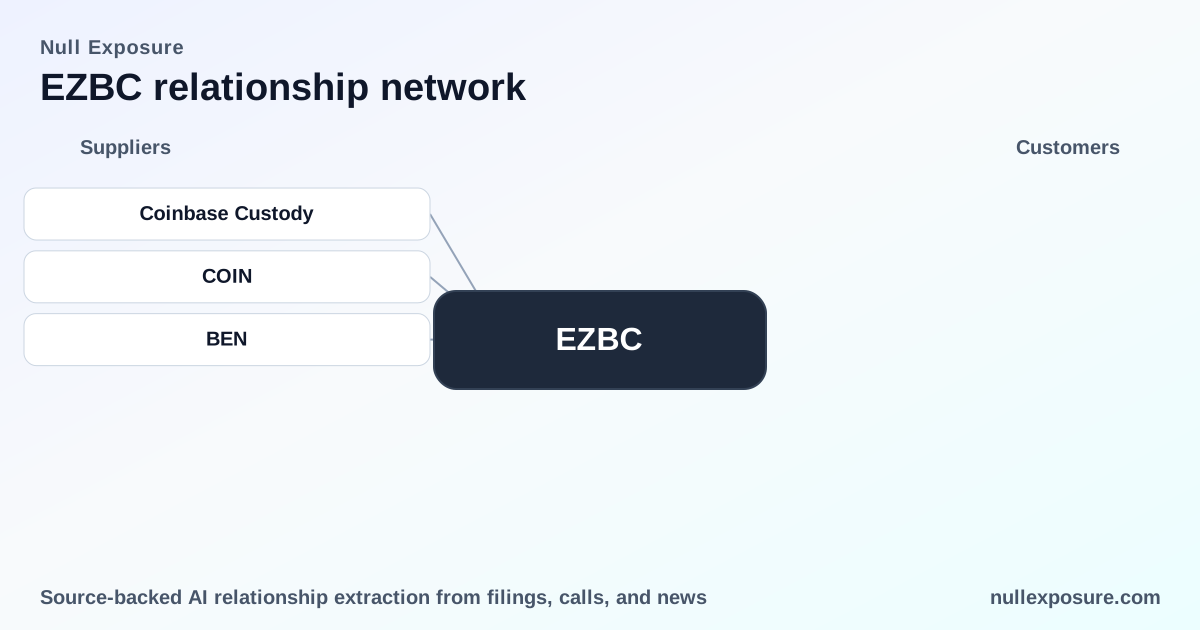
EZBC: Customer Relationships, Operating Constraints, and What Investors Should Price In
EZBC operates as a funds operator that issues and redeems ETF-style Shares and generates revenue through asset-based management fees and trading-related economics tied to fund liquidity and assets under management. The company’s customer relationships are concentrated around market participants who perform creation and redemption functions, and these counterparties are essential to daily liquidity and price discovery — investors should price in counterparty concentration and regulatory proximity as the primary operational risks. Learn more at https://nullexposure.com/.
How EZBC’s commercial model translates into investor risk and revenue
EZBC monetizes primarily through the management of fund assets and the associated fee schedule charged to shareholders, while relying on a narrow set of market intermediaries — Authorized Participants — to convert blocks of fund shares into underlying securities and vice versa. That operational design concentrates counterparty exposure: a small set of broker-dealer Authorized Participants is both the distribution backbone and the liquidity engine for the fund product, making counterparty behavior directly relevant to trading spreads, secondary-market liquidity and the fund’s ability to scale.
Contracting posture and regulatory boundaries that shape customer behavior
EZBC’s operating model is governed by standard ETF mechanics and U.S. securities law: Authorized Participants must be registered broker-dealers subject to federal customer-protection, net-capital and recordkeeping rules. According to the fund’s regulatory disclosure language, these requirements create a contracting posture in which the company depends on licensed broker-dealers to execute creations and redemptions and comply with regulatory obligations. Regulatory compliance is not an optional add-on — it directly constrains who can act as a counterparty and how those counterparties operate.
Concentration: a structural feature, not an outlier
The fund disclosure explicitly flags a limited number of institutions that act as Authorized Participants; those same institutions often serve competing products. The filing states that Authorized Participants are not obligated to make markets or to submit orders, and their incentives can favor competing products over the fund’s Shares. Concentration of Authorized Participants is therefore a structural concentration risk: a small set of counterparties can influence liquidity provision and pricing, and they hold bargaining power over the fund’s secondary-market depth.
Criticality: counterparties are essential to liquidity and redemption mechanics
Authorized Participants function as both buyers and sellers in the creation/redemption process, making them operationally critical to the fund. The fund’s disclosures note that these counterparties are not contractually bound to maintain spreads or submit Creation Unit orders, which creates an exposed operating posture: liquidity is contingent and subject to counterparty choice and market incentives. That dynamic makes operational resilience heavily dependent on the continuity and incentives of those participants.
Maturity signals: active engagement and redemptions
The company’s filings report active redemption activity — the Fund redeemed 102 Creation Units (5,100,000 Shares) in the quarter ended March 31, 2025 — indicating that creation/redemption mechanics are functioning in live markets and that Authorized Participants are operationally engaged. This is a maturity signal: the product has live flows and counterparty interaction, not merely paper disclosures.
Customer relationship coverage: eToro
eToro — listed as ETOR in the relationship set for EZBC — is reported to be expanding its Smart Portfolios offering and launching portfolios with asset managers such as Franklin Templeton, WisdomTree, ARK Invest and Amundi. According to a March 9, 2026 press item reported via FinTech Magazine/GlobeNewswire, eToro expanded its Smart Portfolios to include these new partner portfolios in FY2026. This item is cataloged as a customer-related mention in EZBC’s relationship dataset and indicates eToro’s product expansion activity that could influence distribution channels for fund-like products. Source: FinTech Magazine / GlobeNewswire, March 9, 2026.
What the relationships and constraints imply for valuation and operations
- Revenue sensitivity to flows and spreads: Because EZBC monetizes via asset-based fees and trading-related economics, short-term fee revenue is sensitive to net inflows and to bid/ask spread dynamics driven by Authorized Participants.
- Counterparty concentration premium: Investors should assign a concentration premium (discount) to value depending on the fund’s number and diversity of Authorized Participants; the filing identifies a small set of APs, which increases counterparty concentration risk.
- Liquidity risk is a business risk: The explicit disclosure that Authorized Participants are not obligated to provide market-making means that secondary-market liquidity is a firm-level business risk tied to counterparty incentives.
- Regulatory overhead and operational compliance are baked-in costs: Registration and regulatory compliance for Authorized Participants create an implicit gating function that affects who can serve as a customer and under what terms.
Learn about the methodology and how we surface these relationship signals at https://nullexposure.com/.
Key takeaways for investors and operators
- Concentration is material. A small universe of Authorized Participants delivers core liquidity and distribution functions, and the company’s own disclosures classify that concentration as material.
- Counterparty incentives directly affect liquidity. The contractual posture grants Authorized Participants the choice to prioritize other competing funds, which has direct implications for spreads and redemption execution.
- Active redemptions confirm operating maturity but increase cash-flow variability. Reported Creation Unit redemptions show real-world flows; investors must price in episodic liquidity demands.
- Regulatory exposure is central. Operations run inside U.S. broker-dealer and federal securities frameworks that both limit counterparty choice and create compliance costs.
Bottom line
EZBC is an ETF-style fund operator with monetization tied to assets under management and market liquidity. The primary investment thesis is therefore driven by the stability and incentives of a narrow set of Authorized Participants, plus the firm’s ability to attract and retain assets given that concentration and regulatory framing. For investors evaluating EZBC’s customer relationships, the decisive factors are counterparty concentration, active engagement by Authorized Participants, and the regulatory environment that limits who can transact with the fund.
If you want a deeper read on how these relationship signals move valuation and risk across similar fund issuers, visit https://nullexposure.com/.