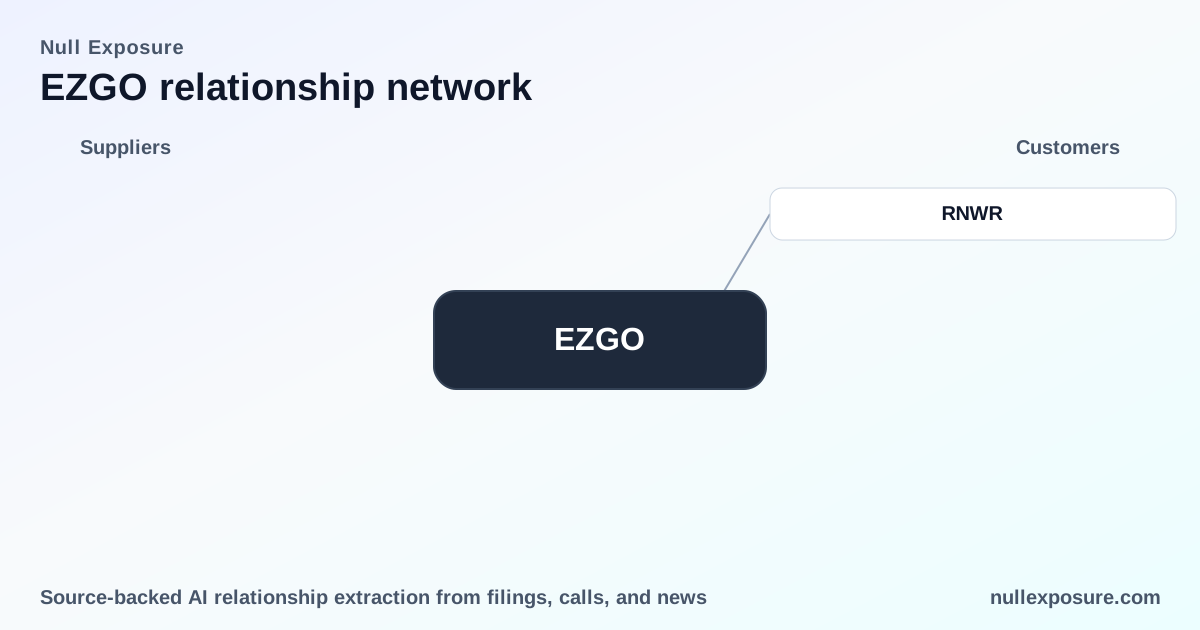
EZGO Technologies: Customer Relationships and What They Mean for Investors
EZGO Technologies designs, manufactures, rents and sells electric bicycles and tricycles in China and monetizes through direct unit sales, rental operations and contract manufacturing partnerships with third-party brands. The company’s commercial model blends product revenue with fee-based manufacturing agreements, where production schedules and cash flow are driven by partner orders rather than fixed long-term supply commitments.
For active investors and operators evaluating EZGO’s customer posture, this note synthesizes every customer relationship disclosed in our review, explains how those links translate into revenue and operational risk, and highlights the strategic implications for valuation and portfolio positioning. For deeper relationship intelligence on EZGO and peers, visit https://nullexposure.com/.
The practical investor thesis up front
EZGO’s revenue base is order-driven and operationally flexible: it sells finished vehicles and offers contract manufacturing capacity to external brands. That structure supports upside when partner demand accelerates, but it also produces revenue volatility because production is scheduled by partner orders rather than guaranteed minimums. Investors should treat EZGO as a manufacturing-exposed consumer-cyclical operator whose top-line is highly correlated with OEM partner sales cycles and consumer demand for electric light vehicles.
Contracting posture, concentration and maturity — what the public record shows
The public disclosures we reviewed do not list long-term guaranteed purchase commitments or service-level guarantees tied to customers; no customer-specific contractual constraints are reported in the available results. That company-level signal indicates EZGO is operating with flexible, demand-triggered manufacturing arrangements rather than fixed, high-visibility off-take contracts.
This posture implies:
- Operational flexibility: EZGO can scale production up or down to match orders, which limits inventory risk in weak demand periods.
- Revenue variability: Without firm multi-year off-take commitments, quarterly revenue will track partner ordering behavior.
- Concentration risk potential: When revenue depends on a small number of brand partners, a single large client’s order cadence can swing quarterly results materially.
Every disclosed customer relationship (concise summaries and sources)
SilverLight Electric Vehicle Inc. (listed in results as SilverLight)
EZGO is publicized as a co-manufacturer for SilverLight’s reverse-trike vehicles, with production to be scheduled according to market demand and orders received from SilverLight. This positions EZGO as a manufacturing partner rather than a distributor or guarantor of sales, making revenue contingent on SilverLight’s order flow. According to a PR Newswire release dated March 9, 2026, EZGO and SilverLight agreed on a co-manufacturing arrangement for reverse-trike vehicles. Source: PR Newswire/PRN Asia release (March 2026).
RNWR (inferred symbol tied to the same release)
The release that names SilverLight is recorded in our results under the inferred symbol RNWR; the same production scheduling condition—production paced by SilverLight orders—is explicitly noted. Investors should treat RNWR as the market ticker flagging the SilverLight relationship in these records. The co-manufacturing agreement is documented in the same PR Newswire release (March 9, 2026), which establishes that EZGO’s manufacturing obligations are contingent on partner demand. Source: PR Newswire/PRN Asia release (March 2026).
What these relationships mean for revenue, margins and capital allocation
EZGO’s engagement as a co-manufacturer for SilverLight (RNWR) demonstrates two core business-model characteristics:
- Revenue is transaction and order-driven: Sales from co-manufacturing accrue when partners place orders; there is no public evidence of guaranteed minimum volumes or take-or-pay clauses in the disclosed materials.
- Gross margins will reflect mix and utilization: Co-manufacture work can improve factory utilization in weak retail cycles but compress margins if volumes are low or if specialized tooling and customization drive costs. EZGO’s latest reported gross profit and margin trends should be read through that lens.
Operationally, EZGO must balance capital allocation between supporting partner projects (tooling, assembly lines) and preserving flexibility to serve its own branded sales and rental programs. Capital deployment decisions will materially affect operating leverage and cash flow volatility.
Key risks and upside drivers for investors
- Key risk — order concentration and volatility: When a partner like SilverLight represents a meaningful portion of production, cancellations or order slowdowns translate immediately into excess capacity risk and top-line swings.
- Key risk — limited revenue visibility: The absence of disclosed long-term off-take commitments reduces near-term revenue visibility and complicates forecasting.
- Upside driver — capacity monetization: When partner demand ramps, EZGO’s manufacturing capabilities generate incremental revenue with relatively low incremental SG&A, improving operating leverage.
- Upside driver — product diversification: Expanding co-manufacturing for different vehicle types (e.g., reverse-trikes) broadens served markets and reduces single-product sensitivity.
Practical signals for underwriting exposure or partnership diligence
When evaluating EZGO for investment or as a potential supplier/customer, prioritize diligence on:
- Order book composition and concentration: Request the list of active partner commitments and their expected cadence.
- Contract terms: Seek clarity on minimum quantity commitments, lead times, termination rights and cost pass-through mechanisms.
- Factory utilization and flexibility: Understand how EZGO reassigns capacity between internal brands and third-party contracts.
Strategic conclusion and investor actionables
EZGO operates a hybrid model that generates revenue from direct sales, rentals and contract manufacturing relationships that are explicitly order-driven. The SilverLight (RNWR) co-manufacturing agreement exemplifies a commercially useful but visibility-limited revenue source: it is growth-enabling when partner orders arrive and a volatility amplifier when they do not. Investors should underwrite valuation models with conservative assumptions about recurring partner orders and stress-test scenarios where a major partner reduces cadence.
For a broader view of EZGO’s customer relationships and comparable partner risk profiles across the electric light-vehicle sector, explore our research hub at https://nullexposure.com/.
Bold takeaways:
- EZGO monetizes both branded sales and contract manufacturing; partner orders dictate production.
- No customer-specific contractual constraints are reported publicly, implying flexible but lower-visibility revenue streams.
- SilverLight (RNWR) is a material co-manufacturing partner by disclosure; production is scheduled by its orders.
This analysis is focused on disclosed customer relationships and their strategic implications; investors should complement it with direct contract review and management commentary for near-term revenue guidance.