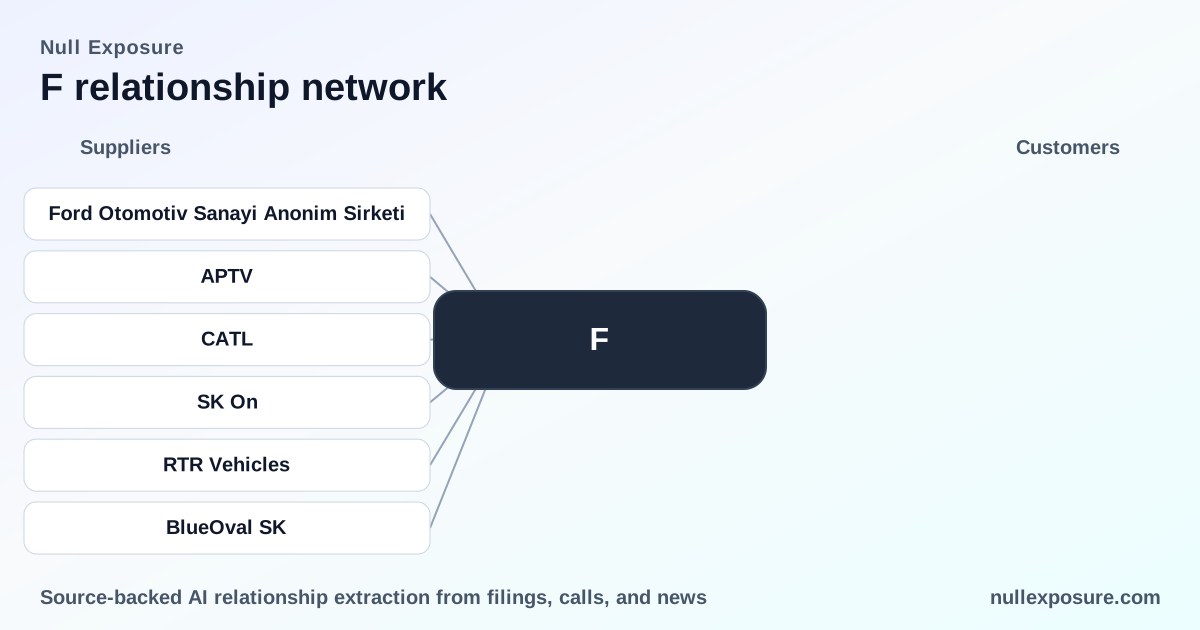
Ford (F) as a Customer: A Synthesis for Investors and Operators
Ford monetizes through vehicle sales, extended service contracts, parts and accessories, fleet solutions (Ford Pro), and an expanding software and electrification franchise. The company’s revenue mix combines high-volume wholesale vehicle sales channeled through independent dealers with recurring, long-duration service and digital offerings that are collected upfront or embedded in financing—creating both cyclical exposure to auto demand and a growing annuity-style revenue stream from services and software. This profile positions Ford as a global OEM whose customer relationships span retail consumers, governments, commercial fleets and a broad set of downstream suppliers and upfitters. For more granular relationship intelligence, visit https://nullexposure.com/.
Market-facing summary and operating context
Ford’s customer ecosystem is large and pluralistic: vehicles and parts are predominantly sold through independent dealers and distributors, while commercial and fleet customers increasingly transact through Ford Pro and certified upfitter programs. Contracting posture blends short-cycle wholesale transfers of control with long-term service contracts (12–120 months) that generate upfront cash flow and extended liability. Geographically, Ford operates globally with concentrated scale in North America and significant presence in EMEA and APAC. Institutional ownership and a diversified dealer base reduce single-buyer concentration, but dependency on dealer channels and strategic upfitter partners creates operational leverage and vendor criticality.
What this means for investors and operators:
- Revenue durability is improving via service and software lines even as vehicle sales remain cyclical.
- Counterparty mix spans individuals, governments and commercial fleets, which smooths demand cycles but raises product customization and integration risks.
- Distribution dependency on independent dealerships and authorized upfitters is a structural feature that affects speed to market and margin capture.
Key relationships uncovered in public filings and news
Below are the customer-side relationships surfaced in the reviewed results, with a concise plain-English take on each and a source citation.
-
ABG — ABG’s FY2024 filing lists Ford and Lincoln among its brand roster for new vehicles, indicating ABG carries Ford/Lincoln product in its dealership or distribution network. According to ABG’s FY2024 10‑K filing, Ford/Lincoln are included in its vehicle memberships (abg‑2024‑12‑31).
-
XPER (Xperi) — Xperi’s DTS AutoStage radio platform ingests connected-vehicle telemetry from a fleet that explicitly includes Ford and Lincoln models, tying Ford into emerging in-car data monetization and advertising channels. This was reported in a March 2026 industry article on DTS AutoStage and connected radio (broadcastdialogue.com, FY2025/2026).
-
AN (AutoNation) — AutoNation’s growth commentary references expansion that included a Ford and Mazda store in Denver, demonstrating AutoNation’s role as a retail partner and point-of-sale channel for Ford vehicles. AutoNation discussed this in its Q4 FY2025 earnings commentary/transcript (insidermonkey.com, FY2026).
-
UTI (Universal Technical Institute) — UTI maintains training partnerships with leading OEMs including Ford, which embeds Ford-specific technician training into workforce pipelines and supports aftermarket and dealer service capabilities. This strategic training relationship was noted in a Barrington Research coverage slip via MarketBeat (marketbeat.com, FY2026).
-
WGO (Winnebago Industries) — Winnebago builds several RV models on proven Ford chassis and has piloted electric Ford platforms, making Ford a critical component supplier for certain RV product lines. Winnebago’s product announcements and earnings comments reference Ford chassis use and EV pilot programs (sahmcapital.com and insider monkey transcripts, FY2026).
-
PCG‑P‑D (PG&E / V2G program) — Public reporting on electric vehicle-to-grid integrations lists Ford among approved vehicle participants for utility V2X programs, positioning Ford vehicles as potential grid assets beyond transportation. Coverage of PG&E’s V2G program referenced Ford’s inclusion (prnewswire.com and electrive.com, FY2026).
-
SHYF (The Shyft Group / Utilimaster, Royal Truck Body, etc.) — Shyft brands are integrated into Ford’s commercial upfitter programs and selected as preferred upfitters within Ford Pro, enabling direct chassis supply and access to Ford’s commercial dealer network. Fleet Equipment Mag and other trade releases documented Shyft joining the Ford Pro Upfitter program (fleetequipmentmag.com, FY2024).
-
UHAL (U‑Haul) — Operational supply decisions at Ford, including plant shift reductions as part of ICE capacity reallocation, have tangentially impacted long-standing supplier-customer dynamics with fleet customers such as U‑Haul that sourced vehicles or chassis from Ford lines. Zacks/Scr analysis of U‑Haul FY2026 results discussed Ford’s capital allocation decisions (scr.zacks.com, FY2026).
-
BLBD (Blue Bird Corporation) — Blue Bird secured funding to commercialize a school bus powered by a Ford engine and Roush CleanTech fueling system and extended collaboration with Ford through 2030, establishing Ford powertrains as a strategic supply relationship in the bus segment. Trade reporting and SEC filings document Blue Bird’s collaboration extension and development funding (lpgasmagazine.com; tradingview news on Blue Bird’s 10‑K, FY2025).
-
GPI (Group 1 Automotive, Inc.) — Group 1 Automotive’s quarterly disclosure shows Ford/Lincoln represent a measurable share of the dealer group’s vehicle mix (roughly mid‑single digits by brand share in the referenced quarter), confirming Ford’s continued reliance on large public dealer groups for volume distribution. Group 1’s Q1 FY2026 financial report includes Ford/Lincoln share statistics (group1corp.com, FY2026).
Operating model constraints and what they signal about Ford’s customer risk profile
The extracted constraints should be read as company-level operating signals rather than relationship-level assertions unless explicitly named in an excerpt.
-
Long-term service contracts: Ford sells separately priced service contracts ranging 12–120 months with upfront payment, creating upfront cash inflows and long-duration warranty/service obligations—this shapes liquidity timing and deferred revenue recognition.
-
Counterparty diversity: Evidence shows Ford serves government, commercial and individual customers across retail and fleet segments, which reduces pure-demand concentration but increases product-configuration complexity.
-
Global footprint: Ford reports wholesale sales globally and operates across North America, EMEA and APAC, with material revenue concentration in North America; this geographic breadth diversifies macro risk but heightens regulatory and supply-chain complexity.
-
Distribution posture: Ford relies predominantly on independent dealers and resellers for the majority of vehicle, parts and accessory sales, while simultaneously investing in direct digital channels—this hybrid model retains dealer leverage over retail execution.
-
Segment split: Business lines include Ford Blue (core ICE/hybrid product), services (fleet telematics, charging, maintenance), and software/Model e development—underscoring a strategic transition from hardware-only to integrated hardware–software offerings.
Collectively, these constraints indicate a company with improving revenue durability through services and software, entrenched distribution dependencies that limit direct margin capture, and operational complexity from a global footprint and transition to electrification. For investors, the critical leverage points are Ford’s success in converting vehicle-installed software and services into recurring revenue and its management of dealer and upfitter channel economics.
If you want deeper, cross-company exposure mapping or tailored alerts on Ford’s partner set, explore our platform at https://nullexposure.com/ for relationship-level analytics and monitoring.
Final takeaway
Ford’s customer map combines legacy wholesale vehicle channels with expanding software and fleet offerings; the company’s future margin and risk profile hinge on monetizing in-vehicle data, scaling long-term service agreements, and managing the dealer/upfitter ecosystem during electrification.