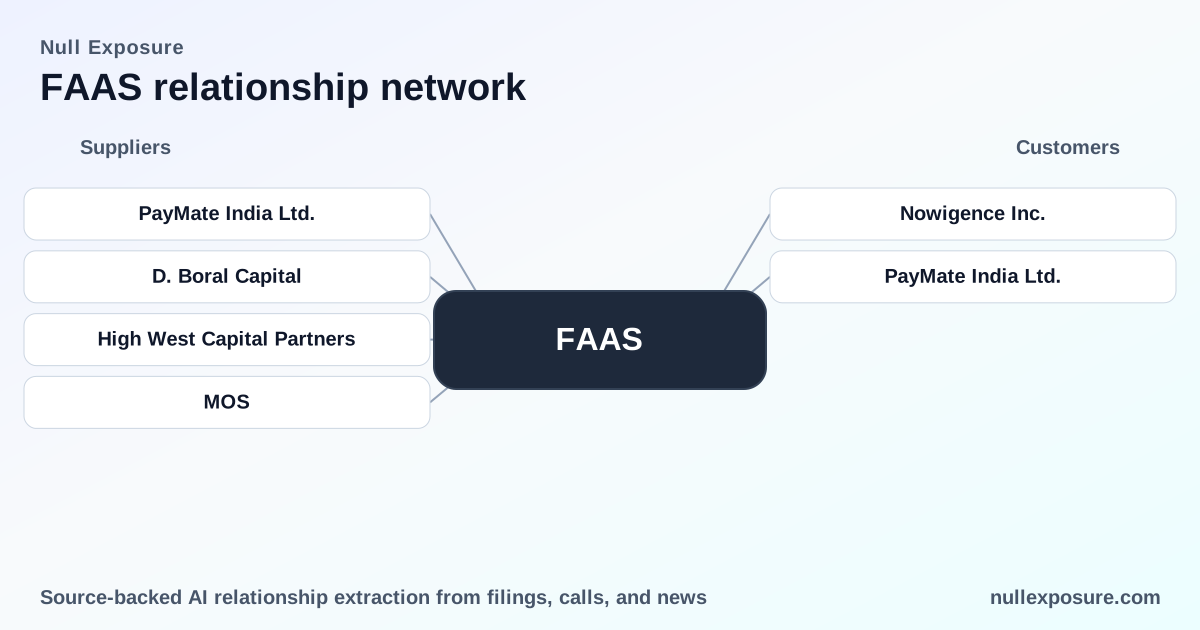
DigiAsia (FAAS): Customer Relationships That Move the Payment Stack
DigiAsia builds and monetizes a payments and fintech platform in Indonesia by licensing payment rails, executing licensed fiat transfers, and selling platform access and white‑label services to regional partners. Revenue derives from transaction fees, FX spread capture and strategic licensing, with recent customer deals expanding both retail crypto on‑ramps and B2B cross‑border flows—an operational profile that rewards scale in transaction volume and licensing leverage while concentrating regulatory and partner risk.
For readers evaluating FAAS customer exposure, this note dissects every reported customer relationship, outlines company‑level operating constraints implied by the pattern of deals, and draws investment implications for operators and allocators. For deeper signals on counterparties and partner history, visit https://nullexposure.com/ for extended research and tracking.
What each customer relationship actually is — concise, attributable takeaways
Indodax — fiat rails into Indonesia’s largest crypto exchange
DigiAsia will provide licensed fiat fund transfer services that allow Indodax’s user base—reported as over 7 million—to deposit and withdraw Indonesian Rupiah in real time, effectively acting as the regulated on‑ramp for a major crypto platform. According to a Newsfile press release dated May 2, 2026, the integration routes IDR flows directly into Indodax and positions DigiAsia as a key payments partner for crypto liquidity and retail transaction volume (Newsfile, 2026-05-02: https://www.newsfilecorp.com/release/254325/DigiAsia-Corp-FAAS-Partners-with-Indodax-to-Power-Fiat-Transfers-for-Indonesias-Largest-Crypto-Exchange).
Nowigence Inc. — licensing exchange for AI platform rights paid partly in stock
DigiAsia agreed to license an AI platform for specified regions in exchange for Nowigence issuing 1,200,000 Class A common shares to DigiAsia as consideration, embedding licensing income into an equity transaction. The company announced this licensing arrangement in a Newsfile release dated March 9, 2026, which frames the deal as a revenue‑generating licensing agreement covering MENA and North American markets (Newsfile, 2026-03-09: https://www.newsfilecorp.com/release/261981/DigiAsia-Corp-FAAS-Announces-6-Million-AI-Platform-Licensing-Agreement-with-Nowigence-Inc.-for-MENA-and-North-American-Markets).
PayMate India Ltd. — B2B cross‑border payments alliance ahead of proposed acquisition
PayMate will leverage DigiAsia’s FX licenses and regional payment rails to accelerate cross‑border B2B transactions across Asia‑Pacific, tapping into a large enterprise payments market and positioning DigiAsia as the operational FX and transfer backbone for PayMate’s regional flows. The strategic alliance was detailed in a Newsfile release on March 9, 2026, which cited cross‑border B2B payments across a stated $500B addressable market (Newsfile, 2026-03-09: https://www.newsfilecorp.com/release/254874/PayMate-and-DigiAsia-Corp-Strengthen-Strategic-Alliance-Ahead-of-Proposed-Acquisition).
What these relationships imply about DigiAsia’s operating model and commercial posture
These customer ties collectively reveal a platform company that sells access to regulated payment rails and monetizes both retail‑facing and enterprise flows. From the pattern of deals, derive the following company‑level signals:
- Contracting posture — partner‑centric and licensing oriented. DigiAsia pursues strategic alliances and licensing deals rather than pure direct‑to‑consumer scale alone; the Nowigence stock consideration and PayMate alliance show a mix of fee and equity compensation, indicating flexible deal structures to accelerate distribution.
- Concentration and counterparty dependence. A meaningful portion of near‑term volume potential is tied to large named partners (Indodax, PayMate); this creates concentration risk around a small set of counterparties that drive transaction throughput.
- Criticality to customer operations. For customers that require licensed FX and real‑time IDR rails (crypto exchanges, B2B payment platforms), DigiAsia offers a mission‑critical service—loss of access would directly interrupt deposit/withdrawal and cross‑border flows, elevating operational importance and bargaining leverage for DigiAsia.
- Commercial maturity and scaling vector. Deals include both regional licensing and equity consideration, signaling a company in commercial scaling mode that uses partnerships to extend geography and product reach while conserving cash.
- Regulatory dependency. Licensing and FX services are regulated activities; the company’s revenue model is tightly coupled to regulatory compliance and license retention in Indonesia and partner jurisdictions.
None of these constraints are tied to a single counterparty in the source material; they are company‑level signals derived from the set of disclosed customer transactions.
Investment implications: where the upside and risk concentrate
- Upside from network effects: The Indodax integration converts retail crypto flows into recurring transaction revenue; if volume ramps, DigiAsia captures fees and spreads at scale. Large on‑ramps can drive meaningful margin expansion on transaction economics.
- Revenue diversification via licensing: The Nowigence arrangement demonstrates alternative monetization beyond per‑transaction fees—licensing and equity consideration diversify economics and reduce pure volume dependence.
- Enterprise growth through B2B rails: PayMate’s use of DigiAsia’s FX licenses points to a scalable enterprise channel. If DigiAsia wins multiple B2B anchor customers, revenue becomes stickier and gross margins improve.
- Key risk — counterparty and regulatory concentration: Heavy dependence on a few partners and licensed activities means partner deterioration or regulatory action would materially affect cash flows.
- Execution risk in cross‑border scaling: Cross‑jurisdictional payments and remittances require certification, local partnerships and settlement capabilities; execution speed and compliance track record will determine whether these deals convert to predictable revenue.
For subscription access to ongoing monitoring of FAAS partner activity and counterparty signals, see https://nullexposure.com/ for subscription options and regular updates.
Tactical takeaways for operators and allocators
- For operators: prioritize operational resilience and compliance in any integration with DigiAsia; its rails are mission‑critical and require rigorous SLA and escrow arrangements.
- For allocators: treat revenue from large named partners as concentration exposure in any model and stress test scenarios where partner volume falls by 30–50%.
- For potential partners: DigiAsia’s mix of licensing and equity consideration shows flexibility—negotiate clear IP and fee frameworks to avoid dilution of long‑term payment economics.
Bottom line
DigiAsia’s disclosed customer relationships reveal a deliberate commercial strategy: sell regulated payment rails and licensing rights to high‑volume partners while taking equity where it accelerates distribution. This is a payments infrastructure play with scalable revenue levers and concentrated counterparty risk; investors should weigh near‑term volume upside against regulatory and partner concentration exposure.