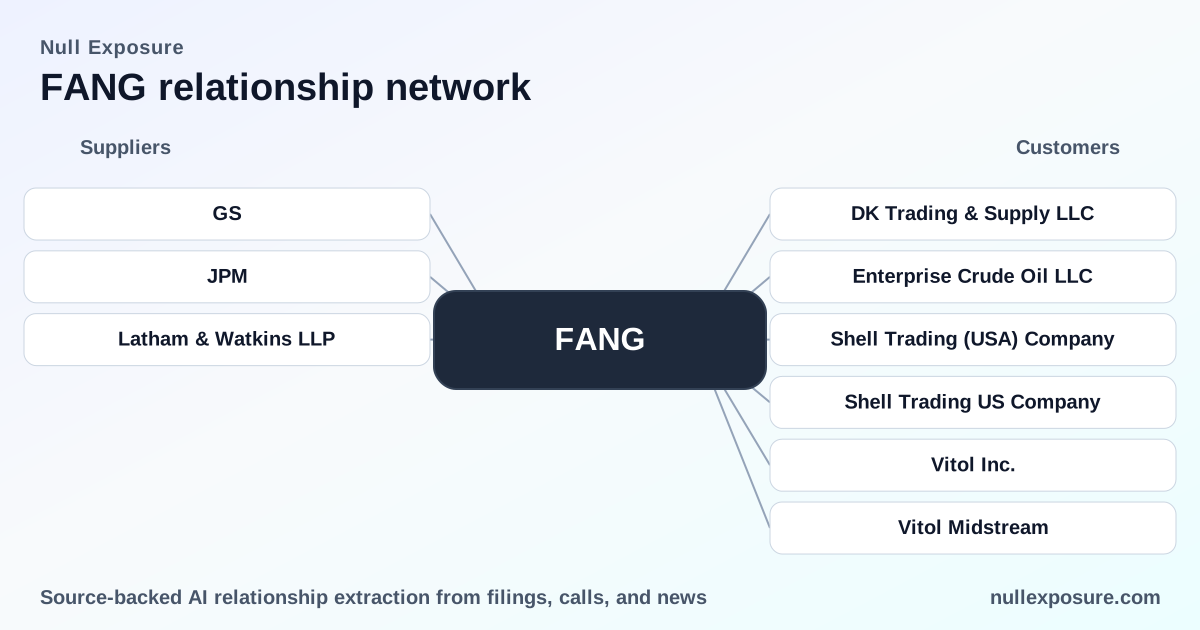
Diamondback Energy (FANG): Customer Map and Contracting Signals for Investors
Diamondback Energy operates as an upstream oil and gas producer focused on the Permian Basin and monetizes by selling crude oil, natural gas and NGLs to a small number of large purchasers, retaining a material royalty/mineral business through Viper and selectively monetizing midstream assets. Revenue is concentrated and sales are executed under a mix of spot and long‑term crude arrangements with large trading houses and pipeline partners, creating both scale economics and customer concentration risk. For deeper coverage of corporate customer relationships, visit https://nullexposure.com/.
Executive thesis: how Diamondback converts production into cash
Diamondback’s core business is upstream oil and gas production in West Texas; substantially all revenue is generated by selling produced hydrocarbons at point of transfer to a narrow set of counterparties. The company supplements cash flow through strategic asset drops to Viper and selective midstream dispositions, converting operating control and acreage economics into distributable value.
What Diamondback named as its top purchasers in FY2024
The 2024 Form 10‑K discloses four purchasers each contributing more than 10% of revenue, a concentrated buyer mix that drives both pricing realization and counterparty exposure.
DK Trading & Supply LLC
DK Trading accounted for roughly 11% of Diamondback’s revenue in FY2024, making it a single, material purchaser in the company’s customer mix. According to Diamondback’s 2024 Form 10‑K, DK Trading was one of four purchasers each representing over 10% of sales.
Enterprise Crude Oil LLC
Enterprise purchased approximately 15% of Diamondback’s production in FY2024, positioning it as the largest individual counterparty disclosed for the year. The company’s 2024 Form 10‑K lists Enterprise Crude Oil LLC as one of four purchasers exceeding 10% of revenue.
Shell Trading (USA) Company
Shell Trading (USA) took about 13% of Diamondback’s production in FY2024, another top-tier offtaker named in the 10‑K and representative of trading‑house scale counterparties in the roster.
Shell Trading US Company
Shell Trading US Company is separately referenced in the 2024 Form 10‑K as a named customer entity, underscoring Diamondback’s reliance on major integrated trading counterparties for marketed volumes.
Vitol Inc.
Vitol accounted for roughly 17% of revenue in FY2024, the single largest purchaser disclosed, and is central to Diamondback’s customer concentration profile as reported in the 2024 Form 10‑K.
Vitol Midstream
Vitol Midstream is also listed among named customer-related entities in the 2024 Form 10‑K, reflecting the commercial and logistical relationships that support Vitol’s crude purchases from Diamondback.
Strategic partnerships and transactions cited in filings and press
Beyond headline purchasers, Diamondback’s public filings and press coverage list transactions and partnerships that affect revenue channels, midstream positioning and mineral monetization.
Viper Energy Inc. (VNOM)
Viper — Diamondback’s former publicly traded mineral and royalty vehicle — executed a $1.0 billion drop‑down closed May 1, 2025, transferring mineral interests from Diamondback; subsequent Viper filings noted a non‑cash impairment tied to assets recorded at Diamondback’s historical carrying value. Multiple company releases and press reports document the drop‑down and its financial impact (Viper press releases and filings, 2025–2026).
Conduit Power partnership (GRNT)
Diamondback partnered with Conduit Power to support development of 200 MW of natural gas‑fired generation scheduled for 2027, indicating a move to monetize produced gas via power offtake and behind‑the‑meter projects; this partnership was described on a GRNT earnings call (2025 Q4).
Verde Clean Fuels (VGAS)
Diamondback’s subsidiary Cottonmouth Ventures entered a joint development arrangement with Verde Clean Fuels to pursue natural gas‑to‑gasoline plants using Verde’s STG+ technology, with natural gas feedstock sourced from Diamondback operations in the Permian. CityBiz and subsequent press coverage documented the JV and funding milestones in 2024–2025.
Plains All American Pipeline, L.P. (PAA) and Plains GP Holdings (PAGP)
Diamondback sold a majority stake in Epic Crude Holdings, LP to Plains (PAA/PAGP) as part of midstream monetization activity; Plains’ disclosure and press coverage report a 55% sale of EPIC for approximately $1.2 billion in consideration across the sellers, reflecting active portfolio management of pipeline and transport exposure (Plains press release, Oct–Nov 2025; market coverage, 2026).
How contracting posture and other operating signals affect risk and upside
Diamondback’s reported constraints in its FY2024 filings provide a concise picture of how the company negotiates and executes sales and the implications for investors.
- Contracting posture — mixed long‑term and spot: The company is party to long‑term crude oil agreements obligating deliveries under specified terms, while the majority of upstream product sales originate only when production occurs and are effectively spot for each day’s production. This structure delivers flexibility to capture spot upside but exposes revenue to near‑term price volatility.
- Counterparties are large enterprises: The buyer roster is composed of major trading houses and pipeline operators, implying professionalized counterparties with credit and logistical capabilities but also concentrated bargaining power on large volumes.
- Geographic concentration — Permian‑centric: Operations and producing properties are concentrated in the Permian Basin, which reduces transportation complexity but raises regional operational risk tied to local takeaway capacity and basis differentials.
- Materiality and concentration risk: Four purchasers each exceeding 10% of revenue is a persistent, material customer concentration signal that affects downside risk if a counterparty recontracts or reduces purchases.
- Role and segment clarity: Diamondback is primarily a seller in the upstream segment; Viper and selective midstream dispositions are explicit strategies to convert reserves and royalties into cash, indicating an active asset‑management agenda rather than passive holding.
Key takeaways for investors
- Concentration is the dominant customer risk: Four buyers accounted for >10% of revenue in FY2024 — Vitol, Enterprise, Shell, and DK Trading — making counterparty disruption a real earnings risk.
- Mixed contracts create both optionality and volatility: Long‑term delivery agreements coexist with daily spot sales, so Diamondback captures market upside but remains exposed to price swings.
- Asset monetization shifts risk to non‑operating interests: The Viper drop‑down and EPIC sale reflect deliberate monetizations that de‑risk capital and monetize midstream stakes.
- Permian focus reduces costs but concentrates exposure: Geographic advantage for development is paired with single‑basin vulnerability to infrastructure and takeaway constraints.
For an investor‑grade feed of customer relationships and transaction links, see the full coverage at https://nullexposure.com/.
The combination of concentrated, large‑counterparty sales and active asset monetization defines Diamondback’s commercial model: scale‑driven upstream receipts tempered by counterparty concentration and midstream portfolio recycling. Investors should weight those dynamics against commodity price outlooks and takeaway infrastructure developments when sizing exposure to FANG.