Farmer Bros. (FARM): Customer relationships, counterparties and what they mean for investors
Farmer Bros. is a century-old coffee roaster and distributor that monetizes through a mix of product sales (roast & ground coffee, tea and related consumables), equipment services and regional distribution, historically delivered via a direct-store-delivery (DSD) network and wholesale contracts. Over the last three years the company has deliberately pared assets—selling its Northlake direct-ship business and shifting roasting concentration to Portland—while continuing B2B brand work and pursuing a sale that would take the company private. For investors, the thesis is simple: value now rests as much on asset disposition and strategic buyers as on the underlying B2B coffee economics.
For a deeper look at the sourcing and analytics that underlie this review, visit the Null Exposure homepage: https://nullexposure.com/
How Farmer Bros. actually operates and the constraints that define the business
Farmer Bros. is a seller of roasted and branded coffee and a downstream distribution and services business. Its revenue base comes from wholesale supply to foodservice, convenience and private-label customers and from equipment installation and maintenance. The company has shifted away from certain legacy direct-ship channels through asset sales, concentrating roasting operations geographically while maintaining a nationwide DSD footprint.
Key operating-model signals to factor into investment decisions:
- Customer mix is broad and split between small-business operators (independents, local foodservice) and large enterprise customers (chains, grocery private-labels and distributors), which reduces single-buyer concentration but exposes the company to both small-market churn and contract renegotiation with big accounts. (Company disclosures cited in FY2025–FY2026 filings.)
- Geographic reach is North America-centric, supported by a DSD network of 200+ routes and ~90 storage locations as of June 30, 2025, with core roasting concentrated in Portland, OR. This regional concentration creates operating leverage but also single-region operational risk. (Company FY2025 statements.)
- Product + services mix: core roasted coffee product sales are complemented by distribution logistics and equipment servicing, creating recurring revenue streams but lower margin services that amplify operational complexity. (Company product/service descriptions.)
- Contracting posture: Farmer Bros. acts as a supplier to large private-label manufacturers and as a seller to thousands of smaller accounts; the company’s posture is therefore both transactional (DSD off-truck sales) and contractual (supply agreements with large buyers). (Company disclosures.)
- Business maturity and strategic transition: the sale of non-core assets and the proposed acquisition offer from Royal Cup suggest a company in transition from standalone operator to consolidation target; that transition drives short-term valuation sensitivity to deal execution and regulatory/closing risk.
Counterparty relationships that matter (complete coverage)
Below are every counterpart referenced in reported coverage. Each entry is a concise, plain-English summary with the reporting source.
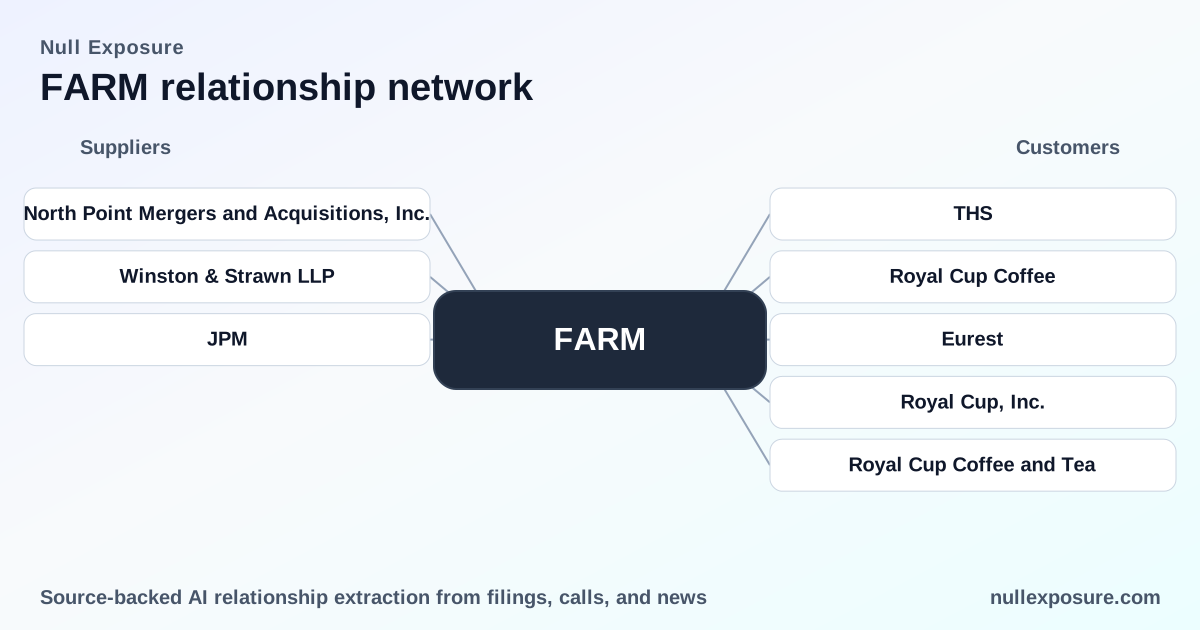
TreeHouse Foods / THS
Farmer Bros. sold its Northlake, Texas production and direct-ship business to TreeHouse Foods for about $100 million in 2023, a transaction that materially reduced Farmer Bros.’s DSD footprint and shifted certain manufacturing/distribution economics off the balance sheet. Multiple industry reports covered the sale and the role of Farmer Bros. as a supplier to TreeHouse’s private-label pod and ready-to-drink beverage businesses (Daily Coffee News, June 7, 2023; Food Business News, 2023; Vending Times and Dallas Innovates, 2023). Financial-content reporting in 2026 also notes TreeHouse disclosed completion of certain asset purchases from Farmer Bros. (Food Business News / DailyCoffeeNews / VendingTimes / Dallas Innovates; Markets FinancialContent, May 2026).
Royal Cup (Royal Cup Coffee & Tea / Royal Cup, Inc.)
Royal Cup announced an all-cash takeover agreement to acquire Farmer Bros. at $1.29 per share, valuing the company near $28 million and proposing to take the business private; the proposal has triggered market scrutiny and at least one shareholder investigation into transaction fairness. Coverage of the acquisition terms and subsequent legal attention appears in Daily Coffee News (March 5, 2026), intellectia.ai’s earnings summary, and a shareholder-alert published by a litigation firm in March 2026. (DailyCoffeeNews, March 2026; intellectia.ai, March 2026; Sahm Capital announcement, March 2026; GCRMag historical note).
Eurest (Compass Group)
Farmer Bros. executed commercial brand work with Eurest (a Compass Group company), supporting rollout of a specialty office-coffee program and helping launch a multi-blend brand for office coffee clients; that engagement highlights Farmer Bros.’s capability to design white-label or co-branded B2B programs for large foodservice operators. The collaboration was reported in Daily Coffee News on March 11, 2025, describing Farmer Bros.’s role in bringing Direct Coffee Roasters / Sum>One offerings to market for Eurest. (DailyCoffeeNews, March 11, 2025)
What the relationships signal for revenue, margin and strategic optionality
The TreeHouse divestiture and the Royal Cup acquisition proposal frame two concurrent themes: de-risking via asset sales and consolidation as an exit route. Selling the Northlake facility and direct-ship business generated near-term liquidity and removed lower-margin or capital-intensive operations, but it also reduced revenue scale and the DSD channel that historically differentiated Farmer Bros.’s reach. The company still retains national DSD delivery capacity, manufacturing in Portland and a services business, maintaining a platform that is attractive both to private-label consolidators (TreeHouse-style buyers) and regional roasters (Royal Cup).
Risk and value drivers for investors:
- Deal execution risk: the Royal Cup all-cash offer is definitive in public coverage but invites scrutiny; closing and any litigation could compress near-term shareholder value or delay realization. (DailyCoffeeNews / Sahm Capital, March 2026.)
- Margin profile: Farmer Bros. reported negative EPS and modest operating margins in recent periods (FY2025–FY2026 trailing measures), making operational improvement or multiple expansion conditional on stronger volume or successful cost-outs rather than purely top-line growth. (Company FY2026 data.)
- Customer concentration vs. diversification: broad customer mix reduces single-buyer risk but requires continued investment in route economics and service execution; the shift toward contract work for large buyers (private label and foodservice partners) increases dependence on a smaller number of higher-volume relationships. (Company FY2025 disclosures.)
Strategic takeaways for investors and operators
- Catalyst-driven real value: near-term valuation is driven by M&A outcomes and asset realizations rather than organic growth alone. The Royal Cup bid is the principal catalyst that will determine the path to private control or continued public ownership.
- Operational optionality preserved: by consolidating roasting in Portland and divesting the direct-ship unit, Farmer Bros. preserved a leaner manufacturing footprint and a service layer that can be integrated into a larger acquirer’s network—this enhances buyer interest but constrains independent scale.
- Balance sheet and liquidity focus: recent dispositions strengthened liquidity but depressed recurring revenue; investors should prioritize cash conversion and how proceeds are redeployed whether in capex, debt reduction, or shareholder returns.
For a concise briefing on comparable customer relationships and how counterparties affect valuation, visit https://nullexposure.com/ for additional reports and data.
Conclusion: Farmer Bros. sits at the intersection of a legacy DSD wholesale operator and a consolidation target for larger processors and regional roasters. Investment outcomes will be driven by transaction execution and post-sale integration economics as much as by the company’s underlying coffee-and-services business.