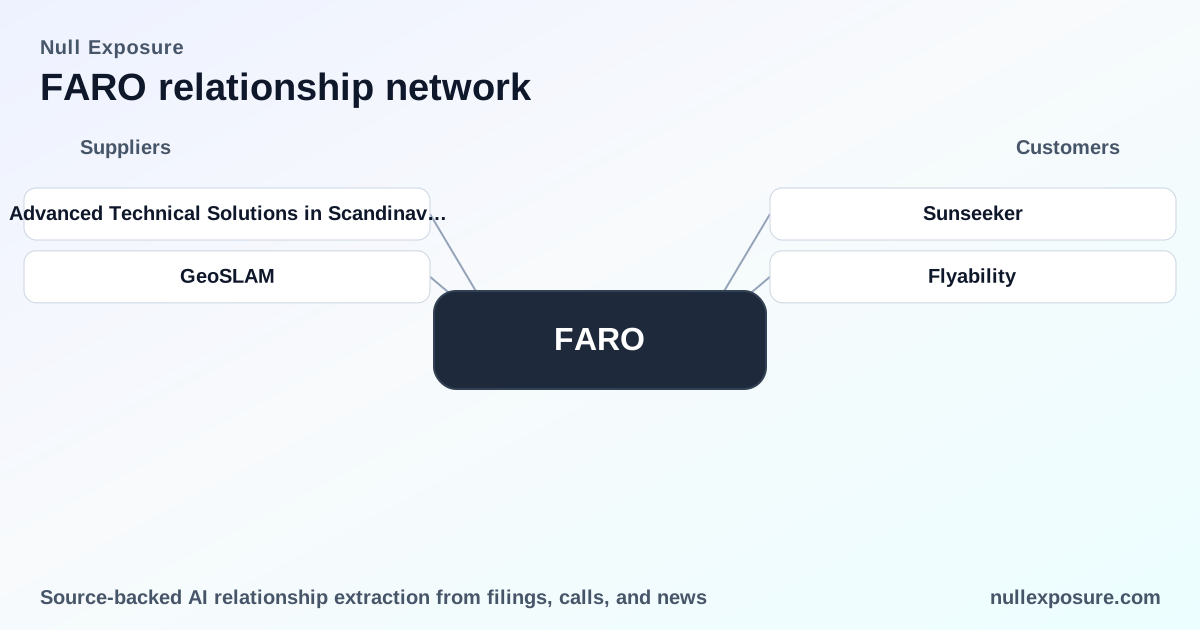
FARO Technologies: Customer Footprints and Commercial Signals
FARO sells precision 3D measurement hardware (laser scanners, trackers, projectors) and complementary software bundles (SCENE, BuildIt, FARO Connect) and monetizes through equipment sales, software licensing and bundled solutions, supported by onsite demonstrations and partner resale. This customer map shows FARO executing a hardware-led, software-enabled commercialization strategy across construction, manufacturing and surveying end markets — a model that drives durable per-unit revenue with recurring software/service attach. For additional context on coverage and sourcing, visit the Null Exposure research hub: https://nullexposure.com/.
Executive summary: what this customer set tells investors
FARO’s cited customer relationships are diverse by industry but consistent in product use — customers buy scanners, trackers, projectors and associated software to unlock accuracy and workflow reductions. These engagements indicate sales that combine discrete capital equipment purchases with software/service attach, and frequent on-site proof-of-value demonstrations that accelerate enterprise adoption. The list demonstrates commercial traction in construction, marine, manufacturing and UAV/surveying channels, which dilutes single-industry concentration risk while keeping FARO’s value proposition tightly tied to precision measurement outcomes.
Key takeaway: FARO’s revenue mix is anchored by hardware transactions with high incremental margin opportunities from recurring software and services, supported by a demo-led sales motion that converts technical buyers.
Customer relationships: what the sources report
Below are the relationships identified in public reporting and trade coverage. Each entry includes a plain-English summary and the reporting source.
PCMInnovation
FARO assisted PCMInnovation by supplying BuildIt software to improve manufacturing accuracy, illustrating FARO’s role as a systems supplier that combines measurement hardware with metrology software. According to a GlobeNewswire industry release (Dec 16, 2024), FARO’s BuildIt integration supported improved process accuracy for PCMInnovation (GlobeNewswire, 2024-12-16 — https://www.globenewswire.com/news-release/2024/12/16/2997357/28124/en/3D-Metrology-Market-Revenue-and-Trend-Forecast-to-2029-Industry-Projected-to-Cross-15-Billion.html).
HTS Advanced Solutions
HTS Advanced Solutions relied on two FARO Focus Laser Scanners and FARO SCENE software to convert 3D scans into 2D deliverables, highlighting FARO’s cross-product workflows that pair scanners with processing software for construction applications. Coverage in PBC Today documented the deployment and software usage in a 2022 construction use case (PBC Today, FY2022 — https://www.pbctoday.co.uk/news/digital-construction/bim-news/3d-laser-scanning-for-2d-applications/105850/).
Helm Mechanical
Helm Mechanical publicly praised FARO’s combined product set — Focus Scanner, Stream and Sphere — for reducing scanning and processing time by roughly 60 percent and enabling new service offerings, signaling clear operational ROI for contractor customers. TradeLink Media quoted Helm’s leader of Innovative Technologies on the time-savings and expanded scanning cadence (TradeLink Media, FY2022 — https://www.tradelinkmedia.biz/publications/6/news/3815).
Sunseeker
Sunseeker ordered a Vantage laser tracker and four TracerM laser projectors after an on-site FARO demonstration, showing FARO’s ability to close fleet-level capital equipment deals following in-person proofs. Assembly Magazine reported the demo and subsequent order at Sunseeker’s plant, demonstrating FARO’s penetration in marine composite assembly (Assembly Magazine, reported March 2026 — https://www.assemblymag.com/articles/96788-laser-based-tracker-and-projector-improve-yacht-hull-assembly).
Advanced 3D Laser Solutions Group (A3D)
A3D implemented two FARO Focus Laser Scanners alongside FARO SCENE software for a construction scanning task, reinforcing that FARO’s Focus product line plus SCENE is a repeatable configuration for building survey projects. The same PBC Today piece that covered HTS references A3D’s use of FARO equipment in the FY2022 case (PBC Today, FY2022 — https://www.pbctoday.co.uk/news/digital-construction/bim-news/3d-laser-scanning-for-2d-applications/105850/).
Flyability
Flyability bundles the new Elios-3 Surveying Payload with FARO Connect software, indicating channel partnerships where FARO software is sold as part of third-party surveying platforms, expanding FARO’s addressable market through OEM and bundle arrangements. Commercial UAV News reported the Flyability–FARO bundle for centimeter-accuracy surveying in challenging environments (Commercial UAV News, March 2026 — https://www.commercialuavnews.com/surveying/flyability-and-faro-technologies-announce-new-elios-3-surveying-payload-for-centimeter-accuracy-in-challenging-environments).
ASNA (ASNAQ)
ASNA leveraged FARO Vantage laser trackers and BuildIt Metrology software to deliver accurate measurement data, another example of FARO supplying high-precision metrology systems for industrial measurement tasks. GlobeNewswire coverage of the 3D metrology market mentioned FARO’s role supporting ASNA with tracker hardware and BuildIt software (GlobeNewswire, Dec 16, 2024 — https://www.globenewswire.com/news-release/2024/12/16/2997357/28124/en/3D-Metrology-Market-Revenue-and-Trend-Forecast-to-2029-Industry-Projected-to-Cross-15-Billion.html).
Operating model and business-model constraints investors should weigh
- Contracting posture: FARO sells largely into capex procurement cycles conducted by engineering, quality or construction teams. Sales convert through demonstrations and proofs of value, implying longer but higher-ticket sales that benefit from field demonstrations and localized service.
- Concentration and channel mix: The customer set spans contractors, OEMs and specialized service providers, which reduces single-industry concentration while requiring multiple vertical go-to-market approaches.
- Criticality of product: FARO’s products are mission-critical for accuracy-dependent workflows (metrology, hull assembly, surveying), which supports pricing power for bundled solutions and service attach.
- Maturity of offerings: Multiple cited clients use established FARO brands (Focus, Vantage, BuildIt, SCENE, FARO Connect), indicating product maturity and repeatable deployment patterns that support incremental software and service revenue.
No explicit operational constraints or negative caveats were extracted in the reviewed relationship reporting; this absence should be treated as a company-level signal that the public customer narratives focus on deployment benefits and product adoption rather than contract friction or counterparty concentration.
What this means for investors and operators
- Revenue quality: Expect a hardware-heavy revenue base with durable upside from software and bundle attach — a classic high-margin software upside layered on capital equipment sales.
- Sales strategy implications: Demo-led selling and partner bundles (e.g., Flyability) are core distribution tactics; management should continue investing in field demos, training and partner enablement to sustain conversion rates.
- Risk profile: The business faces typical capex cyclicality across construction and manufacturing, but industry diversification in the customer list moderates sector-specific downturns. Monitor order cadences and software-recurring revenue growth as the primary signals of margin expansion.
For deeper customer-by-customer sourcing and to track updates to FARO’s commercial footprint, see the Null Exposure research portal: https://nullexposure.com/.
Conclusion: FARO’s public customer mentions collectively validate the company’s hardware-first, software-enabled commercial model across multiple verticals and underscore the strategic importance of demonstrations and partner bundles in converting technical buyers into recurring revenue streams.