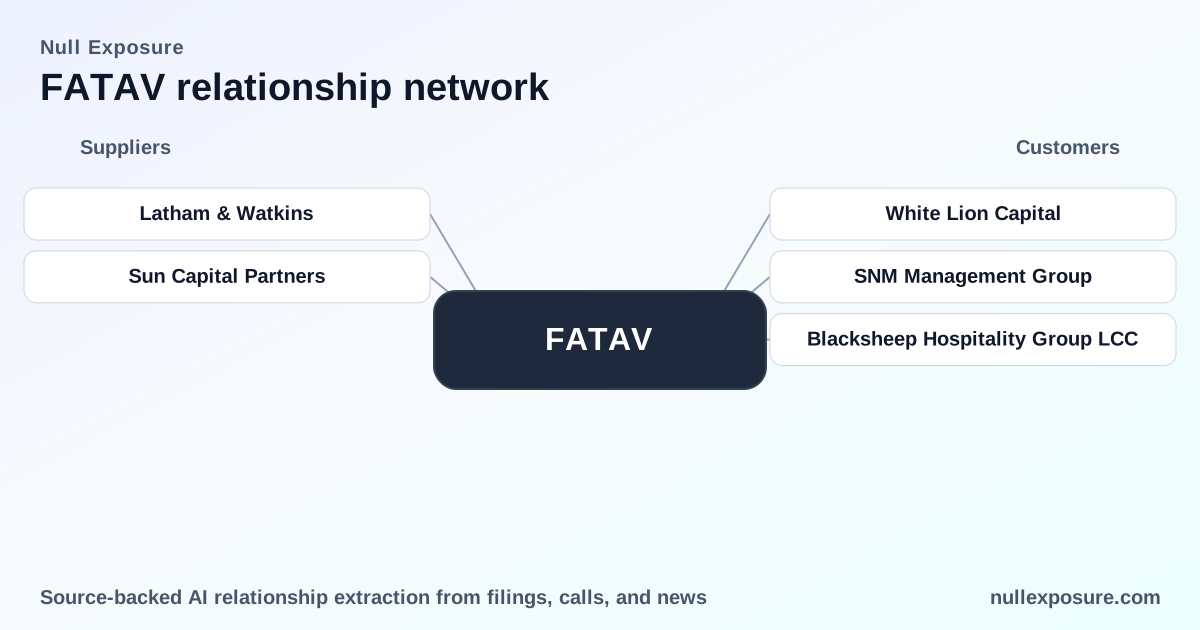
FAT Brands (FATAV) — customer relationships investors should track
FAT Brands is a multi-brand restaurant franchisor that monetizes through franchise fees, ongoing royalty streams, licensing and international development partnerships, and occasional asset sales of brand portfolios. Revenue is concentrated on recurring royalty lifts and large, geographically targeted franchise deals, while value realization often comes from strategic disposals or credit-bid sales of individual concepts. For investors and operators evaluating FATAV exposure, the current customer map is dominated by franchisees, bid vehicles and strategic partners executing both domestic co-branding and international rollouts — developments that directly affect cash flow timing, counterparty risk and recovery value in a distressed capital structure. For a deeper look at how these customer ties translate into portfolio risk, visit the company customer coverage page at https://nullexposure.com/.
How to read FAT Brands’ customer relationships
FAT Brands operates as a franchisor with a hybrid model: it both cultivates franchisee networks and intermittently sells or transfers brand assets. That creates several company-level operational signals investors should weigh:
- Contracting posture: FAT executes franchise and development agreements and, in downturns, pursues asset sales and credit-bid structures; this produces a mix of long-term recurring contracts and one-off transactional counterparties.
- Customer concentration: The business is dependent on a set of large franchisees and strategic buyers; concentration risk is material when groups or bid vehicles control multiple brand rollups.
- Criticality: Franchisees and international partners are critical to cash flow generation because royalties and development fees are the primary monetization mechanism.
- Maturity and heterogeneity: Relationships range from mature franchise partnerships to nascent international development deals and special-purpose bid entities, creating uneven counterparty maturity and recovery profiles.
No explicit operational constraints were reported in the available relationship feed; treat that absence as a company-level signal rather than an endorsement of operational stability.
Customer and counterparty roll call — what each relationship means
Below I cover every relationship item in the data feed with a concise, plain-English summary and the cited source.
White Lion Capital
Fat Brands sold 9 million shares of Twin Peaks operator Twin Hospitality Group to White Lion Capital for $3.1 million, a transaction that signals the use of private capital to monetize subsidiary stakes in FY2026. This was reported by Restaurant Business Online in March 2026.
SNM Management Group
SNM Management Group is the franchisee operating the co-branded Round Table/Fatburger location in Dallas, illustrating FAT’s reliance on regional franchise partners to execute co-brand rollouts (reported by Restaurant Dive; FY2023 context cited in the article).
Fazoli’s
Fazoli’s is part of a buyer consortium reported to be acquiring a large bundle of FAT Brands’ remaining concepts in FY2026, signaling strategic consolidation by peer brands in the sale process (reported by Restaurant Business Online, May 2026).
Johnny Rockets
Johnny Rockets was listed among the lead buyers for a package sale of FAT Brands concepts in FY2026, highlighting industry consolidation and the resale value individual concepts can capture (Restaurant Business Online, May 2026).
Round Table Pizza
Round Table Pizza is named as a lead buyer in the FY2026 package deal for FAT Brands’ remaining chains, and its franchisees have litigated FAT over marketing fund management — a dual role that increases the strategic importance and legal friction in the relationship (Restaurant Business Online and Restaurant Dive, May 2026).
FBG Bid Co.
FBG Bid Co. is referenced as a credit-bid vehicle likely to acquire remaining FAT concepts, indicating debt-driven recovery paths and the use of affiliate bid structures in the sale process (Restaurant Business Online, May 2026).
Tabco International Food Catering
Tabco International Food Catering, a Kuwait-based company, reportedly won the bidding for Elevation Burger, marking FAT’s use of international buyers to extract value from smaller concepts (Restaurant Business Online, May 2026).
TWNPKS Bid Co.
TWNPKS Bid Co., a Delaware-based entity, is likely the buyer for Twin Peaks — the largest and most valuable chain in the FAT portfolio — showing how specialized bid entities are being used for marquee assets (Restaurant Business Online, May 2026).
Round Table (franchisees)
Round Table franchisees have sued FAT Brands over alleged mismanagement of marketing funds, which introduces boutique litigation risk that can complicate franchise revenue streams and reputational dynamics (Restaurant Dive, May 2026).
Big M CIE
Big M CIE is the local partner behind a planned 30-unit rollout of Fatburger in France, representing FAT’s strategy of franchising international growth through country partners (GlobeNewswire press release, March 2026).
Blacksheep Hospitality Group LCC
Blacksheep Hospitality Group LCC signed to bring 12 co-branded Fatburger/Round Table units to Utah over six years, demonstrating FAT’s reliance on mid-sized regional operators to scale co-brand concepts domestically (PizzaMarketplace press release; FY2026 reporting).
Amazing Brands LLC
Amazing Brands LLC, a Nevada company, was identified as the winning bidder for Hot Dog on a Stick at $8 million, an example of standalone concept sales that feed into portfolio rationalization and value recovery (Restaurant Business Online, May 2026).
Big M
FAT Brands is partnering with Mehdi Bella of Big M to develop Fatburger in France, underlining FAT’s international franchising model that leverages local operators for market entry and expansion (FastCasual, March 2026).
Strategic implications for investors and operators
- Revenue sensitivity to franchisee health: Because FAT earns royalties and development fees, the creditworthiness and legal posture of franchisees such as Round Table franchisees and SNM Management materially affect near-term cash flow. Legal disputes over marketing funds are an active risk vector.
- Asset-sale dynamics drive recovery value: The emergence of multiple bid vehicles and buyers (TWNPKS Bid Co., FBG Bid Co., White Lion Capital, Amazing Brands LLC) shows that realizable value is currently being extracted via discrete transactions rather than ongoing royalty growth.
- International partnerships are a diversification lever: Deals with Big M/Big M CIE and Tabco show FAT’s focus on using local partners to internationalize brands — this reduces capital intensity but concentrates execution risk in third-party operators.
- Concentration and counterparty risk are elevated: Multiple large buyers and franchisees are steering outcomes; a small number of counterparties will determine both upside and recovery trajectories in the near term.
What investors should track next
- Monitor court filings and franchisee litigation for Round Table franchisees for signs of royalty flow disruption.
- Watch closing notices and purchase agreements for the FBG Bid Co./TWNPKS transactions to understand recovery pricing for flagship assets.
- Track international rollouts with Big M/Big M CIE and Tabco for development fee timing and early unit economics evidence.
For a consolidated view of FAT Brands’ counterparty exposures and to map recoveries against bid activity, see our coverage hub: https://nullexposure.com/.
Bold positions on FATAV should be grounded in franchisee performance, pending asset-sale outcomes and the pace of international rollouts; these relationships collectively dictate whether FAT Brands will stabilize as a franchisor of record or continue to liquidate and redistribute brand value to specialized buyers.