FAT Brands: customer relationships that drive an asset-light growth machine
FAT Brands operates as an owner and franchisor of multi-brand restaurant concepts, monetizing primarily through franchise fees, ongoing royalties, area-development agreements and co-branding licenses while selectively selling franchise rights or equity stakes in operator groups. The company’s growth thesis is straightforward: accelerate footprint expansion through third-party franchise partners and branded partnerships rather than heavy company-owned store investment, which converts brand development into recurring, high-margin revenue streams. For a concise view of FAT Brands’ customer relationships and their near-term commercial implications, visit https://nullexposure.com/.
How FAT Brands converts partner deals into recurring economics
FAT Brands runs an asset-light franchising model. Revenue streams include up-front development and franchise fees, ongoing percentage royalties on sales, marketing fund contributions and ancillary licensing for co-branded concepts. The company funds brand expansion by signing multi-unit and area-development agreements with local operators and strategic partners, which creates a predictable pipeline of royalty-bearing locations over multi-year horizons. Co-branding and celebrity- and investor-led franchise partners expand market reach while preserving FAT’s cash flow profile.
The partner deals that matter this cycle
Below I cover each public relationship referenced in the collected coverage. Each entry is a concise, plain-English takeaway with the reporting source.
-
Whole Factor Inc. — Large Florida expansion. FAT Brands signed a development deal with franchisee Whole Factor Inc. to open 40 additional Fatburger locations in Florida over the next 10 years, including new markets such as Jacksonville, signaling a substantial long-term pipeline in a single U.S. state. According to Chain Store Age coverage in May 2026, this is an area-development agreement focused on aggressive regional growth.
-
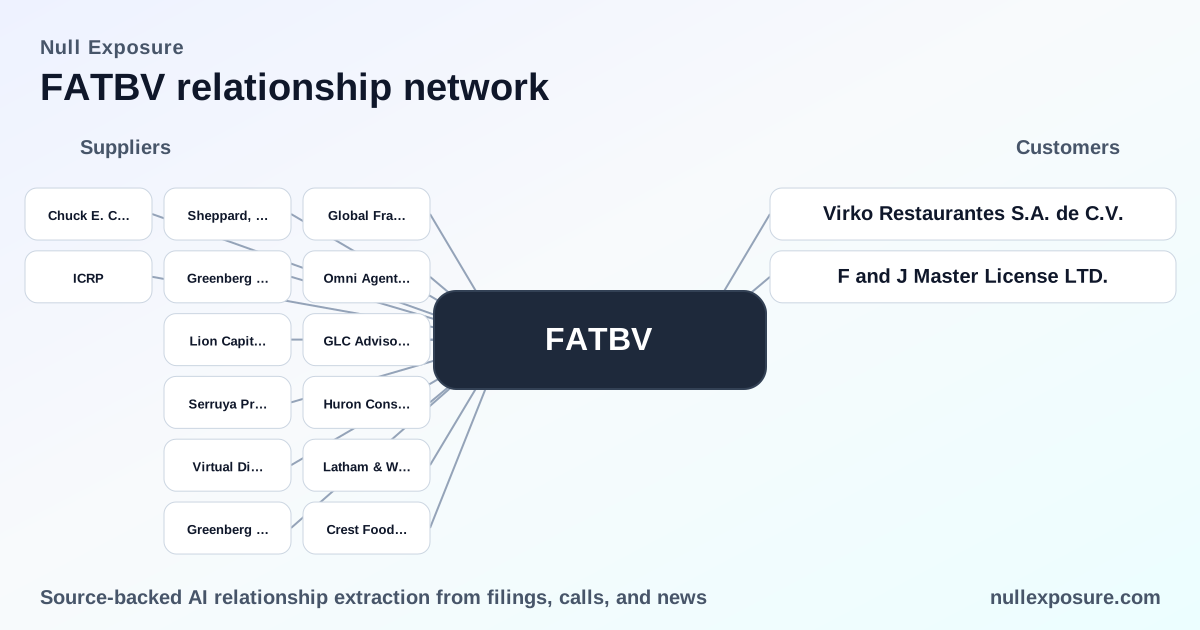
Virko Restaurantes S.A. de C.V. — Mexico roll-out for Johnny Rockets. FAT Brands is partnering with Virko Restaurantes to open 20 new Johnny Rockets locations in Mexico, expanding international franchise penetration through a regional operator. Provisioner Online reported this development in March 2026 as a coordinated franchise expansion in Latin America.
-
F and J Master License LTD. — Israeli entry for Johnny Rockets. FAT Brands granted a multi-year franchise program to F and J Master License LTD. to develop Johnny Rockets in Israel, with restaurants slated to open over a 10-year period. Provisioner Online documented this Israel development agreement in March 2026, underscoring FAT’s use of long-term master-license structures for geographic entry.
-
A.D.T.J. Development — Celebrity- and investor-led co-branded store. A partnership with A.D.T.J. Development, a group that includes NBA players Anthony Davis Jr., Derrick Rose and Tim Hardaway Jr., plus business partners, will open a co-branded Fatburger and Buffalo’s Express in Orland Park, Illinois—an example of leveraging celebrity-backed franchisees to generate local buzz and brand premium. Fast Casual covered this announcement in May 2026, highlighting co-branding as a tactical growth lever.
-
White Lion Capital — strategic sale of operator shares. FAT Brands agreed to sell 9 million shares of Twin Peaks operator Twin Hospitality Group to White Lion Capital for $3.1 million, a transaction that reflects selective monetization of operator equity stakes as part of balance-sheet and partner-relationship management. Restaurant Business Online reported on this transaction in May 2026 in the context of broader financing and governance developments.
-
VegasTP — regional Twin Peaks lodge agreement in Reno. FAT Brands signed a three-lodge Twin Peaks agreement with VegasTP (franchisees Mohit Mal and Aman Singh), with the first lodge opening in the Reno area, marking a small multi-site regional commitment for the Twin Peaks concept. Restaurant News detailed this 2024-originated agreement and the opening sequence, illustrating steady local market rollouts under master franchise agreements.
-
SNM Management Group — co-branded Fatburger and Round Table Pizza in Dallas. SNM Management Group is operating the first of four planned co-branded Fatburger and Round Table Pizza locations in the greater Dallas area, an example of pairing brands to compress unit-level economics and increase site productivity. Snack & Bakery covered the Dallas co-brand rollout in 2023, underlining FAT’s repeated use of co-brand footprints.
What these relationships collectively reveal about operating posture
The relationships above reveal several consistent company-level signals about FAT Brands’ operating model:
-
Contracting posture: long-term, development-focused. Multiple deals specify 10-year pipelines or multi-lodge agreements, showing FAT favors multi-year area-development and master-license contracts that phase in royalties and fees over time.
-
Concentration profile: diversified by partner type and geography. Partners range from single-market groups (SNM, VegasTP) to large area developers (Whole Factor) and international master-licensees (F and J, Virko), indicating geographic and counterparty diversification rather than dependence on a single operator.
-
Criticality: franchisee performance is core to growth delivery. Given FAT’s monetization through royalties and fees, the company’s revenue trajectory is directly dependent on franchisee execution and store-level sales; partner pipelines are therefore operationally critical.
-
Maturity: structured, mid- to long-term rollouts. The prevalence of decade-long development schedules and multi-unit agreements points to an execution horizon measured in years, not quarters.
Note: the coverage reviewed did not include any explicit contractual constraints or flagged limitations in the relationship excerpts provided, which itself is a company-level signal for the scope of public reporting on partner agreements.
Investment implications and risk checklist
- Growth lever: Multi-unit and area-development agreements offer scalable, low-capex expansion and predictable royalty ramp if operators deliver openings on schedule. The Whole Factor Florida program and the Virko Mexico roll-out are material pipeline contributions in their respective regions.
- Execution risk: The business model’s upside is concentrated in operator performance; delays in openings or weaker-than-expected store-level sales directly compress royalty income.
- Partner concentration risk: While the partner mix shows diversification, any outsized agreement (for example a 40-unit commitment in one state) creates single-market execution risk during the development window.
- Balance-sheet tactics: Transactions like the sale of Twin Hospitality Group shares to White Lion Capital show FAT will use equity monetizations and selective asset sales to manage capital and partner alignment.
Bottom line
FAT Brands is executing an asset-light franchising playbook driven by multi-year development agreements, international master licenses and co-branding to increase unit density without proportionate corporate capital expenditure. The relationships reviewed show the company advancing several material pipelines—domestic and international—that, if executed, will translate into recurring royalty and fee revenue over the next decade. For investors tracking partner-driven expansion, the key metrics to watch are franchisee opening cadence, same-store sales at operator groups and any shifts in FAT’s strategy to buy, sell or dilute operator equity positions.
If you want a concise dashboard of partner-level news and implications for FAT Brands, see https://nullexposure.com/ for the latest coverage and relationship view.