Fate Therapeutics (FATE) — how customer relationships shape value and risk
Fate Therapeutics develops programmed cellular immunotherapies and monetizes primarily through collaborative research and development deals with large pharmas and co-development partners, along with milestone and option payments tied to clinical progress and licensing decisions. For investors the critical lens is clear: Fate sells development services and optioned rights, not commercial product revenue today, so counterparty deals drive near-term cash inflows and long-term optionality.
If you want a consolidated map of Fate’s counterparty exposure and the underlying press-release evidence, visit the NullExposure company page: https://nullexposure.com/.
Business model and operating model — what the relationships imply
- Fate operates as a service-oriented R&D partner. Company disclosures state the single reportable segment derives current revenue from research and development collaborations, which positions Fate as a supplier of preclinical and early clinical development capabilities rather than a commercial-stage product vendor.
- Contracting posture is project- and milestone-based: deals are structured around up-front payments, funded preclinical activity, and optional license exercises for later-stage development and commercialization. That means revenue is lumpy and tied to partner decisions.
- Concentration is material: a handful of large pharmaceutical partners dominate the company’s collaboration revenue streams, creating single-counterparty exposures that can swing quarterly top-line figures.
- Criticality is asymmetric: Fate’s technology and development capacity are valuable to partners pursuing allogeneic cell therapy pipelines, but partners retain optionality—licensing or terminating programs—which concentrates commercial execution risk on the partners.
- Maturity of engagements is early-stage. Most disclosed revenues derive from preclinical or early clinical work and option payments rather than product sales, so the economics today reflect development-service margins and milestone optionality, not recurring commercial revenue.
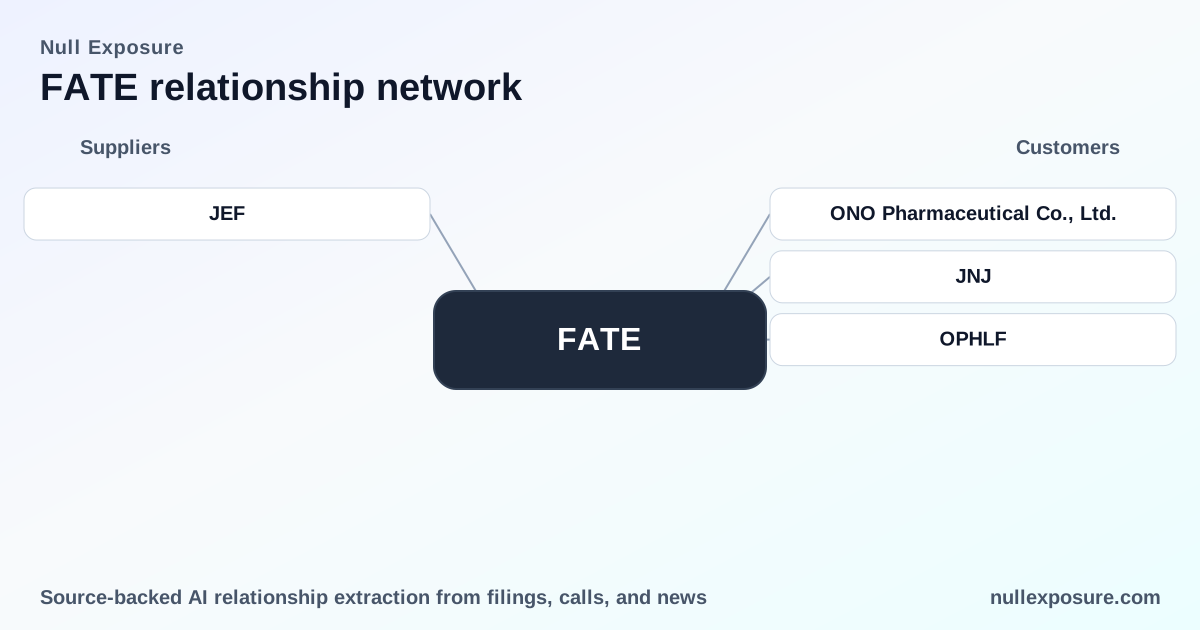
Key relationships — what investors should track now The public record for Fate’s customer/collaboration relationships centers on two large counterparties and their affiliated units: Ono Pharmaceutical (across multiple disclosures) and the Johnson & Johnson family (Janssen / J&J). Below I summarize each relationship and point to the underlying public notices.
Ono Pharmaceutical — ongoing preclinical collaboration with funded activities
Fate has an active collaboration with Ono Pharmaceutical focused on off-the-shelf cell therapy candidates for solid tumors; recent quarterly disclosures show Ono-funded preclinical work consistently contributing modest quarterly revenue (for example, $1.9 million in Q2 2025 and $1.7 million in Q3 2025 derived from preclinical activities under the Ono collaboration). These amounts are recorded as collaboration revenue in company releases and are important short-term contributors to Fate’s reported top line. (See GlobeNewswire press releases reporting Q2 2025 and Q3 2025 results and the company’s full-year 2025 release in early 2026.)
- The Q2 2025 release states revenue of $1.9 million from preclinical development under the Ono collaboration (GlobeNewswire, Aug 12, 2025).
- The Q3 2025 release states revenue of $1.7 million from the same collaboration (GlobeNewswire, Nov 13, 2025).
- The full-year/fourth-quarter 2025 report restates Q4 revenue of $1.4 million tied to preclinical work for an Ono collaboration candidate (GlobeNewswire, Feb 26, 2026).
Together these releases show repeated, project-level funding from Ono for second collaboration candidates, which supports near-term liquidity but is not the same as durable product revenue.
ONO announcement (historical collaboration formation)
Fate initially publicized a collaboration with ONO Pharmaceutical to jointly develop and commercialize two off-the-shelf CAR-T product candidates; that announcement establishes the strategic intent of the partnership and the scope of early programs. The original collaboration press coverage is recorded in industry reporting from 2018 and is the basis for subsequent Ono-funded activity. (See BioInformant coverage of the FY2018 collaboration announcement.)
- BioInformant reported on the 2018 collaboration announcing joint development and commercialization of two off-the-shelf CAR-T candidates (BioInformant, FY2018).
Johnson & Johnson / Janssen — large early deal, later program endings and options
Fate executed a material collaboration with Johnson & Johnson (through Janssen) in 2020 that included a $50 million upfront payment and options around multiple CAR NK and CAR-T programs, creating significant optional upside tied to partner licensing decisions. Industry coverage documented the $50 million upfront and the multi-billion option structure when the deal was announced. (See FierceBiotech and BioSpace, 2020.)
- FierceBiotech reported J&J paid Fate $50 million upfront to collaborate on up to four CAR NK and CAR-T therapies (FierceBiotech, FY2020).
- BioSpace described the structure that gave Janssen rights to exercise options for exclusive licenses to collaboration candidates (BioSpace, FY2020).
However, the relationship with J&J evolved: Fate publicly noted the J&J partnership ended after Fate declined revised terms in a renegotiation in 2023, which underscores counterparty optionality risk—large upfront deals can terminate or be renegotiated on less favorable economics. (See BioPharmaDive, FY2023.)
- BioPharmaDive reported the partnership with Johnson & Johnson ended after Fate declined a proposal to continue on revised terms and conditions (BioPharmaDive, FY2023).
Janssen and J&J appear across the press record both as deal counterparties and as the commercial option-holders, so investors should treat the J&J family as a single source of historical large-option value that is now partially realized and partially closed out.
Operating implications and risk factors investors must price
- Revenue volatility: Because Fate records project-specific payments from partners, quarterly revenue will move with partner-funded activity and option exercises. Recent quarter contributions from Ono (mid-single-digit millions) are meaningful versus Fate’s low revenue base, producing large percentage swings.
- Partner optionality risk: Deals include partner options and exclusive license triggers; as seen with J&J, partners can and will propose revised terms or exit programs, which transfers commercialization and regulatory execution risk away from Fate.
- Concentration risk: A small number of collaboration partners provide most current revenue; a loss or pause in partner-funded programs would disproportionately impact reported results.
- Non-commercial revenue profile: Current cash flows come from research services and milestone structures rather than product royalties or sales, so route-to-market economics depend on successful out-licensing or partner-led commercialization events.
Middle-term investor actionables
- Monitor quarterly disclosures for partner-funded development revenue line items and program-level commentary (especially Ono milestones and any renewed activity with other partners).
- Track option exercise announcements and license grants from large partners; those are the primary pathways to material upside.
- Read partner press releases and regulatory filings for signals of commitment or strategic reprioritization that would affect Fate’s pipelines.
For a structured, deal-level view of Fate’s partner relationships and timelines, visit NullExposure’s consolidated company page at https://nullexposure.com/.
Bottom line: Fate’s value today is largely option-value and service-revenue driven, supported by Ono-funded preclinical programs and shaped by the history of a large, now-concluded relationship with J&J/Janssen. Investors must price lumpy collaboration revenues, concentrated partner exposure, and partner-controlled pathway-to-commercialization into any valuation or operational forecast.