FatPipe (FATN): Commercial Relationships Driving Distribution and Mission-Critical Connectivity
FatPipe develops and sells secure SD‑WAN, SASE and network monitoring software and monetizes primarily through subscription contracts and multi‑year service agreements delivered to enterprises, mid‑market customers and government organizations. The company sells directly and through channel partners; recent press activity shows a concerted push into resilient, convergent connectivity for autonomous vehicles and an expanded global distribution pact to scale reseller reach. For a deeper view of counterparties and commercial posture, visit https://nullexposure.com/.
Why the recent headlines matter to investors
FatPipe’s product set — software aimed at high‑availability networking across cellular, GEO/LEO satellite and IP links — positions it in a niche where reliability and low‑latency switching are differentiators. The company’s commercial news in early 2026 falls into two strategic buckets: validation of technology for high‑risk applications (autonomous vehicle trials) and a go‑to‑market acceleration through a global distribution agreement. Both moves are consistent with a subscription, channel‑oriented growth playbook.
Key takeaway: Product validation with strategic partners plus a broad distributor should increase sales velocity to mid‑market and service providers while preserving recurring revenue characteristics.
The ecosystem of named partners and projects (each relationship covered)
-
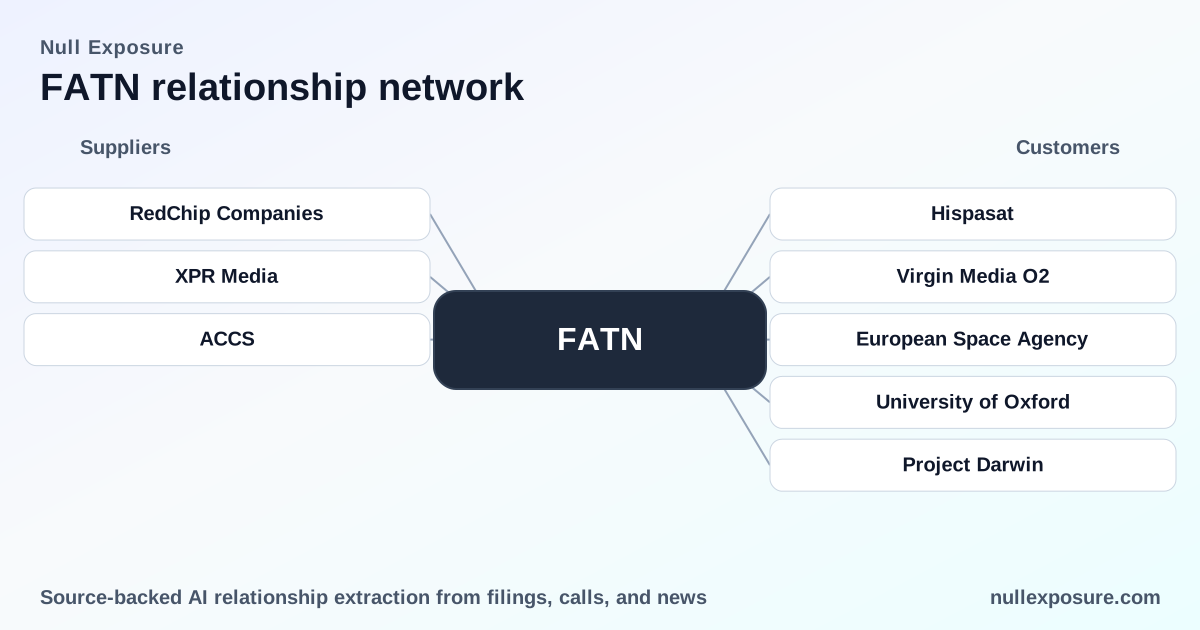
Hispasat
FatPipe was selected by Hispasat as part of a consortium to demonstrate convergent connectivity combining GEO/LEO satellite and 4G/5G with FatPipe’s sub‑second switching on ambulances in London. This underscores FatPipe’s use case in resilience‑critical deployments. According to press releases distributed March 9, 2026 across multiple outlets, the selection was part of Project Darwin publicity. -
Virgin Media O2
Virgin Media O2 participated in Project Darwin’s London demonstrations that employed FatPipe technology to merge cellular and satellite links into a single resilient architecture for autonomous vehicle operations. The March 9, 2026 press materials highlight the telco’s role in the trial and proof of concept. -
European Space Agency (ESA)
The ESA led or coordinated Project Darwin, which included FatPipe’s technology in live trials combining GEO/LEO and terrestrial networks to support vehicle connectivity, demonstrating institutional endorsement from a major public research organization. The project details were publicized in March 2026 press releases. -
University of Oxford
The University of Oxford was listed as a consortium participant in Project Darwin, taking part in trials that used FatPipe’s sub‑second switching to stress test convergent connectivity for autonomous operations; the association signals academic and research validation of the technical approach (press releases dated March 9, 2026). -
Project Darwin
Project Darwin is the consortium program (ESA, University of Oxford, Virgin Media O2, Hispasat and others) that selected FatPipe technology to prove seamless switching across satellite and cellular links for ambulance/autonomous vehicle use cases; FatPipe’s role was presented publicly on March 9, 2026 as a technology provider for the demonstrations. -
TD SYNNEX (SNX)
FatPipe entered a global distribution agreement with TD SYNNEX to expand sales of its secure SD‑WAN and cybersecurity portfolio through TD SYNNEX’s reseller ecosystem, a strategic commercial move announced in early May 2026 (MarketScreener and other outlets May 2–4, 2026). The partnership is aimed at accelerating channel reach and reseller adoption. -
SNX (ticker reference)
Multiple finance and news outlets referenced the TD SYNNEX (SNX) distribution agreement in early May 2026, noting that SNX added FatPipe to its vendor portfolio to broaden security and networking offerings; these reports reflect market recognition of the commercial partnership (Finviz and StocksToTrade coverage May 2026).
What the reported constraints tell us about FatPipe’s operating model
FatPipe’s public disclosures and the captured evidence point to an established software subscription business with the following firm characteristics:
-
Contracting posture — long‑dated, recurring revenue: Customer contracts “generally range from 36–60 months” and core offerings are “typically offered…as a subscription service,” indicating predictable revenue streams and longer customer payback periods. This is a favorable mix for valuation multiple expansion when growth sustains.
-
Customer mix — mid‑market plus government and service providers: FatPipe targets mid‑market organizations, communication and security service providers and government buyers, which means sales cycles can vary but contracts deliver higher stickiness due to mission‑critical network requirements.
-
Geographic footprint — North America and South/Southeast Asia focus: The company’s largest customer populations are in the United States and South Asia/India, with expansion plans across North America and parts of Southeast Asia; distribution deals like TD SYNNEX are consistent with scaling across these geographies.
-
Concentration and materiality — dispersed revenue base: No single end‑user customer accounted for over 10% of revenue in fiscal 2024–2025, which reduces single‑counterparty risk and supports resilience to customer churn.
-
Role and stage — seller and ongoing service provider: FatPipe functions as both vendor and support/maintenance provider post‑sale, maintaining direct relationships through installation and support, which preserves renewal levers and upsell potential.
-
Product maturity — software with IP: Thirteen patents and a software suite for SD‑WAN/SASE/NMS indicate a product set with defensible IP and targeted differentiation in resilience and switching performance.
Commercial implications for investors
-
Distribution lift: The TD SYNNEX relationship is a scalable channel move that should materially increase lead flow from resellers and MSPs; expect a near‑term uplift in channel revenue if FatPipe can operationalize enablement and co‑selling. (MarketScreener/Finviz reporting, May 2026.)
-
Proof points into defense and transport sectors: Participation in Project Darwin with ESA, Oxford, Virgin Media O2 and Hispasat signals a trajectory into safety‑critical markets where reliability commands premium pricing and long procurement cycles. The publicity strengthens FatPipe’s argument for higher‑margin, mission‑critical deployments (press releases March 9, 2026).
-
Recurring revenue stability: With 36–60 month contracts and a subscription posture, revenue visibility is strong, but near‑term growth will depend on channel execution and geographic expansion.
Risks and watch items
-
Channel execution risk: Adding a global distributor expands addressable market but requires investment in partner programs, training and joint go‑to‑market execution; failure to convert lead flow would blunt expected revenue leverage.
-
Sales cycle heterogeneity: Government and mid‑market verticals have different procurement rhythms; investors should monitor bookings cadence versus billings to detect any elongation.
-
Concentration in management/ownership: While customer concentration is low, insider ownership and float metrics in filings hint at possible liquidity and governance considerations investors should review in the company’s filings.
Bottom line and next steps
FatPipe’s 2026 announcements combine technical validation in resilience‑critical networking with a commercial scale play via TD SYNNEX. Together these relationships de‑risk the go‑to‑market story and provide a clear path to accelerate recurring revenue growth if execution matches intent. For deeper counterparty-level diligence and ongoing monitoring, visit https://nullexposure.com/ to track disclosed relationships and contextual signals.
Bold takeaway: FatPipe is transitioning from technology validation to distribution scale — the market impact will depend primarily on partner activation and conversion into recurring license and support revenue.