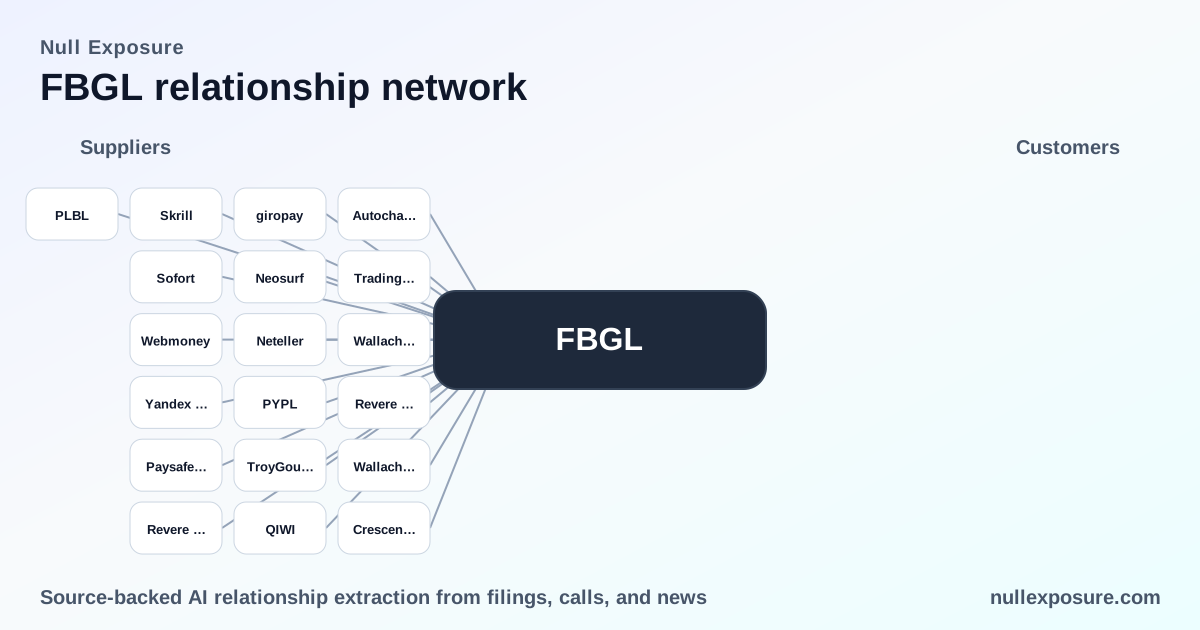
FBGL: Customer Footprint, Revenue Drivers, and What Investors Should Track
FBS Global Limited (FBGL) operates as a fintech and gaming-adjacent financial services provider that monetizes through transaction processing, platform services, and strategic commercial alliances tied to digital payments and immersive products. Revenue is project- and partnership-driven—the company lists large mixed-use developments and institutional projects alongside commercial partners, which produces episodic project revenue and recurring fee income from platform relationships.
For a consolidated view of customer relationships and how they map to FBGL’s go-to-market, visit https://nullexposure.com/ for additional context and mapping tools.
How the customer list clarifies FBGL’s operating posture
FBGL’s publicly reported relationships show a hybrid operating model: a combination of project-based contracts with large property and healthcare developments in Singapore and partnership arrangements with trading/financial services brands. This mix implies:
- Contracting posture: Project contracts with major developers and hospitals indicate multi-stage delivery and milestone billing, while partnerships with consumer-facing trading brands lean toward co-marketing and ongoing service provisions.
- Concentration: The presence of a handful of large named projects suggests revenue concentration risk—single-project wins can materially move top line in any given year.
- Criticality: Contracts tied to major infrastructure and mixed-use developments are high-criticality for FBGL’s project pipeline because they underpin sizeable revenue runs during delivery phases.
- Maturity: The customer roster blends established institutional clients (hospitals, downtown developments) with commercial partners, signaling a company in the scaling phase where marquee projects validate capability but recurring, diversified revenues are still developing.
Financial context for these signals: FBGL’s market capitalization is approximately USD 8.2 million, revenue TTM about USD 13.36 million, with negative net income and a diluted EPS of -0.04; insider ownership is high at roughly 69.4% while institutional ownership is low at 2.7%. These facts position FBGL as a small-cap operator with concentrated control and limited institutional coverage.
If you want a full breakdown of customers and relationship evidence, see the NullExposure landing page for FBGL at https://nullexposure.com/.
Detailed customer relationships every investor should know
FBS
FBGL’s relationship set includes FBS, the online trading firm; Finance Magnates reported that FBS signed a four‑year Official Trading Partner agreement with FC Barcelona that ran through 30 June 2024, underlining FBS’s scale in consumer-facing trading and marketing channels. According to Finance Magnates (original FY2020 reporting), that commercial agreement demonstrates FBS’s market positioning as a high-visibility financial partner. Source: Finance Magnates, article on the FBS–FC Barcelona partnership.
Marina One
FBGL’s reported projects list includes Marina One, a mixed-use development at Marina Bay; MarketScreener reproduced the company’s earnings release for the full year ended December 31, 2025 that lists Marina One among its project references. This indicates FBGL has project exposure tied to significant downtown Singapore development work. Source: MarketScreener, earnings release for the year ended Dec 31, 2025 (published May 2026).
Outram Community Hospital
Outram Community Hospital is named among FBGL’s referenced projects in the company’s FY2025 earnings communication, showing the company’s engagement with healthcare facility projects in Singapore—contracts that typically carry multi-year delivery schedules and institutional procurement processes. Source: MarketScreener, earnings release for the year ended Dec 31, 2025 (published May 2026).
Sengkang General Hospital
Sengkang General Hospital also appears in FBGL’s project list from the FY2025 reporting, reinforcing the company’s project footprint in public healthcare infrastructure and the institutional client segment in the Singapore market. Source: MarketScreener, earnings release for the year ended Dec 31, 2025 (published May 2026).
South Beach Development
FBGL cites South Beach Development, a mixed-use downtown Singapore project, in its FY2025 project list; inclusion of such high-profile urban developments signals engagement in complex, high-visibility construction/technology-integration work that carries reputational upside if delivered successfully. Source: MarketScreener, earnings release for the year ended Dec 31, 2025 (published May 2026).
What the relationship map implies for revenue and risk
- Project-driven revenue cycles. The mix of Marina One, South Beach, and major hospitals points to significant revenue concentration around contract milestones and project completions. These clients are likely to drive lumpy revenue recognition.
- Commercial partnerships add distribution but not guaranteed recurring yield. The FBS partnership profile suggests marketing-led customer acquisition potential, but revenue from such partnerships is contingent on active campaigns and renewal.
- Capital and governance signal caution. With a small market cap (~USD 8.2M), negative EPS, and high insider ownership (≈69%) versus minimal institutional ownership (≈2.7%), governance and capital access are material considerations for larger investors. These metrics underscore execution risk when projects scale or require working capital infusions.
- Margin and valuation context. FBGL posts a modest gross profit yet negative net margins; valuation multiples (price-to-sales ~0.61; price-to-book ~1.03; EV/Revenue ~0.293) reflect small-cap pricing and the market’s current risk discount.
Key investor takeaways and monitoring triggers
- Track contract cadence and revenue recognition. Quarterly disclosures that specify milestone payments or project backlogs for Marina One, South Beach, and the named hospitals will directly affect short-term revenue forecasts.
- Monitor partnership activation. Evidence of active deployment with FBS—co-branded products, sponsored campaigns, or revenue-share announcements—would move the needle on recurring fee prospects.
- Watch cash flow and capitalization. Given negative earnings and small market capitalization, statements about working capital, debt, or equity raises will be material for execution risk.
- Governance and ownership dynamics. High insider ownership centralizes control; any shift in insider stakes or an increase in institutional participation would be a signal of changing investor confidence.
Final perspective
FBGL’s customer roster illustrates a strategic focus on high‑profile Singapore projects and selective commercial partnerships. This positioning supports episodic, project-based growth with upside from partnerships, but it carries concentration and execution risk given the company’s small market capitalization and negative earnings profile. Investors should prioritize contract disclosure, milestone payments, and evidence of recurring revenue conversion when assessing FBGL’s next phase of growth.
Explore a mapped view of FBGL’s customers and evidence links at https://nullexposure.com/ for deeper diligence and tracking.