Fortune Brands (FBIN): Customer Concentration and Channel Dynamics Investors Should Price In
Fortune Brands Innovations sells faucets, locks, cabinetry and outdoor living products and monetizes primarily through wholesale product sales to large home-improvement retailers and distributors, recognizing revenue at shipment or delivery. The company generated roughly $4.46 billion in trailing revenue with EBITDA near $890 million, and its top retailer customers collectively account for material portions of segment-level and company-wide sales — a structural feature that drives both margin resilience and concentration risk.
For a concise briefing and follow-up research tools, visit NullExposure.
Why the retail channel determines FBIN's commercial leverage
FBIN’s go-to-market is anchored to national DIY retailers and big-box chains. The FY2024 filing shows two retailers alone — Lowe’s and The Home Depot — account for double-digit shares of total net sales and a larger share in certain product segments, which creates predictable volume tailwinds in stable housing cycles but concentrates negotiating leverage in buyer hands. The company’s operating margins (roughly 14.7% operating margin TTM) and working capital profile are therefore sensitive to promotional spending, product placement decisions, and inventory cadence driven by those retail partners.
Key structural points investors should hold top of mind:
- Channel concentration: Two customers contribute materially to sales at both the segment and company level.
- Short payment cycles: Payment terms are short (30–90 days), which favors cash conversion but leaves FBIN exposed to retailer ordering volatility.
- Global footprint, North America focus: FBIN sells primarily in North America and China but operates subsidiaries across multiple regions, providing diversification with concentrated retail exposure in the U.S.
Relationship-by-relationship: what the filings disclose
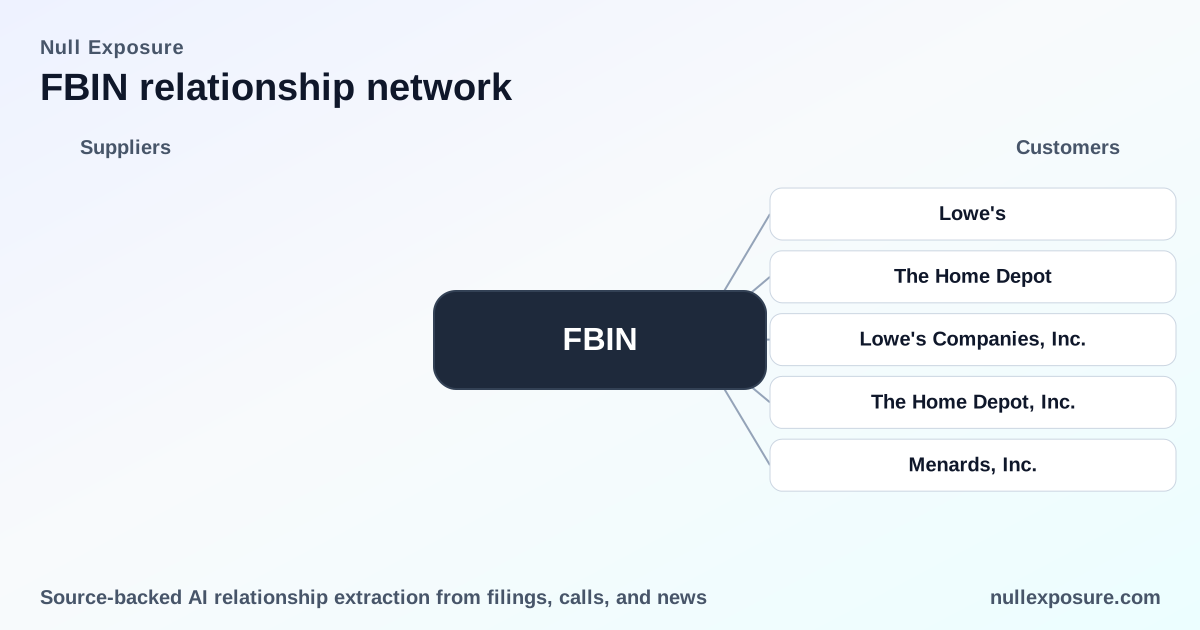
Below are every customer relationship disclosed in the FY2024 filing and the direct language investors should use when modeling counterparty exposure.
Lowe's
FBIN’s FY2024 Form 10‑K states that, on an aggregate basis with The Home Depot, sales to The Home Depot and Lowe’s comprised approximately 16% of Security segment net sales, 19% of Water segment net sales, and 26% of Outdoors segment net sales in 2024. According to the same filing, Lowe’s alone accounted for 11% of company net sales in 2024. (Source: FBIN Form 10‑K, FY2024, filed Dec. 28, 2024)
The Home Depot
The FY2024 Form 10‑K reports that The Home Depot and Lowe’s together comprised those same segment percentages (16% Security, 19% Water, 26% Outdoors), and separately The Home Depot accounted for 10% of FBIN’s net sales in 2024. This places Home Depot among FBIN’s largest single buyers and a primary channel for core products. (Source: FBIN Form 10‑K, FY2024, filed Dec. 28, 2024)
Lowe's Companies, Inc.
The filing specifically identifies Lowe’s Companies, Inc. (Lowe’s) as one of FBIN’s largest customers and records that sales to Lowe’s represented 11% of consolidated net sales in 2024, underscoring single-customer significance to top-line performance. (Source: FBIN Form 10‑K, FY2024, filed Dec. 28, 2024)
The Home Depot, Inc.
FBIN’s 10‑K identifies The Home Depot, Inc. as a principal customer and reports that sales to The Home Depot accounted for 10% of consolidated net sales in 2024, confirming material company-level concentration in two national DIY chains. (Source: FBIN Form 10‑K, FY2024, filed Dec. 28, 2024)
Menards, Inc.
FBIN groups Menards, Inc. with The Home Depot and Lowe’s as one of the three largest Do‑It‑Yourself retailers to which it sells, inclusive of internet portal sales; Menards is therefore an important channel though the filing does not break out a standalone percentage for Menards. (Source: FBIN Form 10‑K, FY2024, filed Dec. 28, 2024)
Contracting posture and operating constraints that shape cash flows
The company filing supplies several operating constraints that investors should incorporate into models and scenario analysis:
- Short-term payment terms (company-level signal): FBIN states payment terms normally range 30 to 90 days, supporting fast cash conversion but increasing sensitivity to sudden drops in orders.
- Geographic footprint (company-level signal): Products sell primarily in North America and China, with subsidiaries operating in Canada, Mexico, the U.K., South Africa, Vietnam and France — a mix that reduces single-market revenue concentration while introducing supply‑chain and trade-policy exposures.
- Role and revenue recognition (company-level signal): FBIN operates as both manufacturer and seller, recognizing revenue when control transfers (generally upon shipment or delivery), which reinforces inventory-to-cash mechanics and the importance of retailer inventory management.
- Core product focus (company-level signal): The company’s principal performance obligations are sale of durable building products — faucets, locks, doors, decking, cabinetry — which produces stable gross margins but creates exposure to housing/activity cycles.
These constraints form the backbone of FBIN’s working-capital profile and should be explicit in stress tests and counterparty disruption scenarios.
For deeper coverage on customer concentration and supply‑chain analytics, see NullExposure.
Valuation and downside risk checklist
Investors and operators should price the following into FBIN’s multiples and scenario models:
- Concentration risk premium: Two retailers delivering ~21% of consolidated sales (11% + 10%) justify a valuation discount relative to peers with more diversified retail mixes.
- Margin sensitivity to promotional passes: Large retailers can extract price concessions or demand promotional support that compresses gross margin on targeted SKUs.
- Working-capital resiliency: Short payment terms mitigate financing strain in normal cycles but accelerate downside when order flow declines.
- Geopolitical/supply-chain exposure: China and multi-country manufacturing footprint require monitoring for tariffs, logistics cost shocks, and component sourcing constraints.
Bottom line
FBIN is a structurally profitable, product-driven builder of water, outdoor and security hardware with a well-defined retail concentration that both stabilizes volume under normal housing conditions and amplifies downside if major retail partners tighten purchases. Investors should model both the cash-flow benefits of short payment cycles and the valuation dampener of customer concentration, and stress-test earnings against abrupt retailer-led inventory corrections. For a tailored brief or portfolio exposure analysis, visit NullExposure for further research tools and filings.