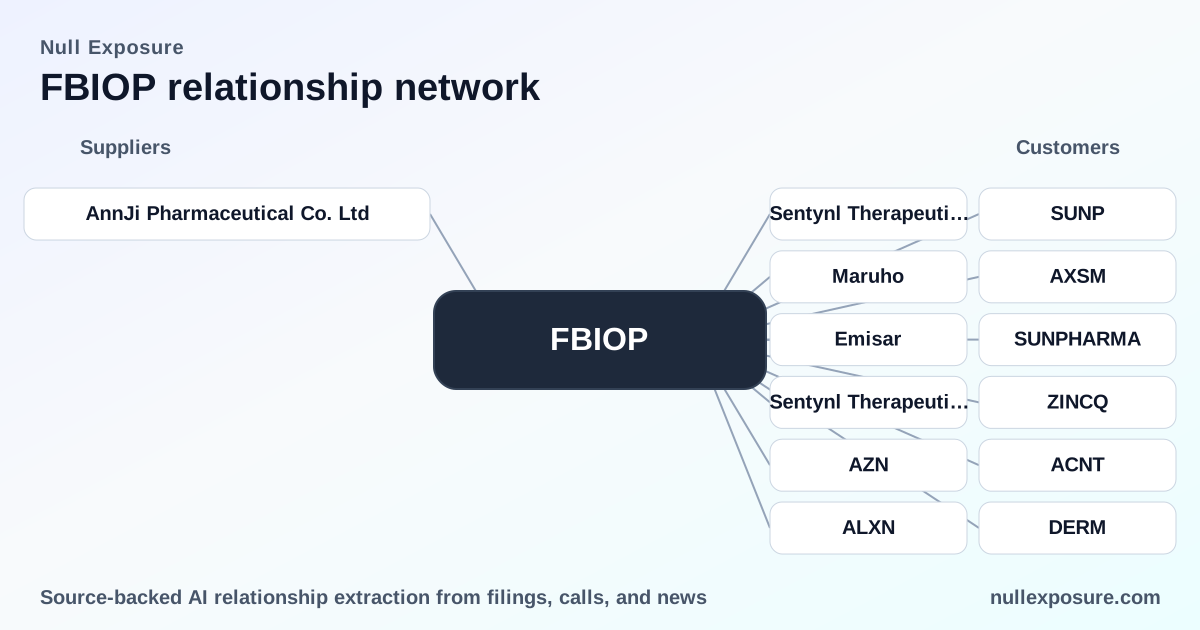
Fortress Biotech (FBIOP): customer map that drives royalties, milestones and asset monetization
Fortress Biotech operates as a holding-and-development platform that monetizes through a combination of product sales from partner companies, licensing and milestone agreements, tiered royalties on marketed products, and intermittent asset sales or CVR structures. The preferred shares (FBIOP) abstract exposure to Fortress’s cashflows from royalties and milestone pipelines, recent FDA approvals, and one-off monetizations such as the sale of a priority review voucher and the Checkpoint Therapeutics divestiture. For a concise analytical dashboard and deeper relationship tracking, visit https://nullexposure.com/.
High-level read: how customers create cashflow and risk
Fortress’s revenue base is hybrid: core product sales provide short-term, transaction-based revenue, while licensing, royalties and milestone contracts supply lumpy, higher-margin upside. The filings and press releases show:
- A predominance of U.S.-centered commercial activity for certain partner products. (Fortress’s disclosures record Journey product revenues in the U.S.)
- Contracting posture that mixes short-term product delivery with longer-term commercial and licensing commitments (including multi-year desk-share agreements and multi-tier royalty schedules).
- Revenue concentration is limited at the customer-line level (no single dermatology customer >10% of Journey product revenue), but the company’s economics remain sensitive to a handful of successful product launches and milestone events.
- Fortress routinely converts program value into cash via asset sales (Checkpoint) and PRV monetization, producing discrete cash inflection points reported in recent periods.
Relationship-by-relationship: what investors should know
-
Emisar — Fortress negotiates contracts broadly with the three major group purchasing organizations, including Emisar, for product access and distribution agreements, indicating Fortress’s commercial channels include major GPO contracts. Source: Fortress Q3 2025 earnings call (Q3 2025 earnings transcript).
-
Zinc — Zinc is cited alongside the other major GPOs (Ascent and Emisar) as part of initial contract negotiations for product access, reflecting Fortress’s use of standard healthcare distribution channels. Source: Fortress Q3 2025 earnings call (Q3 2025 earnings transcript).
-
Ascent / ACNT — Ascent is named with other major GPOs during contract negotiation commentary, confirming Fortress engages GPOs for breadth of contracting rather than one-off distributors. Source: Fortress Q3 2025 earnings call (Q3 2025 earnings transcript).
-
Maruho — Fortress’s subsidiary Journey granted Maruho an exclusive license to develop and commercialize Qbrexza, establishing a direct licensing relationship that transfers development and commercialization responsibility to Maruho. Source: Fortress 2024 Form 10‑K (FY2024).
-
Sentynl Therapeutics, Inc. — Fortress/Cyprium transferred CUTX‑101 (ZYCUBO) development responsibility to Sentynl; Cyprium remains eligible for tiered royalties and up to ~$128–129 million in aggregate development and sales milestones, and received a PRV transfer upon FDA approval. Source: Globenewswire and Fortress press releases (January–March 2026) and related news coverage (March 2026).
-
Sun Pharmaceutical Industries (Sun Pharma / SUNP / SUNPHARMA) — Fortress sold Checkpoint Therapeutics to Sun Pharma in May 2025, receiving roughly $28 million upfront (part of a larger ~$355M headline deal) plus potential CVR payments and a 2.5% royalty on future net sales of UNLOXCYT™. Source: Fortress financial highlights and Globenewswire press releases (November 2025; FY2025–FY2026 reports).
-
Axsome Therapeutics (AXSM) — Avenue Therapeutics’ subsidiary Baergic (an Avenue/Fortress affiliate) was acquired by Axsome; under the purchase agreement sellers are eligible for up to $79 million of sales milestones and tiered mid‑to‑high single‑digit royalties, with Avenue entitled to approximately 74% of future payments. Source: Fortress Q3 2025 financial release (November 2025 Globenewswire).
-
Alexion Pharmaceuticals / AstraZeneca (ALXN / AZN) — Earlier-stage portfolio history: Alexion funded Caelum/CAEL‑101 development with roughly $140 million over
2.5 years, and when AstraZeneca exercised its option in October 2021 the transaction generated a $150 million upfront payment to Caelum shareholders, of which Fortress received a material share ($64 million). These precedents demonstrate Fortress’s capacity to realize substantial exit proceeds from successful options and asset sales. Source: FierceBiotech sponsored coverage and historical disclosures (FY2022 commentary). -
Journey Medical Corporation (DERM) — Journey is a partner company that pays Fortress an annual equity dividend and product royalties under existing partner arrangements; Journey contributed the majority of Fortress’s product revenue in 2024 (Journey product revenue reported as the bulk of $57.7M total net revenue). Source: FierceBiotech sponsored piece and Fortress 2024 Form 10‑K (FY2024).
-
Crystalys Therapeutics — Urica (a majority-owned Fortress subsidiary) holds an equity position in Crystalys and is eligible for a 3% royalty on future net sales of dotinurad, tying Fortress equity stakes to downstream royalties pending Phase 3 outcomes. Source: Fortress corporate highlights and Globenewswire (2025 Q3 / FY2025–FY2026 communications).
How the contracts and disclosures shape the investment case
The company-level constraints extracted from filings and earnings commentary present a coherent operating model:
-
Contracting posture: mixed — Fortress recognizes primarily short-term product contracts for delivered goods, but also holds longer-term desk-share and licensing agreements; desk-share agreements have five‑year initial terms, while certain partner arrangements reimburse Fortress on a usage basis for shared services (e.g., salary and benefits reimbursement). These contract structures deliver predictable cost recovery on shared services while leaving product revenue exposed to market sales volatility. Source: Fortress 2024 Form 10‑K; Q3 2025 earnings call.
-
Commercial maturity and criticality: portfolio-driven — Several marketed products and recent FDA approvals (Emrosi™, UNLOXCYT™, ZYCUBO®) provide recurring royalty potential and validate Fortress’s ability to generate milestones and sale proceeds; asset sales and PRV monetization deliver near-term cash, while royalties provide longer-term upside. Source: Fortress FY2025/FY2026 releases (January–March 2026).
-
Concentration: mixed signals — Journey accounts for the majority of product revenue at the company level, but Journey’s customer base does not show single-customer >10% concentration for dermatology products, indicating product-line revenue is diversified at the end-customer level even if Fortress depends on a limited number of partner companies. Source: Fortress 2024 Form 10‑K.
-
Spend and commercial scale: modest direct spend, potential upside from milestones — Shared-office rent and cost-reimbursement arrangements show mid-single-digit million annual allocations (rent payments and invoiced reimbursements in the $1–$10M band), while milestone and royalty pools across agreements represent materially larger upside if commercial performance and approvals proceed. Source: Fortress 2024 Form 10‑K.
Bottom line for investors
- Fortress’s cash profile is driven by a mix of recurring product revenue and high-variance milestone/royalty events. Recent asset sales and FDA approvals materially de‑risk near-term liquidity and validate the platform model.
- Key risks are execution and commercialization concentration: upside depends on partner commercialization and milestone triggers rather than broad-based, fully captive revenue streams.
- For ongoing monitoring of how these customer relationships convert into royalties, milestones and realized cash, explore the relationship signals and primary-source tracking at https://nullexposure.com/.
Bold takeaways: Fortress leverages licensing, royalties and selective asset monetizations to produce outsized cash events relative to its market cap, while continuing to rely on partner commercialization to convert potential into recurring revenue.