FB Bancorp (FBLA): NOLA mortgage divestiture sharpens the bank’s regional focus and risk profile
FB Bancorp operates as a community regional bank that earns net interest margin from deposit-taking and loan portfolios while supplementing income with mortgage banking fees and gains on loan sales. The banking subsidiary, Fidelity Bank, originates both held-for-investment loans and mortgage loans intended for resale; recently the company monetized part of that mortgage pipeline by selling NOLA Lending Group assets, crystallizing capital and reducing origination exposure. For investors and operators, the transaction and corporate disclosures reveal a mixed contracting posture—long-term fixed-rate mortgage assets offset by significant short-term deposit maturities—and a concentrated geographic footprint that drives both opportunity and idiosyncratic risk. Learn more at https://nullexposure.com/.
Why the NOLA sale matters for revenue and balance-sheet mix
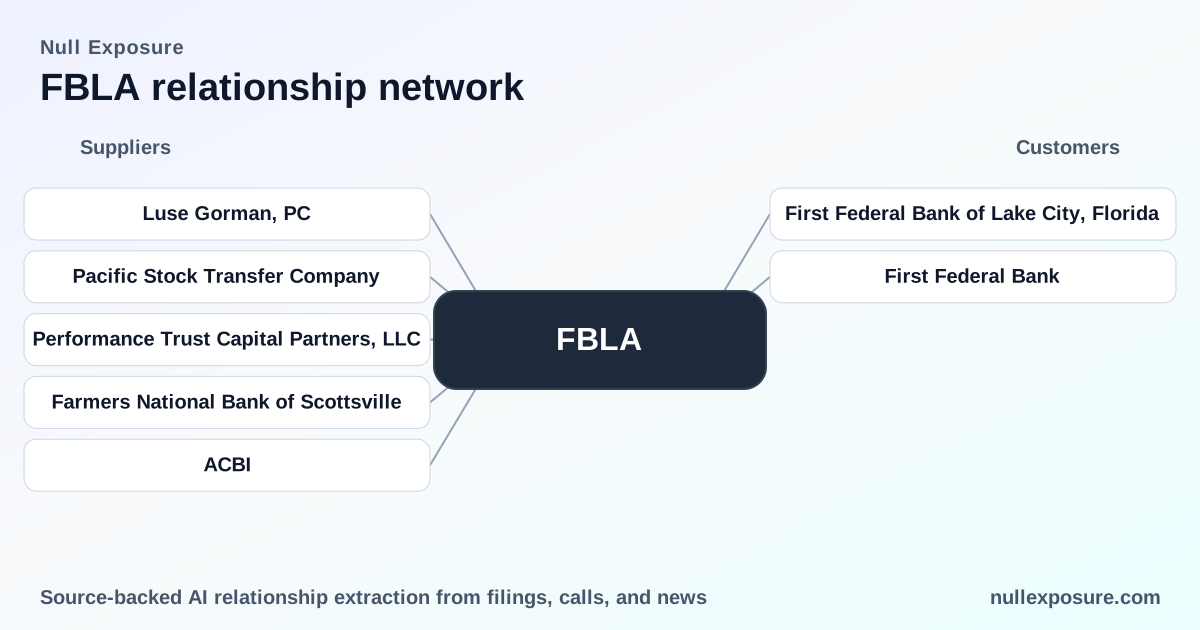
FB Bancorp’s decision to sell portions of its NOLA mortgage business to First Federal Bank of Lake City repositions mortgage banking from an origination-and-hold model toward a capital-light, fee-driven mortgage pipeline. The sale reduces future interest-rate sensitivity of held-for-sale mortgages, lowers origination throughput on the balance sheet, and provides liquidity that can be redeployed into core deposit-funded lending or capital returns. Strategically, this is a move to concentrate on traditional banking margins while shedding a portion of mortgage servicing or production volatility.
Source-by-source relationship log (every result covered)
The Globe and Mail — press release (March 9, 2026)
FB Bancorp disclosed that on December 31, 2025, Fidelity Bank entered an asset purchase agreement to sell certain assets of its NOLA Lending Group mortgage division to First Federal Bank of Lake City, with closing expected in Q1 2026. Source: The Globe and Mail press release (March 9, 2026) — https://www.theglobeandmail.com/investing/markets/stocks/FBLA/pressreleases/36915281/fb-bancorp-sells-nola-lending-assets-to-first-federal/
The Globe and Mail — press release (March 1, 2026)
A follow-up press release reports that on March 1, 2026 Fidelity Bank completed the previously announced sale of certain NOLA mortgage division assets to First Federal Bank of Lake City. Source: The Globe and Mail press release (March 1, 2026) — https://www.theglobeandmail.com/investing/markets/stocks/FBLA/pressreleases/547335/fb-bancorp-sells-nola-mortgage-assets-to-first-federal/
Investing.com — SEC filings summary (May 2, 2026)
An SEC-filings summary on Investing.com reiterated that FB Bancorp completed the sale of certain NOLA mortgage assets to First Federal Bank as part of recent corporate actions disclosed at the annual meeting. Source: Investing.com — https://au.investing.com/news/sec-filings/fb-bancorp-elects-directors-and-ratifies-auditor-at-annual-meeting-93CH-4397878
Investing.com — alternative SEC filings item (May 2, 2026)
A second Investing.com item covering the same filings repeats that FB Bancorp finalized the sale of NOLA mortgage division assets to First Federal Bank, underscoring the transaction’s prominence in corporate communications. Source: Investing.com — https://www.investing.com/news/sec-filings/fb-bancorp-elects-directors-and-ratifies-auditor-at-annual-meeting-93CH-4650719
Investing.com — mobile insider trading item (May 2, 2026)
A mobile Investing.com insider-trading report mentioned the company’s finalized sale of certain NOLA mortgage assets to First Federal Bank while covering insider activity, linking equity moves with the asset-sale narrative. Source: Investing.com mobile (insider-trading article) — https://m.uk.investing.com/news/insider-trading-news/baker-fb-bancorp-coo-sells-34k-in-fbla-stock-93CH-4546530?ampMode=1
Investing.com — AMP mobile SEC filings variant (May 2, 2026)
An AMP-mode version of the SEC filings story on Investing.com again confirms FB Bancorp’s completion of the sale of NOLA mortgage assets to First Federal Bank, reflecting syndicated press pickup. Source: Investing.com mobile (SEC filings AMP) — https://m.investing.com/news/sec-filings/fb-bancorp-elects-directors-and-ratifies-auditor-at-annual-meeting-93CH-4650719?ampMode=1
BizNewOrleans — corporate recap (March 9, 2026)
BizNewOrleans reported that Fidelity reached an agreement to sell its NOLA Lending Group mortgage division to First Federal Bank of Lake City, framing the move as a notable strategic reshaping in local operations. Source: BizNewOrleans (March 9, 2026) — https://bizneworleans.com/fb-bancorp-repurchases-10-of-outstanding-shares/
Investing.com — alternative Globe press release mirror (March 9, 2026)
An Investing.com mirror of the Globe press release reiterates the December 31, 2025 asset purchase agreement between Fidelity Bank and First Federal Bank of Lake City to transfer NOLA Lending Group assets, with closing in Q1 2026. Source: Investing.com mirrored press release — https://www.theglobeandmail.com/investing/markets/stocks/FBLA-Q/pressreleases/36915281/fb-bancorp-sells-nola-lending-assets-to-first-federal/
Investing.com — Canadian outlet (May 2, 2026)
A Canadian Investing.com posting covering insider or SEC filings confirmed the finalization of the sale of NOLA mortgage assets to First Federal Bank, reflecting broad distribution of the disclosure. Source: Investing.com Canada — https://ca.investing.com/news/insider-trading-news/baker-fb-bancorp-coo-sells-34k-in-fbla-stock-93CH-4500870
Investing.com — Nigeria mirror (May 2, 2026)
An Investing.com Nigeria mirror of the insider/SEC notices also highlights the sale closure, underscoring the transaction’s coverage across markets. Source: Investing.com Nigeria — https://ng.investing.com/news/insider-trading-news/baker-fb-bancorp-coo-sells-34k-in-fbla-stock-93CH-2380273
MarketBeat / TipRanks citation (March 2, 2026)
MarketBeat aggregated a March 2, 2026 note that FB Bancorp sold NOLA mortgage assets to First Federal, linking to third-party tip reporting and analyst commentaries. Source: MarketBeat (March 2, 2026) — https://www.marketbeat.com/instant-alerts/fb-bancorp-nasdaqfbla-cut-to-sell-at-wall-street-zen-2026-03-28/
Operational constraints and what they imply for investors
FB Bancorp’s public filings and disclosures set clear operational characteristics that drive credit and commercial risk:
- Contract maturity mix: The bank originates long-term residential mortgages (up to 30 years) while simultaneously holding $230.3 million of certificates of deposit maturing in less than one year, producing a funding-tenor mismatch that requires active liquidity and interest-rate management.
- Counterparty profile: Lending and deposit relationships skew toward individuals and small businesses, making the bank’s credit cycle—and deposit stability—tied to local economic health rather than institutional counterparties.
- Geographic concentration: Operations and originations center on southern Louisiana with extensions into the Florida panhandle and Mississippi, concentrating market risk but also enabling local market expertise.
- Material exposures: Commercial real estate comprises roughly one-third of the loan portfolio, a material allocation that magnifies local economic sensitivity and CRE-cycle risk.
- Business model split: The company operates two reportable segments—traditional banking and mortgage banking—where mortgage activities are both a revenue source and a liquidity tool through loan sales.
- Spend and exposure sizing: Deposit maturities exceed $100M in short-term CDs, while individual commercial credits can sit in the $10M–$100M band, indicating a mid-sized commercial loan footprint with potential single-name concentration.
Collectively these signals describe a bank with local-market concentration, a mixed maturity profile, and material CRE exposure—factors investors must weigh against capital adequacy and liquidity metrics.
Investment implications: concise, actionable takeaways
- Positive: The NOLA asset sale to First Federal Bank provides immediate liquidity and reduces origination balance-sheet volatility, allowing FB Bancorp to redeploy capital into higher-return, core deposit-funded lending or to shore up capital ratios.
- Negative: The funding-tenor mismatch (long-duration mortgages vs large short-term CD maturities) and ~32% CRE concentration amplify sensitivity to local economic downturns and rising rates.
- Net view: FB Bancorp is executing a sensible rebalancing toward its core banking franchise, but investors must track deposit roll-over, CRE credit trends, and the effective use of proceeds from the NOLA sale.
For continued, structured monitoring of regional banking relationships and transaction flows, visit https://nullexposure.com/ for proprietary signals and relationship mapping.
Conclusion: FB Bancorp is a regional bank refining its footprint through strategic asset sales while maintaining a classic community-bank model—the bank’s future performance will hinge on execution of redeployment, deposit stability, and CRE credit management.