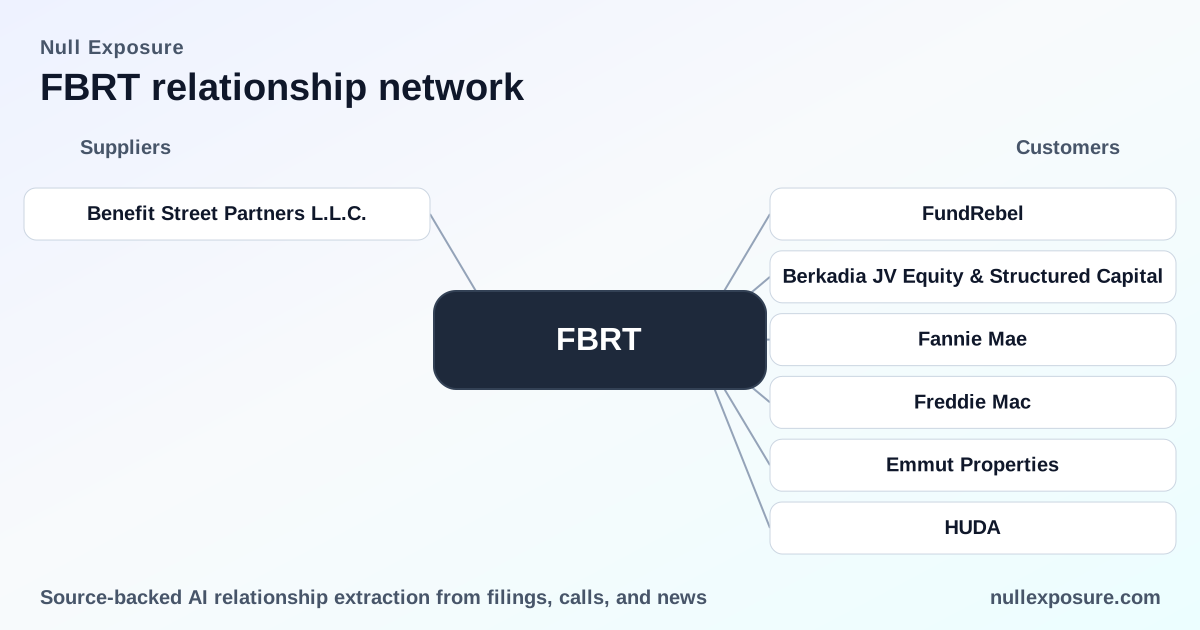
Franklin BSP Realty Trust: customer relationships that drive originations and credit exposure
Franklin BSP Realty Trust (FBRT) originates and acquires commercial real‑estate debt and monetizes through interest income, fee income on loan production and planned conduit sales into CMBS via its TRS. The company’s business model centers on originating long‑duration, asset‑backed loans and leveraging agency programs and private lenders to scale originations and manage capital — producing predictable coupon income but exposing FBRT to capital‑markets and agency program access dynamics. For more context on how partner relationships feed FBRT’s pipeline and risk profile, visit https://nullexposure.com/.
Why partner relationships matter to an income‑oriented REIT
FBRT’s operating model is weighted toward loan origination and portfolio management rather than property operations. That creates four structural characteristics investors should internalize:
- Contracting posture: long‑term loan assets. The firm underwrites fixed‑rate conduit loans that can extend up to ten years and are predominantly current‑pay, which supports steady yield but lengthens duration risk.
- Concentration and criticality: agency program dependence. Repeated originations under Fannie Mae, Freddie Mac and HUD programs point to critical reliance on GSE and agency pipelines for deal flow and pricing frameworks.
- Geography and diversification: global origination footprint. FBRT explicitly originates and manages loans both inside and outside the U.S., which reduces single‑market concentration but raises underwriting complexity and cross‑jurisdiction execution risk.
- Business maturity and service orientation. The company runs a services‑style real‑estate debt platform — originating first mortgages, subordinate debt and mezzanine loans — signaling a product mix that spans credit layers rather than a single product line.
These signals shape valuation drivers: stable net interest income tempered by securitization execution and agency access, and risk drivers: capital markets, interest rates, and geographic/structural underwriting variability. If you want a rapid overview of FBRT’s partner exposure and how it supports origination volume, see https://nullexposure.com/ (home).
Relationship roll call: counterparties, deals and press references
Berkadia JV Equity & Structured Capital
Berkadia JV Equity & Structured Capital arranged a stretch‑senior financing where an $84 million loan was secured from Franklin BSP Realty Trust for a Manhattan hotel‑to‑multifamily conversion. According to YieldPro (January 2022), Berkadia sourced the debt and identified FBRT as the lender on the transaction.
Emmut Properties
The Emmut Properties deal — the acquisition and conversion of the century‑old Excelsior Hotel on Manhattan’s Upper West Side — was financed in part by an $84 million loan provided by FBRT, as reported in YieldPro (January 2022). This illustrates FBRT’s role in financing complex urban adaptive‑reuse projects.
FundRebel
Records reported in The Real Deal (March 2024) show FundRebel obtained a $41 million loan from Franklin BSP Realty Trust to acquire the Nine Hollywood apartment property; FBRT acted as the lender on this multifamily acquisition loan.
Fannie Mae
FBRT originated a material portion of its new commitments under agency programs: the company reported $2.2 billion of new loan commitments under programs with Fannie Mae, Freddie Mac and HUD in its third‑quarter 2025 results summary, demonstrating active engagement with GSE origination channels (TradingView coverage of FBRT Q3 2025 results).
Freddie Mac
Freddie Mac is a co‑participant in FBRT’s agency‑sponsored originations, contributing to the same $2.2 billion of new loan commitments reported in Q3 2025; FBRT uses these agency programs to scale origination flow and achieve competitive funding/pricing (TradingView, Q3 2025 results).
HUD
The Department of Housing and Urban Development (HUD) is listed among the agency channels FBRT used for originations in Q3 2025, and those programs are included in the $2.2 billion of new commitments the company reported — a clear sign that public programs are a material distribution channel for certain asset classes (TradingView, Q3 2025 results).
HUDA (duplicate HUD reference)
The dataset includes a duplicate reference to HUDA (HUD) related to the same Q3 2025 origination disclosure. TradingView’s Q3 2025 summary reiterates that FBRT’s originations included programs with HUD alongside Fannie Mae and Freddie Mac, reinforcing the prior point on agency program penetration.
CLPR (Clipper Realty)
MarketBeat coverage (various alerts in late 2025 / early 2026) referenced underwriting activity in which FBR and Raymond James acted as underwriters for an IPO involving Clipper Realty (CLPR), with Janney Montgomery Scott and Wunderlich as co‑managers. The press excerpts reference the broker‑dealer FBR; these items appear in the relationship dataset and should be read as market‑mention activity that intersects with industry underwriting channels reported in news coverage.
What the relationship map means for investors
- Origination stability: Direct lending to borrowers such as FundRebel and Emmut/Excelsior transactions demonstrates FBRT’s active role as a direct lender in core and value‑add multifamily and conversion projects; these loans generate coupon income and optional fee income on production.
- Agency program leverage: The Q3 2025 disclosure of $2.2 billion in commitments under Fannie Mae, Freddie Mac and HUD channels signals scale and standardized pricing, reducing some idiosyncratic pricing risk while increasing sensitivity to GSE policy changes.
- Complexity and execution risk: A global footprint and a product slate that includes subordinated and mezzanine positions require stronger asset management capabilities; securitization intent (conduit loans sold through the TRS into CMBS) exposes FBRT to capital‑markets windows and underwriting scrutiny.
- Concentration considerations: While relationships with major agencies diversify funding ways, large individual loans (e.g., $84M, $41M) mean asset‑level performance can drive near‑term earnings volatility if stressed.
Bottom line and action items
FBRT’s customer relationships demonstrate a hybrid origination strategy: direct lending to sponsors on sizeable transactions plus systematic use of agency programs to scale volume. That combination supports current yield but links performance to securitization markets and agency program access.
For a concise briefing on counterparties and how those relationships align with risk and revenue drivers, visit https://nullexposure.com/. If you want a custom map of FBRT’s partner exposures and how they affect cash‑flow sensitivity, our platform provides investor‑grade relationship intelligence.