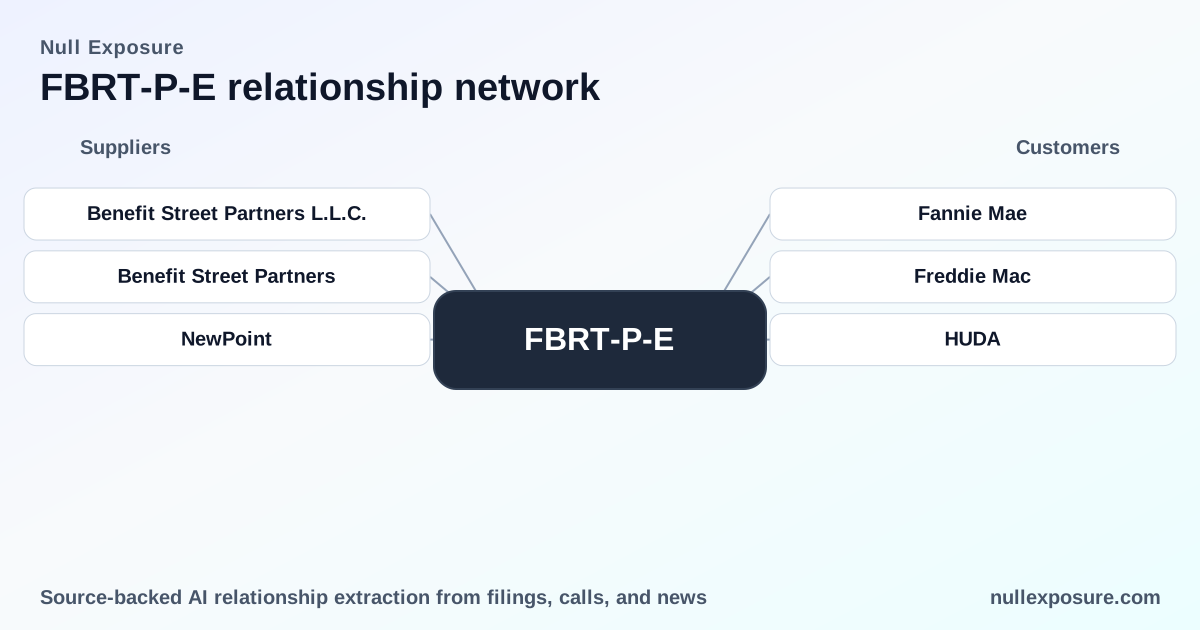
FBRT-P-E: Agency partnerships anchor origination-led yield for Franklin BSP Realty Trust
Franklin BSP Realty Trust’s preferred instrument FBRT-P-E sits on top of a business model built around originating and holding real estate-related debt and equity, with a clear focus on multifamily and commercial collateral. The trust monetizes through interest income and fee-driven loan originations, leveraging agency programs to scale originations and de-risk credit exposure — a structure that supports preferred-level distributions while preserving balance-sheet optionality for management.
Read more background and data at https://nullexposure.com/
What the FY2026 agency origination headline means for investors
Franklin BSP’s FY2026 disclosure reports $1.1 billion of new loan commitments originated under programs with Fannie Mae, Freddie Mac, and HUD. That single-line disclosure is critical: it signals an operating posture that uses agency conduits to deploy capital at scale, capture origination fees, and transfer or mitigate credit risk through agency platforms. For investors in FBRT-P-E, the reliance on agency programs is a primary revenue driver for the trust’s Agency Business segment and a leading indicator of recurring fee and interest flows available to preferred holders.
This dynamic also defines counterparty exposure and regulatory sensitivity: agency relationships reduce individual credit idiosyncrasy but increase policy and program-concentration risk. The $1.1 billion figure anchors the scale of that exposure for the latest fiscal year.
Counterparty relationships and what they mean — line by line
Fannie Mae
Franklin BSP originated loans under Fannie Mae programs as part of its Agency Business, contributing to the $1.1 billion in new loan commitments reported for FY2026. According to the company’s FY2026 results press release distributed via Business Wire on February 11, 2026, Fannie Mae is a core conduit used to scale multifamily lending and standardize credit transfer. (Business Wire / FinancialContent, Feb 11, 2026)
Freddie Mac
Freddie Mac is named alongside Fannie Mae as a co-participant in the trust’s agency-originated loan flow, reflecting a dual-agency origination strategy that broadens distribution and pricing optionality. The FY2026 press release lists Freddie Mac as one of the platforms through which Franklin BSP generated agency commitments totaling $1.1 billion. (Business Wire / FinancialContent, Feb 11, 2026)
HUD
HUD programs are included in the same agency origination batch that delivered $1.1 billion of new commitments in FY2026, indicating that Franklin BSP uses government-insured financing corridors in addition to the GSE channels. The FY2026 company release identifies HUD as a program partner for Agency Business originations. (Business Wire / FinancialContent, Feb 11, 2026)
HUDA
The record includes a second mention labeled HUDA with an inferred symbol; this entry mirrors the HUD relationship and reflects the same set of agency-originated commitments recorded in FY2026. The press release lists HUD/related HUD programs among the agency platforms that produced the $1.1 billion in new loan commitments. (Business Wire / FinancialContent, Feb 11, 2026)
How these relationships shape the operating model and business risks
- Contracting posture: The trust operates under standardized agency program contracts rather than bespoke bilateral mortgage facilities; this creates predictable documentation, pricing templates, and program eligibility criteria that constrain underwriting but accelerate deal flow.
- Concentration: Agency programs are a meaningful channel for new originations; while agencies reduce single-borrower concentration risk, they introduce concentration risk at the program and policy level since a material portion of originations flow through the same counterparty set.
- Criticality: Access to Fannie Mae, Freddie Mac, and HUD programs is critical to the trust’s scale and fee generation. Loss or restriction of program access would materially reduce origination capacity and dealer/distribution economics.
- Maturity: Use of GSE and HUD programs signals a mature origination platform that conforms to agency underwriting rules and quality controls, enabling consistent securitization or agency-sale pathways rather than opportunistic whole-loan dispositions.
These are company-level signals drawn from the FY2026 operating disclosure and should be treated as structural features of Franklin BSP’s Agency Business.
Investment implications — what investors and operators should track
- Positive: scale and credit handling — Agency partnerships let Franklin BSP originate at scale with standardized credit interfaces, which supports recurring fee income and predictable servicing mechanics for portfolio assets.
- Risk: policy and program dependency — The trust’s economics are sensitive to GSE and HUD program rule changes, which can alter spreads, eligibility, and required capital. Regulatory shifts are a direct channel to earnings volatility.
- Liquidity angle — Agency access creates reliable exit or securitization pathways, improving liquidity for originated assets versus wholly private placements.
- Structural instrument risks — Preferred shareholders in FBRT-P-E are exposed to upstream operating performance and capital allocation; preferred distributions depend on the trust’s ability to sustain originations and interest income after covering senior obligations.
Key monitoring checklist for FBRT-P-E investors:
- Track quarterly disclosures for the run-rate of agency-originated commitments versus total originations.
- Monitor changes in Fannie/Freddie/HUD program terms and pricing.
- Watch for concentration disclosures: percent of originations sold to agencies or retained on balance sheet.
- Evaluate management commentary on servicing, repurchase risk, and capital allocation between equity and preferred distributions.
Conclusion: practical view for research and portfolio decisions
Franklin BSP Realty Trust’s FY2026 agency origination of $1.1 billion under Fannie Mae, Freddie Mac, and HUD programs is a clear, quantifiable signal that the company runs an origination-first business model with agency-distribution at its core. For holders or prospective buyers of FBRT-P-E, the critical lens is not only the absolute scale of agency flow but how dependent recurring distributions are on continued program access and stable agency economics.
For a concise, data-driven briefing and ongoing monitoring tools, visit https://nullexposure.com/ — the source used to compile this relationship-focused profile and the broader coverage for real estate originators and securities.