Falcon’s Beyond (FBYD): Customer Footprint, Concentration, and Commercial Levers
Falcon’s Beyond operates as an entertainment design and experiential production company, monetizing through master planning, design, content production and sale/licensing of attraction hardware and experiential technologies via its Falcon’s Creative Group (FCG) division. Revenue flows from large consultancy and license agreements for major destination projects, recurring management/incentive fees from equity investments, and ancillary digital tie‑ins. For a concise view of customer-level exposure, see NullExposure’s coverage: https://nullexposure.com/.
How Falcon’s commercial model works and why customers matter
Falcon’s Beyond sells high‑touch services and licensed products to sovereign and institutional destination developers. The company provides master planning, attraction design, media production, technology integration and hardware procurement on a work‑for‑hire or licensing basis, and it recognizes multi‑year project revenue against remaining performance obligations. Company filings show active, cancellable service agreements and a material backlog: $36.4 million in remaining performance obligations as of Dec 31, 2024, with ~82% expected to convert to revenue within 12 months.
Several operating characteristics drive valuation and operational risk:
- Customer concentration is extreme and critical. FCG reported one customer generating roughly 99% of its revenue in 2024, with accounts receivable dominated by that counterparty. This elevates single‑counterparty credit and execution risk.
- Contracting posture mixes licensing and services. Public disclosures describe both work‑for‑hire and licensing revenue models, implying a mix of lump‑sum project fees, milestone billings, and potential ongoing IP monetization.
- Geographic reach is global but anchored in large EMEA/APAC destination projects. Filings list client engagements in Saudi Arabia, the United States, Hong Kong, the Caribbean and Spain across FY2023–FY2024—pointing to strategic focus on large destination builds outside North America.
- Contract maturity and optionality are limited but active. As of April 3, 2025 the company disclosed 9 active agreements with its largest customer, each terminable on relatively short notice, indicating flexibility but also unpredictability in near‑term revenue timing.
These characteristics make customer relationships the primary valuation lever and the principal source of downside risk for FBYD investors.
High‑impact customer relationships investors must track
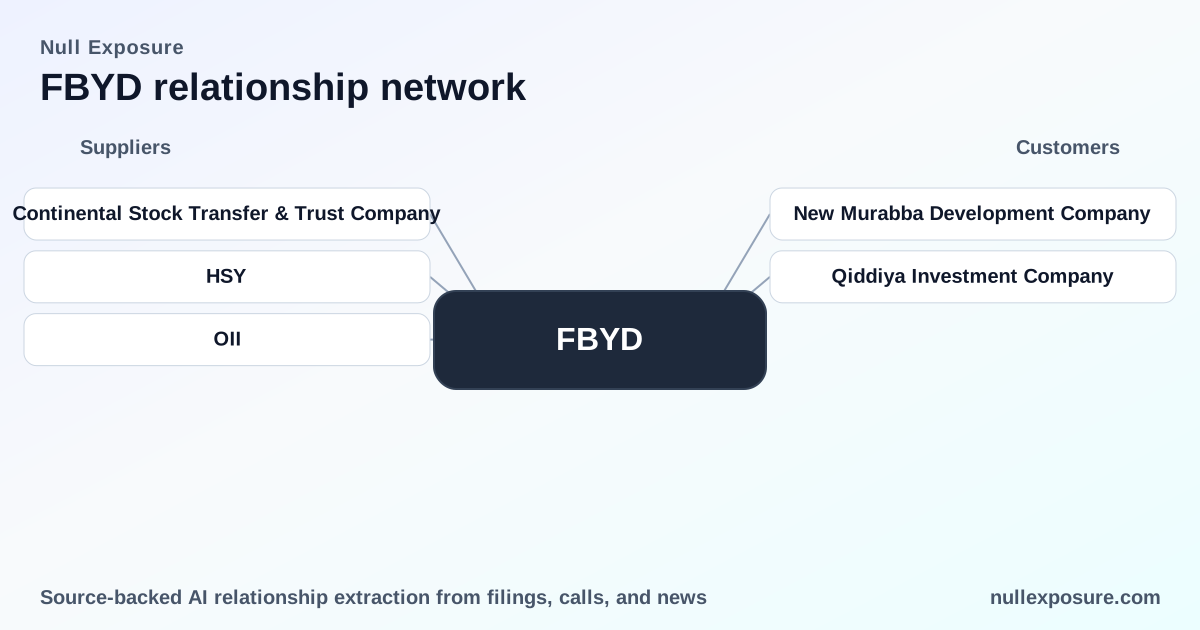
Qiddiya Investment Company — the revenue engine
Falcon’s Creative Group is deeply embedded in the Qiddiya development program and is the largest and most critical single customer for FCG. Company filings state QIC generated approximately 99% of FCG’s revenue for the year ended December 31, 2024 and accounted for 98% of accounts receivable balances as of that date; the company also disclosed a Consultancy Services Agreement with QIC (January 2024) with total potential value up to approximately $83.1 million if all opportunities are won. According to a BizWire press release and related company filings (FY2024–FY2025), FCG provides master planning and design services for multiple immersive entertainment projects across Qiddiya City. (Source: BizWire press release, Nov 6, 2025; company filings FY2024/FY2025.)
New Murabba Development Company — creative lead for The Mukaab
Falcon’s was named Creative Lead Advisor for The Mukaab and its surrounding district under an engagement with New Murabba Development Company, positioning FCG as a design/creative partner on a marquee Riyadh‑area project. That collaboration was disclosed in Falcon’s press communications in late 2025 and reprinted in news outlets covering executive appointments. (Source: BizWire/Spoke article on Falcon’s Creative Group naming Mitchell Magill as President, Nov 6, 2025.)
Roblox — digital extension of park experiences
Falcon’s product roadmap includes digital extensions of physical parks; BeyondME’s Punta Cana project was described as connecting park experiences to mobile games and Roblox to drive engagement and XP systems. The company’s strategy to monetize on‑site experiences through digital platforms demonstrates a hybrid physical/digital revenue pathway that augments project economics and lifetime guest monetization. (Source: ANB Media coverage of BeyondME/Katmandu Park Punta Cana, Oct 2022.)
Contract and constraint signals that shape execution risk
Several extracted constraint signals provide clarity on how Falcon’s operates beyond headline relationships:
- Licensing and work‑for‑hire commercial mix is a foundational operating choice at FCG and implies varied margin profiles and IP ownership outcomes across contracts (evidence: company description of services).
- Geographic diversification exists but is project‑led: disclosures specifically list Saudi Arabia, the U.S., Hong Kong, the Caribbean and Spain across FY2023–FY2024, indicating the company pursues large international destination clients rather than a broad retail customer base.
- Materiality is concentrated at the company level: filings explicitly classify FCG’s largest customer as critical, which translates to substantial revenue and receivables concentration risk for the consolidated enterprise.
- Contract scale is large: the QIC consultancy agreement illustrates potential contract values in the tens of millions, consistent with a $10m–$100m spend band signal.
- Relationship staging is active and near‑term revenue heavy: the firm expects most backlog to convert within 12 months, which focuses investor attention on delivery cadence and milestone billing rather than distant, speculative upside.
Where constraint excerpts name QIC specifically, treat those as relationship‑level facts; where they do not, treat the constraints as company‑level operating signals.
Investor implications and operational checklist
- Concentration risk dominates the investment thesis. With one counterparty accounting for ~99% of FCG revenue and receivables, any payment disruption, scope change, or termination materially alters cash flow and valuation.
- Execution and cash conversion are the primary operational KPIs. Monitor milestone achievement, receivables aging, and the pace at which the $36.4 million backlog converts to revenue.
- Contract structure matters for upside. Licensing and IP‑linked arrangements create optionality for recurring income; work‑for‑hire deals are more one‑time and require continuous deal flow to maintain revenue.
- Geopolitical and sovereign counterparty risk is elevated. Heavy exposure to Saudi‑led megaprojects delivers scale but requires tracking policy, budgetary and timeline shifts at the sovereign investor level.
- Digital partnerships are strategic diversifiers. Relationships like the Roblox tie indicate a path to monetize guest lifetime value beyond capex projects.
For a structured view of customer concentration, contract terms and signals that matter to operators and investors, review NullExposure’s analytical customer profiles: https://nullexposure.com/.
Falcon’s Beyond is a project‑scale creative champion whose upside runs through successful execution of a handful of large destination engagements; the single largest customer defines both growth runway and existential risk. Investors and operators should prioritize covenant, receivable and milestone transparency when assessing FBYD exposure.