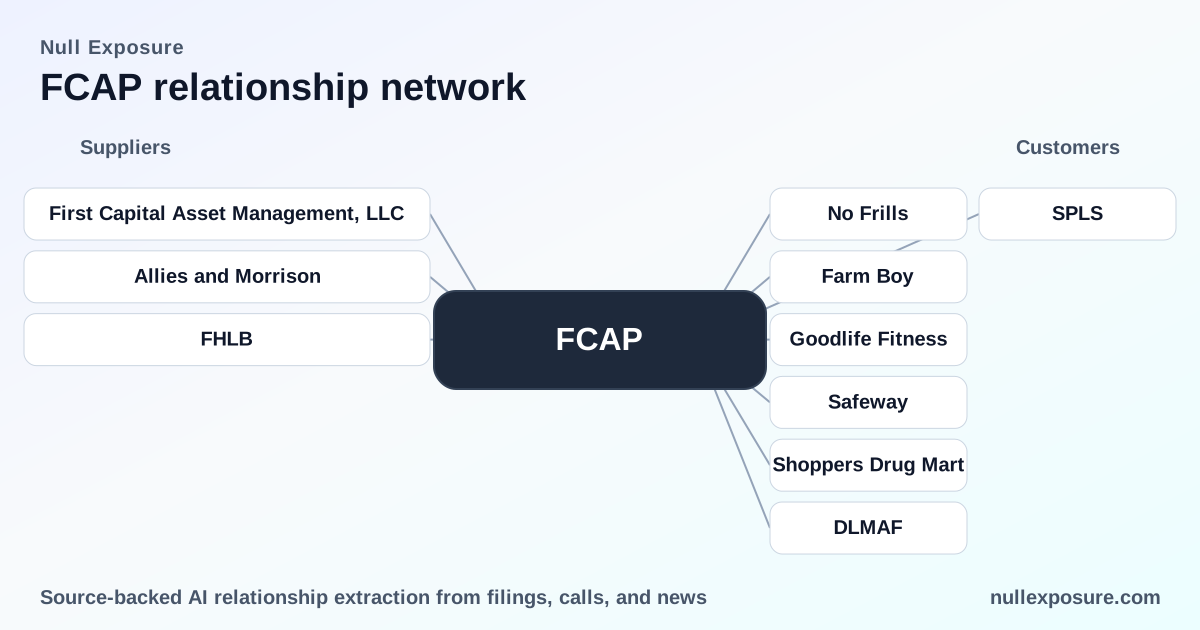
FCAP Customer Map: What First Capital Inc’s relationship signals mean for investors
First Capital, Inc. is the bank-holding company for First Harrison Bank that monetizes a local deposit franchise by originating mortgage, consumer and commercial loans and collecting transaction and account-maintenance fees. Revenue derives from net interest margin on a mix of short-term and long-term credit products plus fee income from deposit and transaction services; the balance sheet is regionally concentrated and driven by community banking flows. For investors evaluating customer relationships, the signals below show how the company’s commercial footprint and fee mix translate into credit and concentration dynamics that matter for valuation and risk.
Explore the full dataset at https://nullexposure.com/ for deeper relationship-level context.
Why these customer hits matter for a community bank
The relationship records provided are anchor-tenant and retail-name mentions tied to a public real-estate sale story; for a bank like FCAP, these name matches function as indirect indicators of commercial real-estate underwriting exposure and local retail credit interdependence. They are not customer contracts for banking services in themselves, but they map to the kinds of commercial locations and tenant mixes that influence lease-backed CRE loans, deposit patterns, and merchant transaction flows.
Key takeaway: the list is dominated by national retail anchors and fitness/grocery tenants—entities that typically secure rental income streams and affect property-level cashflows that community banks underwrite.
Anchor tenant directory — one-line investor summaries
Below are the relationships surfaced in the coverage, each with a concise plain-English summary and the sourcing context.
Safeway
Safeway is listed as an anchor tenant at the Towerlane and Airdrie Village retail centres referenced in the sale coverage; this points to grocery-anchored retail collateral in the cited assets. According to the Renx.ca article (March 9, 2026), Safeway anchors the Calgary-suburb properties sold in the transaction.
Shoppers Drug Mart
Shoppers Drug Mart is named among the anchors at the Airdrie retail centres, signaling typical pharmacy tenancy that supports foot traffic and lease stability at those locations (Renx.ca, March 9, 2026).
Farm Boy
Farm Boy is identified as the anchor for retail space within a 40-storey mixed-use Station Place development; the mention implies grocery-led retail within a larger residential rental project (Renx.ca, March 9, 2026).
Goodlife Fitness
Goodlife Fitness is cited as a tenant anchoring one of the shopping centres, representing service-anchored traffic that supports weekday visitation patterns important to small retail tenants (Renx.ca, March 9, 2026).
No Frills
No Frills is listed as the anchor at Langley Mall, a 137,000-square-foot centre noted as 96% leased, indicating a discount-grocery-backed occupancy profile (Renx.ca, March 9, 2026).
DLMAF
DLMAF is included in the matching results (mapped to Dollarama in the dataset) and is referenced in the same retail-centre anchor list; this reinforces the presence of value-price retail within the covered assets (Renx.ca, March 9, 2026).
Dollarama
Dollarama is explicitly named as an anchor in the Airdrie properties, reflecting a low-priced retail partner that stabilizes smaller in-line tenant demand (Renx.ca, March 9, 2026).
Staples
Staples is mentioned as an anchor in the Towerlane and Airdrie Village centres, signaling office-supply tenancy that complements grocery and pharmacy anchors in a suburban mall composition (Renx.ca, March 9, 2026).
Each of the above relationships is drawn from the same Renx.ca coverage of a retail sales and development partnership announced March 9, 2026, which enumerated anchor tenants across the sold properties.
What the constraints tell you about FCAP’s operating model
The relationship-level hits above come alongside company-level constraints and disclosures that reveal how First Capital runs its banking business. These are firm-level operating signals, not allocations to the anchor tenants listed.
- Contracting posture — mix of short and long durations. Lines of credit are described as one-year renewable instruments, while residential mortgages and ARMs are issued with 15–30 year terms. This creates a dual interest-rate sensitivity: near-term repricing through renewables and long-duration fixed-rate assets on the balance sheet.
- Revenue recognition and fee structure. Account maintenance fees are recognized over the month (subscription-style recurring revenue), while ATM and transaction fees are recognized at the point of transaction (spot revenue). This produces a predictable base of recurring fee income plus transactional volatility tied to economic activity.
- Customer composition. The bank explicitly serves individuals, small and mid-market businesses, and commercial real-estate borrowers, which concentrates credit risk in borrower segments that are more sensitive to local economic cycles than national counterparts.
- Geographic concentration. All operations are domestic and focused in Harrison, Floyd, Clark, Washington counties in Indiana and Bullitt County, Kentucky, with 18 branch locations; this is a regional franchise with high local concentration risk and tight regulator oversight as an Indiana-chartered bank.
- Role mix and revenue drivers. The firm functions as both a service provider (deposit, payment and credit products) and a seller of standard deposit instruments; commercial credit commitments and standby letters of credit are explicit underwriting instruments.
- Scale signal. Reported growth of total deposits to ~$1.07 billion as of Dec 31, 2024 positions the company in the $100m-plus spend band for local lending and fee exposure.
These constraints together depict a community bank with stable deposit funding, a blend of short-term funding commitments and long-duration assets, recurring fee revenue, and concentrated regional credit risk.
Investment implications — what investors should watch next
- Interest-rate exposure is structural. The coexistence of one-year renewables and long-term fixed mortgages makes net interest margin sensitive to the yield curve path; monitor loan repricing cadence and deposit beta.
- Concentration risk is material. The bank’s geography and small- to mid-market borrower mix create local economic sensitivity that investors should price into valuation multiples.
- Fee diversity cushions cyclicality. Account maintenance and transactional fees provide recurring revenue that buffers interest volatility, but ATM and merchant fee volumes can decline with local slowdown.
- Collateral quality is visible through tenant mix proxies. Anchor tenants noted in the coverage—grocers, pharmacies, value retail and fitness—are typical stabilizers of mall cashflows; where FCAP underwrites CRE against similar tenant lineups, loss given default and vacancy timelines are different than single-tenant office or discretionary retail.
For a deeper view on linkages between borrower collateral, tenant mixes and balance-sheet exposure, visit https://nullexposure.com/ to review relationship-level mappings and evidence.
Bottom line
First Capital Inc’s customer and operating signals portray a conservative community bank with a deposit-funded loan book, diversified fee streams, and concentrated regional exposure. The retail-anchor matches in the public coverage are useful proxies for the types of CRE collateral and local commerce that influence credit performance, but the core investment driver remains the bank’s ability to manage interest-rate timing across short-term renewables and long-term mortgage assets while preserving deposit stability.
For analysts building credit scenarios or investors stress-testing regional loan books, these relationship and constraint signals provide actionable context for valuation and risk assessment.