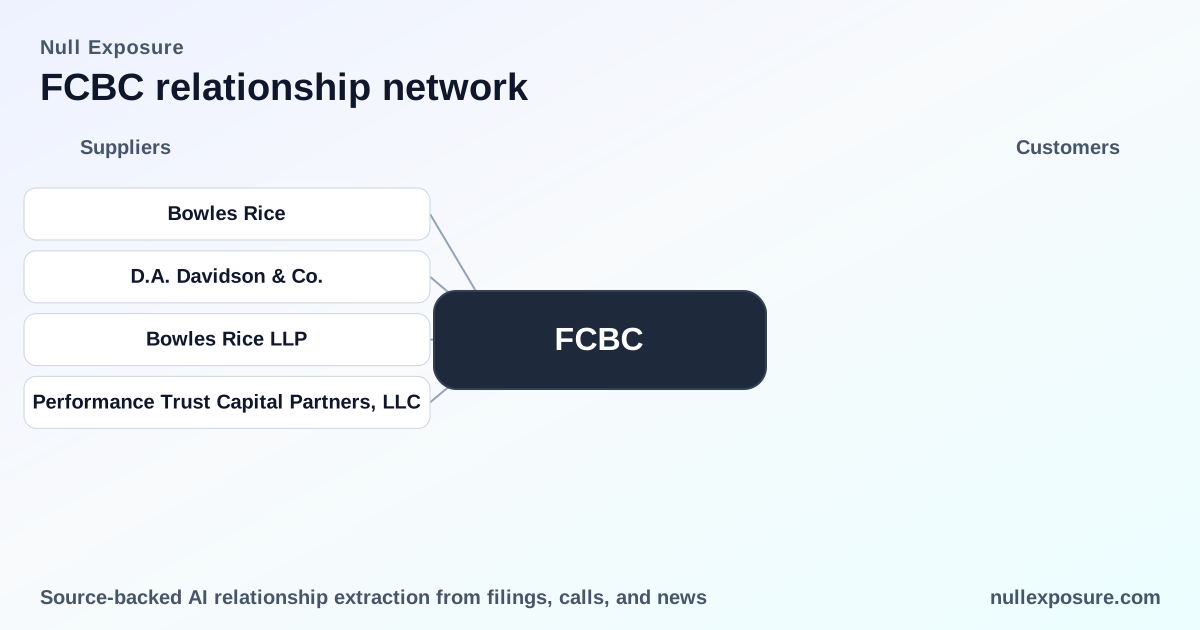
First Community Bancshares (FCBC): Customer Relationships and Operational Signals for Investors
First Community Bancshares operates as a regional financial holding company that monetizes through traditional community-banking channels: deposit gathering, commercial and consumer lending, fee income from payments and wealth services, and balance-sheet optimization post-acquisitions. The company runs a single operating segment—Community Banking—delivering banking products through First Community Bank across 53 branches in Virginia, West Virginia, North Carolina and Tennessee, and expands revenue and scale through strategic M&A. For background and platform-level analysis see https://nullexposure.com/.
Why the recent M&A matters to customers and revenue growth
FCBC has been executing a roll-up strategy that increases scale in adjacent markets and widens product distribution to acquired customer bases. The completed purchase of Hometown Bancshares is emblematic: the transaction transfers customers and deposit franchises onto FCBC’s platform, where the bank can expand lending limits and introduce new product suites, lifting both interest-bearing balances and fee income over time. According to CityBiz (May 2, 2026), the company emphasized improved product and technology offerings as key benefits of the deal.
For a concise investor view of FCBC’s platform and third-party relationship posture, visit https://nullexposure.com/ for related research.
Hometown Bancshares, Inc.
First Community completed the acquisition of Hometown Bancshares and stated the FCBC platform will allow Hometown to better serve existing customers and expand into additional product offerings, indicating an integration that prioritizes cross-sell and technology uplift. Source: CityBiz, May 2, 2026.
Union Bank, Inc.
CityBiz’s coverage notes that Union Bank’s customers will gain “increased scale, higher lending limits, and enhanced product and technology offerings” through First Community, implying FCBC will absorb or partner with nearby institutions’ customer bases to deliver broader services. Source: CityBiz, May 2, 2026.
All customer relationships in the record — concise coverage
This dataset records two customer-facing relationships tied to FCBC’s M&A activity and its platform positioning:
- Hometown Bancshares, Inc.: The acquisition moves Hometown’s customer flow onto FCBC’s platform to enable broader product delivery and service expansion (CityBiz, May 2, 2026).
- Union Bank, Inc.: Reported as benefitting from FCBC’s scale and product/technology set—Union’s customers are positioned to receive higher lending limits and expanded offerings after integration (CityBiz, May 2, 2026).
Each relationship is tied to the same CityBiz announcement, reflecting a single strategic push to roll local franchises into First Community’s regional banking model.
Operational constraints and what they signal about the business model
The textual evidence from company disclosures and filings delivers clear company-level signals about how FCBC contracts, where it concentrates risk, and what drives its customer economics:
- Counterparty mix and customer concentration: FCBC serves a mix of individuals, small businesses, and mid-market commercial clients through local branches. This places earnings largely on net interest margin from consumer real estate and commercial loans and on deposit stability from retail customers. The company’s own disclosures highlight consumer real estate loans and commercial lending to small and mid-size firms as principal activities (company filings, FY2024–FY2026 disclosures).
- Geographic concentration: FCBC’s footprint is regional—53 branches across Virginia, West Virginia, North Carolina and Tennessee—so credit cycles and deposit behaviors will be correlated across these states rather than diversified nationally. The bank’s principal executive office is in Bluefield, Virginia (company filings).
- Contracting posture and role: FCBC acts primarily as a seller/service provider of banking solutions via its wholly owned bank subsidiary. The firm sells deposit, lending and wealth products while also serving as the operational platform that acquired institutions adopt.
- Relationship criticality: Acquisitions that convert standalone local banks to FCBC customers are highly strategic because they transfer core deposit bases and lending relationships onto FCBC’s balance sheet, increasing both funding flexibility and potential fee cross-sell.
- Maturity and segment concentration: The business reports a single operating segment—Community Banking—signaling a mature, consolidated operating model rather than a diversified financial-services conglomerate. That concentration simplifies regulatory and strategy execution but increases exposure to regional economic shifts.
Collectively, these signals describe a contracting posture that is acquisitive and platform-driven, a concentration in regional retail and commercial client segments, high criticality of deposit franchises, and a mature, single-segment operating model.
Investment implications: revenue levers and risk vectors
- Scale and cross-sell are the primary revenue levers. Acquisitions like Hometown enable immediate deposit growth and create opportunities to increase loan penetration and fee income from enhanced product sets. FCBC’s forward P/E of 8.53 and trailing P/E of 16.32 indicate market expectations of near-term earnings expansion and potential cost synergies from M&A (company market data, FY2026 Q1).
- Regional economic exposure is the principal risk. Heavy concentration across four neighboring states links credit performance to local industry cycles; a regional downturn would pressure NPLs and deposit growth concurrently.
- Execution risk on technology and integration. The stated benefit of improved technology offerings to acquired customers is real revenue upside but requires successful systems migration and customer retention during transition.
- Balance-sheet funding model. FCBC funds lending primarily through retail deposits supplemented by repurchase agreements and FHLB borrowings, making deposit retention central to liquidity stability (company filings).
Key takeaway: FCBC’s strategy combines organic community banking with targeted acquisitions to enlarge deposit and loan books while relying on a single, geographically concentrated operating platform. That strategy delivers attractive scaling economics if integration and local credit quality remain controlled.
Final assessment and recommended monitoring
First Community is executing a classic regional bank expansion play—acquire deposit-rich local franchises, migrate customers onto a broader product platform, and extract cross-sell and interest-income lift. Investors should monitor: loan portfolio performance in the newly acquired regions, deposit retention rates post-integration, and reported technology-integration costs or realized efficiency gains in quarterly filings.
For a deeper look at FCBC customer relationships and to track additional deal-driven customer disclosures, visit https://nullexposure.com/ for periodic updates and analytics.