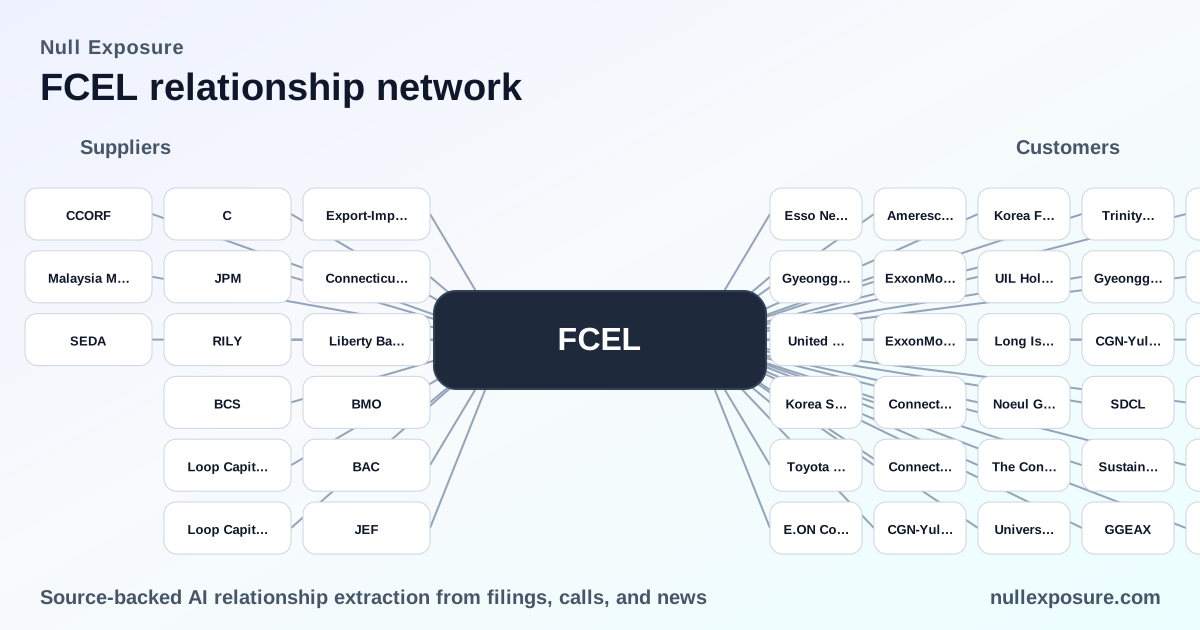
FuelCell Energy (FCEL): customer map and what it means for investors
FuelCell Energy designs, manufactures and operates stationary molten-carbonate fuel cell power plants and monetizes through product sales, long‑term service agreements (LTSAs) and power purchase agreements (PPAs) that convert capital projects into multi‑year, recurring cash flows. The business model combines upfront module revenue and long‑duration contracted service/PPA receipts, and FY2025 disclosures show a highly concentrated customer base and meaningful backlog tied to utility and large‑enterprise counterparties. For a focused commercial counterparty view, read on — or visit https://nullexposure.com/ for the full platform analysis.
How FuelCell contracts shape cash flow and risk
FuelCell’s commercial posture is contractually anchored toward long‑term revenue: the company discloses remaining performance obligations across service agreements and generation PPAs that span multiple years. The firm also sells modules on a per‑unit basis where revenue recognition is milestone driven, so its go‑to‑market mixes long‑duration contracted cash flows with spot product sales. Geographic reach is global — with especially large exposure to North America, EMEA and APAC, and management identifies South Korea as a priority growth market. FY2025 results show customer concentration is material (top customers accounted for 82% of revenue), which creates both scalability in signed backlog and counterparty concentration risk. The company has proven utility‑scale operations and 22 years of operating history, supporting the maturity of its operating assets.
Customer-by-customer readout (complete list)
Below is a concise, source‑backed summary of every counterparty mentioned in FuelCell’s customer universe in our data.
Esso Nederland B.V.
FuelCell received a purchase order tied to a Rotterdam refinery modular point source carbon capture pilot and plans a pilot commissioning in 2026 at Esso’s Rotterdam facility. According to FuelCell’s FY2025 Form 10‑K, Esso‑affiliated orders underpinned revenue recognition for the Rotterdam project (FY2025 10‑K).
Gyeonggi Green Energy Co., Ltd. (GGE)
GGE is FuelCell’s largest single named customer in FY2025, representing 46% of consolidated revenue, and is contracted under a long‑term service agreement for a 58.8 MW deployment in South Korea. This is disclosed in the FY2025 Form 10‑K, which also describes LTSA payment schedules and module replacement terms (FY2025 10‑K).
Toyota Motor North America
FuelCell’s first Tri‑gen system is deployed at Toyota’s Port of Long Beach operations center, and the company recorded consideration payable related to this engagement. This is reported in the FY2025 Form 10‑K (FY2025 10‑K).
United Illuminating
FuelCell entered a 20‑year PPA with Eversource and United Illuminating for a 7.4 MW carbonate fuel cell plant in Hartford, Connecticut (the Hartford Project). This long‑dated PPA is disclosed in the FY2025 Form 10‑K (FY2025 10‑K).
Korea Southern Power Company (KOSPO)
FuelCell is contracted to operate and maintain a 20 MW power plant for KOSPO in South Korea, as referenced in the company’s FY2025 filing (FY2025 10‑K).
ExxonMobil
FuelCell received an $11.6 million purchase order from Esso (an ExxonMobil affiliate) for fuel cell modules and related services for a Rotterdam carbon capture pilot. The order and project scope are disclosed in the FY2025 Form 10‑K (FY2025 10‑K).
ExxonMobil Technology and Engineering Company (EMTEC)
EMTEC is named as a collaborating affiliate under a joint development arrangement referenced in FuelCell’s FY2025 filing. The FY2025 Form 10‑K lists EMTEC among key collaborative partners (FY2025 10‑K).
Ameresco / Sacramento Sewer
FuelCell lists Ameresco/Sacramento Sewer among customers in its FY2025 disclosure; it is cited as part of the utilities/municipal customer group that historically drives deployments (FY2025 10‑K).
CGN‑Yulchon Generation Co., Ltd.
FuelCell executed a long‑term service agreement with CGN‑Yulchon for the Yulchon facility in South Korea, expanding the company’s Korean utility footprint. The LTSA is disclosed in the FY2025 Form 10‑K (FY2025 10‑K).
Connecticut Light and Power / Eversource Energy (CLPC / Eversource)
Derby Project companies amended a PPA to sell all output to CLPC (Eversource); separately, Eversource is a co‑counterparty on the Hartford PPA. Those PPA arrangements are documented in the FY2025 Form 10‑K (FY2025 10‑K).
Connecticut Municipal Electric Energy Cooperative (CMEEC)
The Groton Project Company agreed to sell electricity output to CMEEC under the amended Groton PPA, creating a utility counterparty revenue stream in Connecticut (FY2025 10‑K).
E.ON Connecting Energies
E.ON Connecting Energies is identified as a European utility customer in FuelCell’s FY2025 filing, illustrating the company’s EMEA utility relationships (FY2025 10‑K).
Korea Fuel Cell Co., Ltd. (KFC)
Korea Fuel Cell is referenced in the FY2025 disclosure as a named customer in the Korean market cohort (FY2025 10‑K).
Long Island Power Authority (LIPA)
LIPA is cited among historical utility customers and specific projects such as the Yaphank Project, underscoring FuelCell’s East‑coast utility footprint (FY2025 10‑K).
Noeul Green Energy Co., Ltd.
FuelCell is contracted to operate and maintain a 20 MW plant for Noeul Green Energy in South Korea, per the FY2025 filing (FY2025 10‑K).
Trinity College
FuelCell entered a PPA with Trinity College for a 250 kW solid oxide system in Hartford, first announced in fiscal 2022 and referenced in FY2025 disclosures (FY2025 10‑K).
UIL Holdings Corporation (owned by Avangrid, Inc.)
UIL/Avangrid is listed among the historic utility customers that form the company’s core market on both U.S. coasts (FY2025 10‑K).
University of Connecticut (UConn)
FuelCell signed a PPA with UConn in March 2024 for four 250 kW solid oxide systems (1 MW total), as disclosed in FY2025 filings (FY2025 10‑K).
CGN‑Yulchon Generation (news coverage)
News coverage in March 2026 highlighted that product revenue growth was driven by LTSAs with Gyeonggi Green Energy and CGN‑Yulchon, indicating commercial momentum in Korea (Intellectia news, Mar 2026).
Sustainable Development Capital LLP (SDCL)
FuelCell announced a strategic collaboration with SDCL to explore deploying up to 450 MW of fuel‑cell systems at data centers and mission‑critical sites; market reports captured the partnership in March 2026 (Finviz and InsiderMonkey coverage, Mar 2026).
Diversified Energy / DEC
Industry commentary ties a partnership with Diversified Energy to potential deliveries of up to 360 MW to data centers across several U.S. states, positioning FuelCell in AI/high‑performance computing markets (SimplyWallSt commentary, Mar 2026).
GGEAX
GGEAX is referenced in the FY2025 filing in the context of payment structure for the GGE LTSA, with consideration payable over seven years per module (FY2025 10‑K).
GGE (alternate listing)
The filing includes multiple references to GGE (alternate naming), reinforcing the materiality of the Gyeonggi relationship in FY2025 results (FY2025 10‑K).
ES / Eversource (alternate listing)
An alternate listing for Eversource (ES) appears in the filing in connection with the Hartford PPA and other Connecticut projects (FY2025 10‑K).
Goji Green Energy Company Limited
Management stated on the FY2025 Q4 earnings call that module deliveries to Goji Green (GGE) materially drove revenue increases, underscoring the same Korean LTSA demand (FY2025 Q4 earnings call, Mar 2026).
Inuverse
Analyst coverage referenced a memorandum of understanding with Inuverse for a Korean data center project, noted in post‑earnings press summaries (Finviz news coverage, FY2025 commentary).
CGN, Yocheng, Generation Company Limited (earnings call variant)
On the FY2025 Q4 call, management attributed revenue growth to additions including the Hartford project and an LTSA with CGN (FY2025 Q4 earnings call, Mar 2026).
Los Angeles Department of Water and Power
Historical references identify LADWP as a named customer for a FuelCell‑manufactured power plant, cited in market commentary (StockTwits article referencing historical project, 2003; mentioned in FY2026 news stream).
Southern California Edison / SCE‑P‑K
Southern California Edison is listed among utilities that historically form the company’s largest market; an SCE preferred‑share mapping (SCE‑P‑K) appears in result metadata (FY2025 10‑K).
What investors should focus on next
- Backlog and duration: FuelCell reports large remaining performance obligations split across LTSAs and PPAs, creating multi‑year revenue visibility but concentration risk.
- Korea is strategic: Multiple large LTSAs and module deliveries in South Korea account for a material share of FY2025 revenue.
- Customer concentration: Top customers drove 82% of FY2025 revenues, a double‑edged sword that accelerates growth when contracts perform and raises counterparty concentration risk if performance or payment issues emerge.
- Move into data centers: Partnerships with SDCL and Diversified Energy target data center deployments (up to hundreds of megawatts) and represent a potential new large‑scale commercial channel reported in March 2026 press coverage.
For a deeper, transaction‑level view and monitoring of these counterparties over time, see the platform at https://nullexposure.com/.
Conclusion: FuelCell’s commercial model combines durable contracted cash flows with spot product sales and a clear geographic bet on South Korea and expanding data‑center use cases; investors should weigh the long‑dated revenue visibility against high customer concentration and execution risk on large international LTSAs.