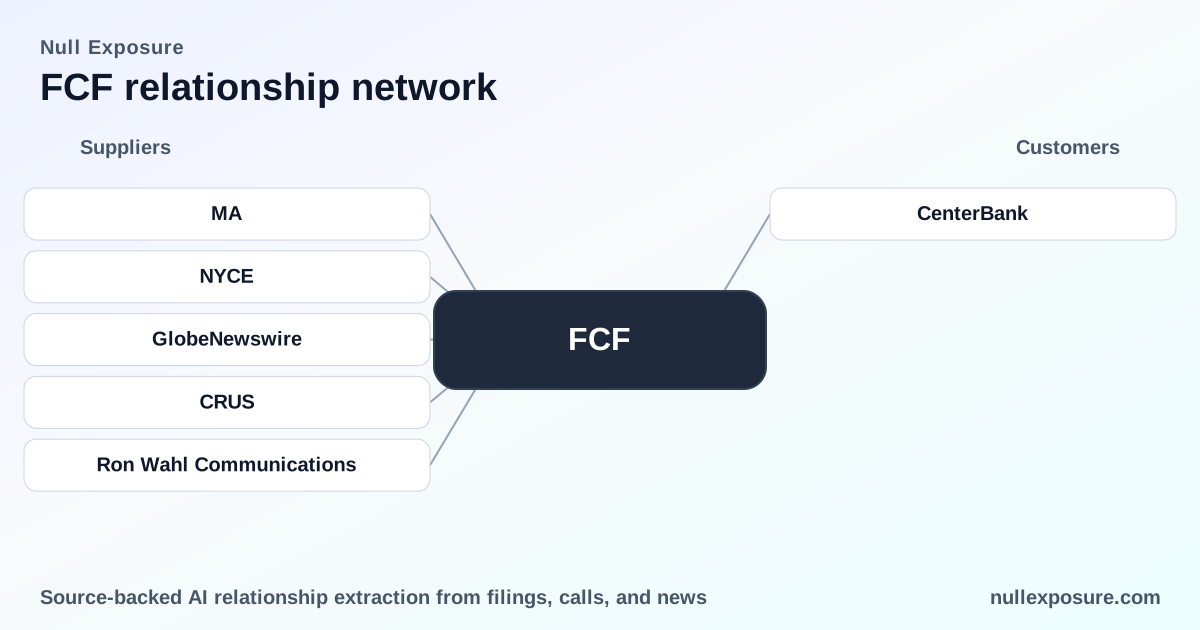
First Commonwealth Financial (FCF): Customer Relationships That Drive a Regional Banking Franchise
First Commonwealth Financial operates and monetizes as a regional community bank: it generates net interest income from consumer and commercial lending, plus fee income from payments, trust and wealth management, and mortgage origination. The company leverages a dense branch footprint across Pennsylvania and Ohio, a sizable surcharge-free ATM network, and a small-business focus to capture deposit flows and cross-sell borrowing and advisory products. For investors, the key driver is durable local market share combined with predictable fee streams; the key risk is geographic concentration and integration execution on acquisitions.
If you want a concise view of customer ties and integration outcomes, visit https://nullexposure.com/ for deeper signals and context.
The high-level customer thesis: relationship banking, scale-through-network effects
First Commonwealth’s business model is classic community banking with modern distribution scale. The bank captures retail deposit balances and consumer loans across tens of thousands of households while serving small and mid-market businesses with commercial lending and treasury services. Revenue mixes are interest-rate sensitive but buttressed by recurring service fees (wealth, trust, payments) and mortgage origination activity.
Performance context: FCF reports roughly $496 million in trailing revenue and a market capitalization near $1.88 billion, with a return on equity north of 10 percent—indicative of an incumbent regional bank converting local franchise strength into profitable results.
What the customer roster shows about how FCF wins
First Commonwealth’s customers fall into three pragmatic groups: individual consumers, small businesses/SBA borrowers, and mid-market commercial clients. This segmentation implies a dual contracting posture: standardized retail/consumer contracts at scale, and relationship-based, bespoke commercial agreements for business customers. The firm’s operating posture is therefore a hybrid of transactional volume economics and relationship banking margins.
Key operating signals:
- Widespread retail exposure and data collection practices indicate high-volume, standardized customer contracts for deposits and consumer lending.
- Recognition as a leading SBA lender and awards in small business banking signal deep small-business penetration and differentiated servicing capabilities.
- The bank’s branch and ATM footprint in western and central Pennsylvania and Ohio supports geographic concentration with operational maturity—a strength in market knowledge, a source of concentration risk.
For more granular relationship intelligence and coverage, see https://nullexposure.com/ for structured customer mappings.
CenterBank: a recent conversion that expanded reach and distribution
CenterBank completed a systems conversion into First Commonwealth in June 2025, bringing its client base onto FCF’s platform and extending customer access to 55,000 surcharge-free ATMs worldwide and 127 retail offices across Pennsylvania and Ohio. This integration expands FCF’s retail distribution and deposit access points, improving customer convenience and cross-sell opportunities. A CityBiz report covering FY2025 documented the conversion and the resulting customer access changes (CityBiz, March 2026: https://www.citybiz.co/article/688909/first-commonwealth-completes-acquisition-of-centergroup-financial/).
All documented customer relationships (complete)
- CenterBank — Following a full systems conversion in June 2025, CenterBank customers gained access to First Commonwealth’s network of 55,000 surcharge-free ATMs and 127 retail offices across Pennsylvania and Ohio, effectively enlarging FCF’s deposit and service footprint in its core markets (CityBiz, March 2026).
This article covers every relationship listed in the latest customer-scope results.
Contracting posture, concentration, criticality and maturity — what constraints reveal
The company-level evidence points to a mature, regionally concentrated franchise with specific risk and opportunity characteristics:
-
Contracting posture: Predominantly standardized contracts for consumer deposits and loans, combined with negotiated credit and treasury agreements for SMB and mid-market clients. The firm executes mortgage interest-rate lock commitments and participates in secondary market delivery programs, indicating active capital markets interaction in its mortgage channel.
-
Customer concentration and geography: Commercial and consumer portfolios are concentrated in Pennsylvania and Ohio. That regional density supports strong local market share and branch economics but increases sensitivity to local economic cycles and policy shifts.
-
Criticality of relationships: For retail customers, FCF’s large ATM network and branch access are critical convenience differentiators that underpin deposits and transaction revenue. For small businesses, recognition as a top SBA lender and dedicated servicing elevates First Commonwealth from a commodity deposit taker to a strategic partner—implying higher switching costs for certain commercial clients.
-
Maturity and integration capability: The completed integration of CenterBank and the stated branch count suggest operational maturity and proven systems migration ability, but integration events also represent execution risk that can temporarily impact costs, customer experience, or deposit flows.
These constraints are company-level signals drawn from public excerpts and filings, not tied to any single named relationship unless explicitly stated.
What this means for investors: revenue levers and risk levers
-
Revenue upside: Expanded distribution via acquisitions like CenterBank and a large ATM footprint create cross-sell opportunities—deposit growth, fee income from payments, and mortgage origination roll-throughs will drive near-term revenue gains if retention holds.
-
Margin sensitivity: As a regional bank, net interest income is the dominant earnings driver; asset-liability management and loan mix shifts (consumer vs. commercial vs. mortgage) will materially influence margins given prevailing rate dynamics.
-
Risk concentrations: Geographic concentration in Pennsylvania and Ohio and dependence on small-business lending mean local downturns or industry-specific shocks can compress credit quality and deposit stability faster than for geographically diversified peers.
-
Operational execution: Systems conversions and portfolio integrations produce near-term costs and customer disruption risk; successful conversions enhance scale and lower unit costs over time.
Key takeaway: First Commonwealth combines stable, fee-accretive customer relationships with regional scale economics; investor returns will track loan growth quality, deposit retention after conversions, and the bank’s ability to convert distribution scale into higher fee capture.
Bottom line and next steps for diligencing
First Commonwealth’s customer relationships reflect a bank that earns through scale in local market distribution and relationship depth with small businesses and consumers. The CenterBank integration is a tangible example of disciplined roll-up to expand reach and deposit access. Investors should focus due diligence on post-integration deposit retention, mortgage lock pipeline execution, and local economic indicators in Pennsylvania and Ohio.
For ongoing signal-driven monitoring of FCF customer relationships and integration outcomes, visit https://nullexposure.com/ for continuous coverage and source-linked evidence.