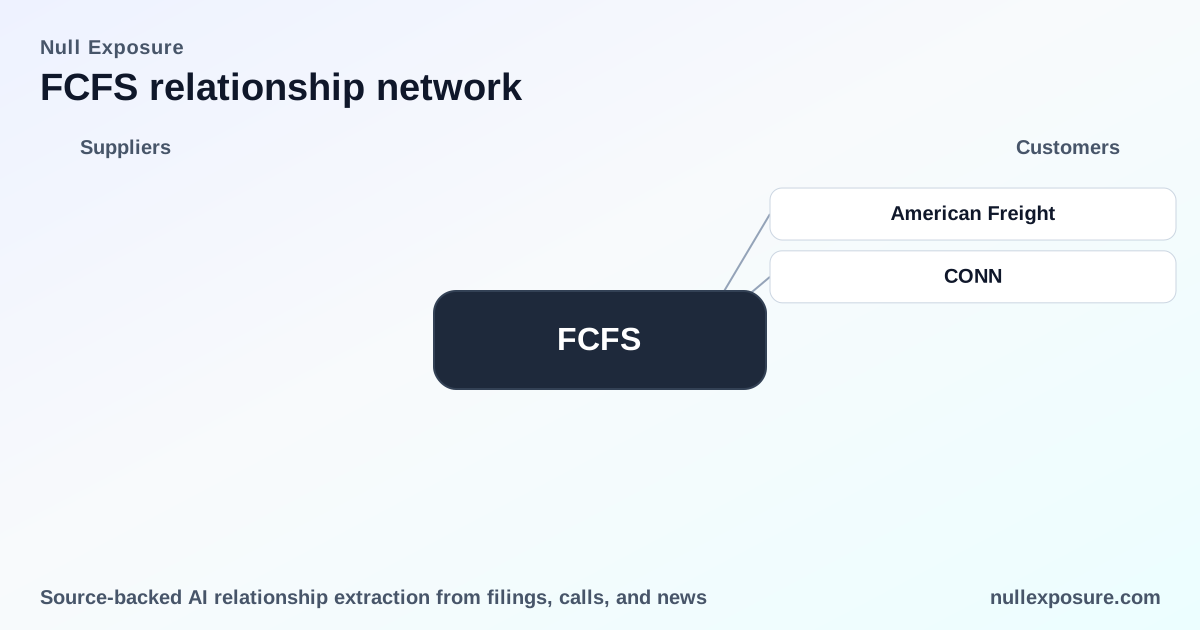
FirstCash (FCFS): How customer relationships and lease runoff shape near-term revenue dynamics
FirstCash operates and monetizes a dual retail finance model: a global pawnshop network that underwrites small, secured consumer loans and a receivables/lease origination business tied to third‑party retail partners. The company generates cash from pawn loan interest and sale of unredeemed collateral, plus finance receivables and lease portfolios purchased or serviced on behalf of retail partners. Recent public disclosures show material sensitivity in originations to the bankruptcy-driven runoff of partner lease portfolios, a dynamic investors must price into growth and credit assumptions. Explore the relationship detail and implications at NullExposure.
The operating model that matters to investors
FirstCash is not a pure consumer lender: its core product is retail pawn operations supplemented by finance receivables tied to partner relationships. Several company-level signals matter for credit and revenue modeling:
- Contracting posture: Company disclosures describe a partnership with a Utah state‑chartered bank that requires FirstCash to purchase rights to cash flows from certain finance receivables marketed to retail consumers on the bank’s behalf, indicating non‑recourse idiosyncrasies and balance‑sheet linkage between partner programs and FirstCash cash flows.
- Customer concentration and type: The business serves predominantly individual retail customers — pawn loans explicitly target unbanked and credit‑constrained consumers — so pricing and loss rates track consumer credit cycles more than corporate counterparty credit.
- Geographic footprint: FirstCash reports a global footprint with meaningful North American scale and substantial Latin American operations; disclosures list Mexico (836,238) and Other Latin America (53,286) alongside the U.K. (150,664) and a dominant U.S. revenue component, signaling diversified market exposure but regional execution risk.
- Segment focus: The company’s core product remains pawnshop retail, with lease/finance originations as an adjunct line that is sensitive to partner performance and bankruptcy outcomes.
- Institutional ownership and governance: With institutional ownership above 90% and insiders around 8.4%, market reactions to partner shocks translate quickly into valuation movements.
These operating characteristics produce a hybrid risk profile: stable cash generation from retail pawn operations offset by episodic volatility tied to partner portfolio runoffs and retail bankruptcies.
Catalog of customer relationship mentions in recent reporting
Below I list every relationship cited in the set of results. Each entry includes a concise plain‑English takeaway and the source citation.
CONN — FY2026 (Manila Times / GlobeNewswire distribution)
FirstCash reported that the expected runoff of lease portfolios generated by Conn’s (CONN) contributed to a fourth‑quarter revenue decrease, reflecting the impact of Conn’s bankruptcy on leased receivable flows. Reported March 2026 in a GlobeNewswire distribution picked up by Manila Times. (Manila Times / GlobeNewswire, March 9, 2026: https://www.manilatimes.net/2026/02/05/tmt-newswire/globenewswire/firstcash-reports-record-fourth-quarter-and-full-year-operating-results-fourth-quarter-revenues-increase-20-driving-even-greater-earnings-growth-28-new-pawn-locations-added-in-the-fourth-quarter-through-acquisitions-and-openings-declares-quarterly-cash-dividend/2272357/amp)
Conn s (typographic variant) — FY2026 (Manila Times / GlobeNewswire distribution)
An identical mention of Conn’s bankruptcy framed the same effect: lease originations and associated cash flows ran off following Conn’s Chapter actions, depressing quarter‑over‑quarter originations. (Manila Times / GlobeNewswire, March 9, 2026: https://www.manilatimes.net/2026/02/05/tmt-newswire/globenewswire/firstcash-reports-record-fourth-quarter-and-full-year-operating-results-fourth-quarter-revenues-increase-20-driving-even-greater-earnings-growth-28-new-pawn-locations-added-in-the-fourth-quarter-through-acquisitions-and-openings-declares-quarterly-cash-dividend/2272357/amp)
American Freight — FY2026 (Manila Times / GlobeNewswire distribution)
FirstCash attributed part of its fourth‑quarter decline to runoff from lease portfolios originally generated by American Freight after that retailer’s bankruptcy, demonstrating direct sensitivity of originations to large partner insolvencies. (Manila Times / GlobeNewswire, March 9, 2026: https://www.manilatimes.net/2026/02/05/tmt-newswire/globenewswire/firstcash-reports-record-fourth-quarter-and-full-year-operating-results-fourth-quarter-revenues-increase-20-driving-even-greater-earnings-growth-28-new-pawn-locations-added-in-the-fourth-quarter-through-acquisitions-and-openings-declares-quarterly-cash-dividend/2272357/amp)
Conn’s Home Plus — FY2025 (GlobeNewswire press release)
FirstCash disclosed that gross transaction volume for lease and loan originations fell about 13% year‑over‑year in Q3 FY2025, primarily due to bankruptcies at American Freight and Conn’s Home Plus, confirming that originations are fragmented and reversible when large retail partners fail. (GlobeNewswire press release, Oct 30, 2025: https://www.globenewswire.com/news-release/2025/10/30/3177144/0/en/FirstCash-Reports-Record-Third-Quarter-Operating-Results-Across-All-Segments-Recent-U-K-Acquisition-Drives-Additional-Revenue-and-Earnings-Growth-Declares-Quarterly-Cash-Dividend-a.html)
CONN — FY2025 (GlobeNewswire press release)
The company’s FY2025 third‑quarter disclosure reiterates that a 13% decline in originations was driven by partner bankruptcies, with Conn’s among the named retail counterparties, signaling persistent multi‑quarter pass‑through effects to reported originations. (GlobeNewswire press release, Oct 30, 2025: https://www.globenewswire.com/news-release/2025/10/30/3177144/0/en/FirstCash-Reports-Record-Third-Quarter-Operating-Results-Across-All-Segments-Recent-U-K-Acquisition-Drives-Additional-Revenue-and-Earnings-Growth-Declares-Quarterly-Cash-Dividend-a.html)
CONN — FY2025 (Yahoo Finance reprint)
A Yahoo Finance reprint of FirstCash’s results emphasized the same point: Conn’s bankruptcy materially reduced gross transaction volumes for lease and loan originations in the quarter, compressing near‑term growth metrics. (Yahoo Finance coverage of FirstCash results, reported March 2026: https://finance.yahoo.com/news/firstcash-reports-record-third-quarter-100000017.html)
Conn’s Home Plus — FY2025 (Yahoo Finance reprint)
The Yahoo Finance note called out Conn’s Home Plus specifically as a driver of the 13% fall in originations, underscoring that named retail partner failures have immediate top‑line effects on FirstCash’s originations business. (Yahoo Finance, March 2026: https://finance.yahoo.com/news/firstcash-reports-record-third-quarter-100000017.html)
American Freight — FY2025 (GlobeNewswire press release)
The FY2025 disclosure explicitly connects American Freight’s bankruptcy to the reduction in gross transaction volume, showing that multi‑retailer exposure creates concentrated single‑event risk. (GlobeNewswire press release, Oct 30, 2025: https://www.globenewswire.com/news-release/2025/10/30/3177144/0/en/FirstCash-Reports-Record-Third-Quarter-Operating-Results-Across-All-Segments-Recent-U-K-Acquisition-Drives-Additional-Revenue-and-Earnings-Growth-Declares-Quarterly-Cash-Dividend-a.html)
American Freight — FY2025 (Yahoo Finance reprint)
Yahoo Finance reiterated the American Freight linkage and the resulting 13% origination decline, reinforcing the market’s understanding that partner bankruptcies translate to measurable originations and revenue contractions. (Yahoo Finance, March 2026: https://finance.yahoo.com/news/firstcash-reports-record-third-quarter-100000017.html)
Investment implications: what to model and watch
- Earnings sensitivity to partner bankruptcies is concrete and repeatable. The company’s own releases tie sequential declines in originations to the bankruptcies of large retail partners.
- Core pawn operations provide ballast, but originations volatility can compress growth and margins quarter‑to‑quarter. Model a scenario where originations remain below peak for multiple quarters post‑bankruptcy while pawn sales and loans sustain base EBITDA.
- Retail consumer counterparty risk dominates loss modeling. The company’s business serves primarily individual customers, which implies losses correlate strongly to consumer credit cycles rather than large corporate counterparty defaults.
- Geographic diversification mitigates but does not eliminate concentration risk. FirstCash operates in North America, Latin America and the U.K.; each market has different recovery dynamics and regulatory exposures.
For a closer look at how partner runoff histories affect FirstCash’s origination pipeline and valuation sensitivity, visit NullExposure.
Final read: tradeoffs and catalyst roadmap
FirstCash combines durable cash flow from pawn operations with episodic, partner‑linked origination volatility. The immediate catalyst set investors should track includes any further disclosures about residual lease portfolio balances, legal outcomes from partner bankruptcies, and sequential originations trends. A disciplined model tests downside originations for multiple quarters while preserving steady pawn revenue; upside resumes when partner programs stabilize or new partnerships replace lost volumes.
Bold, measurable partner events — like the Conn’s and American Freight bankruptcies described in FirstCash’s releases — have demonstrable effects on reported originations and therefore on near‑term growth rates. Position sizing should reflect that hybrid profile: stable core cash generation plus idiosyncratic partner risk.