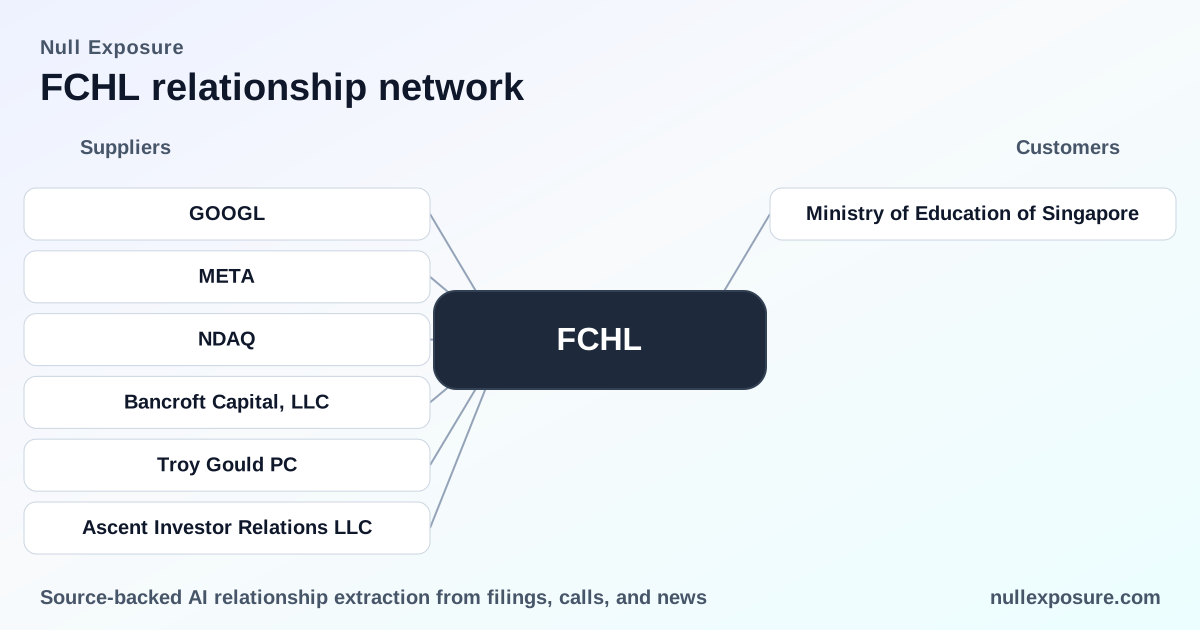
Fitness Champs (FCHL): The public-school customer relationship that defines the business
Fitness Champs Holdings operates and monetizes by selling structured sports education — primarily swimming and related physical-education programs — to both the private market and institutional customers in Singapore. Revenue flows from two clear streams: contracted school programs (public and private) under branded curricula and direct-to-consumer private lessons, with the company reporting roughly $4.15 million in trailing revenue and a small market capitalization that reflects concentrated customer exposure and negative earnings. For investors, the thesis is straightforward: this is a niche service provider whose valuation will track contract stability with institutional buyers and its ability to scale private-lesson revenue while improving margins.
For a quick dive into how these customer ties are documented, see NullExposure for structured counterparty analytics: https://nullexposure.com/
Why the Ministry relationship matters for valuation and operational risk
Fitness Champs is identified publicly as a provider to Singapore’s school system under the SwimSafer program. That connection is not background color — it is a revenue driver and a commercial signal about the company’s contracting posture. Institutional contracts with public schools are cash-generative when stable, but they introduce concentration and procurement risk that investors need to price into an already tight capital structure.
A short, source-backed review of the reported relationships follows.
Ministry of Education of Singapore — Yahoo Finance (March 9, 2026)
According to a Yahoo Finance release on March 9, 2026, Fitness Champs is “one of the largest providers of swimming lessons to children enrolled in public schools under the Ministry of Education of Singapore” through the SwimSafer program, and it has offered private lessons under the Fitness Champs brand since 2012. (Source: Yahoo Finance news post, March 9, 2026 — https://sg.finance.yahoo.com/news/fitness-champs-holdings-limited-reports-210500316.html)
Ministry of Education of Singapore — GlobeNewswire (March 18, 2026)
A GlobeNewswire company release on March 18, 2026, reiterated Fitness Champs’ role in the SwimSafer program while announcing a corporate action (a share consolidation effective March 23, 2026), underlining the firm’s public messaging that the Ministry relationship is a core part of its operating narrative. (Source: GlobeNewswire announcement, March 18, 2026 — https://www.globenewswire.com/news-release/2026/03/18/3258446/0/en/FCHL-to-Effect-Share-Consolidation-on-March-23-2026.html)
How these customer links translate into operational characteristics
Investor decisions require translating relationship statements into business-model constraints. At the company level, the public information supports the following signals:
- Contracting posture: Fitness Champs operates as a supplier to public-sector programs and a direct-service provider to consumers. That dual posture creates different margin profiles and payment rhythms, with institutional work typically characterized by tender cycles and defined service SLAs.
- Concentration: Public reporting highlights a material institutional channel; this implies revenue concentration risk because a meaningful share of program supply is tied to formal school programs rather than a widely diversified customer base.
- Criticality: The services provided—school swimming lessons—are operationally important to school extracurricular programming, giving Fitness Champs leverage in procurement but also exposing it to policy shifts in school budgets or public-program priorities.
- Maturity: The company has marketed private lessons since 2012 and positions itself as an established swim provider, suggesting a stable operational playbook but limited scale to date by financial metrics.
These are company-level signals drawn from public disclosures and news; they are not attributions to any single contract beyond what the company itself has disclosed.
For deeper counterparty and revenue-concentration analytics, visit NullExposure: https://nullexposure.com/
Financial context that shapes investor risk/return
Fitness Champs is a micro-cap with constrained profitability. Key reported figures include $4.15 million of trailing revenue, gross profit of $1.37 million, and EBITDA of negative $424,000. The company reports a diluted EPS of -$6.12 and a Price-to-Sales ratio near 0.11, reflecting the market’s low valuation of current cash flows relative to the small equity base.
These metrics frame two realities for investors:
- Upside requires operational improvement or contract expansion. Given limited institutional diversity, growth depends on either expanding the private-lesson business or winning additional public-program mandates.
- Downside is governed by concentration and liquidity. A small share count and minimal institutional ownership elevate governance and liquidity risk; strategic actions (for example, the announced share consolidation) can change capital structure dynamics quickly.
Risks, catalysts, and what to monitor
Investors should treat the Ministry-related disclosures as both an opportunity and a liability:
- Risk — contract renewal and procurement exposure. If a substantial portion of revenue is linked to school programs, changes in MOE procurement policy or competitive re-tendering cycles will directly affect top-line visibility.
- Risk — limited financial cushion. Negative EBITDA and sharply negative EPS mean the company has limited room to absorb revenue volatility without additional financing or cost restructuring.
- Catalyst — successful private-lesson scale-up. Growth in direct-to-consumer lessons, higher utilization of coaching resources, and margin expansion would materially re-rate the stock.
- Catalyst — additional institutional wins. Securing other public-sector or large private-school contracts would reduce concentration risk and add predictable revenue.
What to watch next: contract announcements and tender awards from Singapore’s education authorities, quarterly revenue concentration disclosures, and management commentary on customer diversification and margin improvement.
Final takeaways for investors and operators
- The Ministry of Education linkage is a defining commercial fact for Fitness Champs; it underpins credibility and revenue but introduces procurement concentration risk.
- Financials are small and loss-making today; valuation hinges on contract stability and the company’s ability to scale private lessons or win new institutional accounts.
- Monitor tender outcomes, contract renewal language, and quarterly breakdowns of institutional vs. consumer revenue. These items will move valuation more than headline corporate actions such as share consolidation.
For a practical next step: evaluate contract-duration language and payment terms in any future filings or announcements, and consider the company’s ability to diversify away from a single institutional channel before increasing exposure.
For structured counterparty profiles and ongoing surveillance on FCHL customer links, explore NullExposure: https://nullexposure.com/